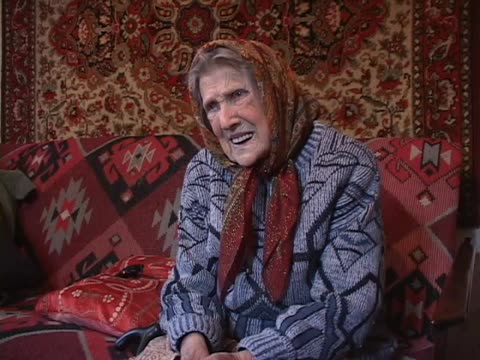
Sobol gives her Yiddish name, which differs from the name in her documents, and her birth year, 1915, in Mohyliv-Podil's'kyy. She names her mother Ester, who was a housewife, and says seven children were born but only she and one brother survived. Her father worked as a factory labourer, and she names her grandparents. She briefly mentions her husband, a Bukovinian, and says they met in the camp at Kozenits (?).
The passage also covers her grandparents, her father's work in a factory-type enterprise, and her first mention of meeting her husband in the camp.
Sobol recalls the great famine of 1932–33, when she was a teenager: people swelled up from hunger and there was no food, and everything cost money. Her family survived because her father worked with a horse for the militia, and they ate potatoes.
Sobol talks about her childhood while her mother was alive, a poor but quiet home, and being orphaned at fourteen. She describes Passover poverty, her father leading the seder, and a relative who asked the Four Questions. She also covers kashering the house and storing the Passover dishes in the attic. The questions turn to holiday food: Passover dumplings, Hanukkah latkes, Purim treats and the Sabbath cholent. A remedy against the evil eye (a red ribbon) is also touched on.
The passage also covers the evil-eye remedies and the terms for Sabbath dishes.
Sobol says that in Soviet times people were not allowed to pray freely, while her husband came from a Bukovinian Jewish life. She talks about cooking for her husband and about ritual slaughter: there was a shoykhet even under the Soviets, but later none, and she or her husband slaughtered chickens themselves. Lemster then asks whether she has children.
The passage also covers Soviet limits on religious life and the question of who slaughtered chickens.
Sobol says she has two sons and grandchildren. One son lives in Mohyliv, and the eldest lives in Belarus. One grandson is in America. She says she lights Sabbath candles and prays to God in a mix of Yiddish and other languages for health and a good week.
Sobol answers questions about the river and the bathhouse, and recalls the big synagogue on Stavyshche (?) Street that her parents attended. She says that today there is no minyan and the Kaddish is paid for or read in Russian letters. Asked whether Christians spoke Yiddish, she says yes. She says her husband knew Yiddish, Romanian, German and some Hebrew but no Russian when they married. She also tells how her husband had lost his parents and how they lived in her father's house with her stepmother.
The passage also covers her husband's languages and work, the synagogue before the war, and Kaddish practice today.
Sobol says she worked as a nurse in a hospital ward, on day and night shifts, while her children were in nursery and kindergarten. The interviewers ask whether she remembers Yiddish songs, sayings and stories. She recalls a drinking song and says she knew many, but gives no further text.
Sobol answers questions about childhood games and schooling. She went to a Yiddish school for only a short time, from 1922 (?), until her mother died and she took over the household, and then carried on studying. When asked which Yiddish writer she remembers, she names Sholem Aleichem, whom she read in Russian.
The passage also covers her Yiddish schooling and her reading of Sholem Aleichem in Russian.
Sobol speaks about her children and a son who caused her trouble, and about her husband, who spoke a different Yiddish and no Russian. In answer to Kerler she names Chernivtsi and nearby places in Bukovina as his birthplace, and says a book records it. She mentions the tsadik (a "good Jew") of that shtetl, and Lemster then asks about Yiddish theatre.
The passage also covers the husband's different Yiddish and the tsadik of his shtetl.
Sobol says that Yiddish theatre troupes used to visit before the war. Her husband told stories about the good Jew of Shishkivtsi (?), whom people travelled to, and about Jewish soldiers asking for Passover leave. She explains the word for a shepherd, and speaks about postal telegrams from relatives in America. Kerler asks about the Kozenits camp; she describes work under the Romanians, the rich buying their way out, and Ukrainians helping Jews with food.
The passage also covers the husband's stories of the tsadik, the camp near Kozenits and Ukrainian help.
Lemster asks for curses; Sobol says they were not used at home and recalls only the phrase "black wedding". She then describes her wedding in 1944 (?), held with a rabbi and a chuppah at home, with the marriage contract hidden during the war. She tells many stories about her husband: he was a hard worker and the neighbours doubted he was Jewish, and he once bought a goat for their baby. She goes on to his last illness, hospital and death, and his work in the camp under the Romanians. The speakers are hard to tell apart in this stretch, and the passage ends with the request to see the book.
The passage also covers the curses, her husband's stories and death, and the move to the book.
The speakers read the place name in the book (a Bukovinian village, name unclear), and Sobol says she will read it all. The interview ends with thanks, good wishes for health, and farewells between Kerler and the people present.