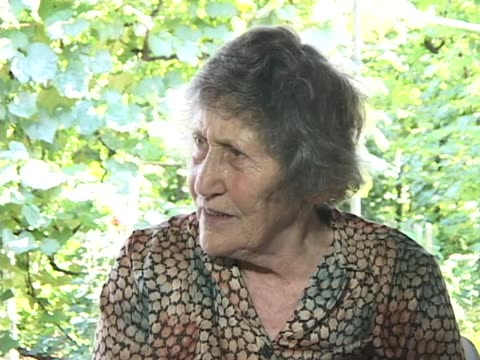
Nayman talks about her husband’s life during the war and his return home. He was imprisoned in several concentration camps and ghetto. He was liberated in Auschwitz. Nayman then talks about her life during the war. Nayman was imprisoned in Auschwitz and talks about her difficult life there. Nayman was selected for forced labor in another camp in the woods. She worked at a factory in town, welding metal during the day for three months until the camp and factory was bombed by the Red Army. She was then forced on a death march for five days. When she reached another town, she was sent to forced labor in a field, building trenches to prevent tanks from crossing over.
Nayman tells of her husband's and his family's arrest by Hungarian gendarmes after he hid at home, their time in camps, and the later deportation of the whole community to a ghetto and then to Auschwitz. At Auschwitz she tried to save a small child from the crematorium selection and a German soldier intervened. She describes the overcrowded barracks and starvation food, selection for labor in a camp in the woods, welding work at a factory, the bombing of the town, a march lasting five days and trench digging in a field, and says she was liberated on 9 May.
Adds the husband's hiding and arrest by Hungarian gendarmes and the attempt to save a child at Auschwitz.
Nayman talks about life after the liberation. She remembers people dying from typhus and from eating too much after living on starvation rations for so long. Nayman talks about her life in a DP camp among Germans. Nayman then discusses her observance of religious customs, which she claims to have kept up during the war.
Nayman describes how liberated prisoners died of typhus after eating too much rich food, and her stay with an old German woman in a town after liberation. Kerler asks whether she believed in God in Auschwitz; she says she did and still does, and she describes her prayer book and psalm book.
Adds the old German woman and the prayer book and psalm book.
Nayman then talks about prewar Jewish life and her school education in Turya-Bystra. She then talks about contemporary Jewish life in Vynohradiv (Yiddish: Selish). Nayman moved there in 1978 and remembers that none of the congregants could read the prayer book except for her husband. She then talks about non-Jews speaking Yiddish in her home town, in particular a housemaid.
Nayman answers Kerler's questions about the religious books in her parents' home, the Czech/Russian word for a school satchel, and the Jews of her husband's village. She and S3 discuss the village prayer house in Turya Bystra, and she recalls Vynohradiv in the 1970s, where she says no one but her husband could read the prayer book. She gives the Yiddish name of Vynohradiv and recalls non-Jews who knew Yiddish, such as a neighbor who worked for a Jewish shop owner.
Adds the books in her parents' home, the school satchel word, and the Yiddish name of Vynohradiv.
Questionnaire work with Kerler and Katz on Yiddish vocabulary, including a word for a handsome man, words for lying and deceiving, thanks, memory, and counting families by prayer shawls. They also ask about words for non-Jews and for a blind-night term for the eve of a holiday. The talk then turns to making a video copy for Nayman's family and to the interview she gave on Soviet television about the war, ending with mentions of her daughter in America and grandchildren.
Nayman discusses prewar religious customs of female magicians. Her daughter Hendshe explains that the custom “rolling an egg” was only practiced by non-Jews. Nayman then answers questions about cultural terminology and reads from the tsene-rene (women’s bible), from Perek Shlishi.
Kerler asks about beliefs and terms: casting spells, a dybbuk and a golem. Nayman then reads aloud and explains passages from a Yiddish religious text, which she identifies as the women's Bible (the catalogue says the third chapter), on conduct, Torah study and divine judgment. The recogniser garbles much of the reading, and Kerler occasionally asks her to explain individual words.
Adds the questions on dybbuk and golem before the reading.
Nayman answers a number of dialectological questions from the AHEYM Yiddish questionnaire. She then discusses Yiddish songs and remembers song snippets, before talking about life today.
Kerler asks more dialect questions about words for ill-behaved or released people, and for a snack or an extra course after a meal, and Nayman gives a few answers. She recalls fragments of Yiddish riddle songs and a Purim rhyme, and says her mother did not sing. They discuss a planned visit to the Munkacs rebbe and Nayman's memories of him. Nayman says she does not care for theater but recalls school plays. The tape ends with talk, with S2 and Katz, about sending a cassette or DVD of the interview to her daughter, mentioning Spielberg and the earlier interview.