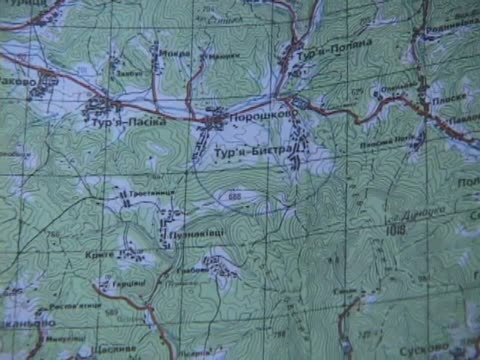
Nayman and her daughter Hendshe talk about life today. The camera films several towns on the map, before Nayman talks about her life under Hungarian occupation in 1939.
Opening conversation, partly with a second woman, about Carpathian Yiddish versus Polish Yiddish and about the interviewers' family backgrounds, languages and birthplaces. Nayman says her granddaughter knows Yiddish and can read Hebrew prayers but not speak Hebrew. Nayman then tells of Hungarian rule, when gendarmes questioned a girl about her name and Hungarian and accused the Jews of not liking them. Kerler closes by saying he will ask some questions.
The transcript shows much talk about Carpathian Yiddish and the interviewers' backgrounds, and a story of gendarmes questioning a girl; the catalogue mentions towns on a map and life today.
Nayman answers a long sequence of dialectological questionnaire items from Kerler, with some follow-ups from Katz. Items include household and building words (house, floor, window pane, bed, attic, beam, bridge, yard), the body and ailments, adjectives and adverbs of degree, kinship and midwife terms, and numerals and dates. She is also asked about forms of address (singular, plural and honorific), verbs and grammar, a few religious terms (cantor, prayer, rich man, wishing the dead rest), and example sentences. Along the way she explains words, tells a short proverb about a pious man and a cross, and mentions that her father died in the First World War. At the end the interviewers thank her.
The team concludes the interview with Nayman and the camera collects footage of her courtyard. The team travels to the old Jewish cemetery of Vynohradiv.
The interview ends with thanks and farewells. Others present talk, partly in Russian and Polish, about contacting someone and conveying greetings. The garbled speech makes the content of the later part unclear.
The transcript shows the camera and the courtyard footage only through the conversation; it shows no clear sign of the trip to the cemetery.
At the old Jewish cemetery, Kerler and Katz read and discuss gravestone inscriptions, deciphering names, dates and Hebrew abbreviations. The words are largely garbled.