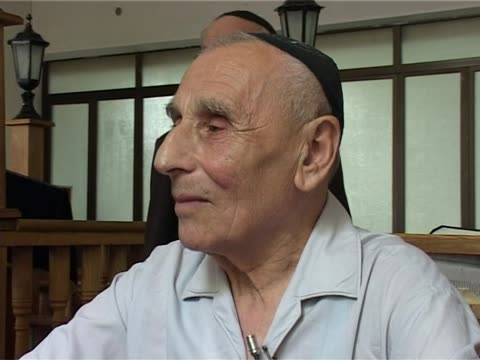
Informal chat among the team and several men at the synagogue. They discuss the oldest members still alive (around 85) and why the visitors have come to collect material on Jewish life and history; one man speaks of grandchildren who no longer want to know Yiddish. A Russian explanation of the project's purpose is also heard.
Kerler formally opens the interview, noting the date and place, Zhytomyr on 9 July 2002. Shpitz gives his name, says he was born in Zhytomyr, and speaks of his schooling and work years. He recounts being drafted in 1939 and moving through Poland and Finland into German territory, and returning to Zhytomyr in 1948, where he married and worked as a turner.
adds his name and patronymic and the return in 1948
Shpitz recalls how, in Soviet times, he had to hide letters to America from the neighbours because his wife's sister lived there. He says he is 87 and bears the effects of the war in his legs. Kerler asks about his front: he served on the Belorussian front and in Poland, and in a tank battalion, but cannot recall the name of a city.
Answering Kerler's questions about his childhood family, Shpitz names his siblings, six brothers and two sisters, and tells that the sisters were killed in 1941 because they could not be evacuated. He recalls his schooling in the Yiddish school no. 24 on Sadova street and the poverty that sent him to work at the Stalin factory before being drafted in 1939. He says that the language of instruction was Yiddish, and mentions a rich friend and his own studies.
adds the siblings' names and the school's language of instruction
Shpitz recalls kheyder, whose teacher was the local shoykhet and who also fed the children, and says he learned to read Yiddish. He describes his father, a poor religious cobbler, attending the cook-shul and prayer on Passover, Purim and other holidays. He tells of carrying gifts to the shul and Simchat Torah, and says he no longer remembers the morning prayers; he also talks about observance today.
A questionnaire session led by Kerler, with Katz joining in. They ask Shpitz how he says numbers such as one and a half, words for the attic, latkes and their ingredients, potato terms, Elijah and related names, and the Jewish street. They continue with expressions for wishing joy in children, the evil eye, kinship terms, words for wealth and poverty, window parts, 'then', blessings such as gomel, and some food words.
Shpitz recalls the street where he lived as a child, a street inhabited only by Jews, among them several doctors, and says his father was a cobbler. Kerler adds a couple of questionnaire items, including the word for an honest person.
Mixed questionnaire work and memories. Shpitz is asked for words such as cart or wagon and 'road', and says that his family had no wagon and that Jewish occupations included fish dealing. He explains golem, the dreidel, the ceiling and cleaning the floor for Passover. He also describes the interior of a house.
Kerler asks Shpitz to describe the house where he grew up with his parents and eight children. He mentions that his older brothers went to kheyder and that he studied only two or three years and writes letters to America. He is asked how he says some phrases such as 'good people' and something written in the Torah. The passage closes as someone invites the team to eat.
adds the questionnaire items and the invitation to a meal