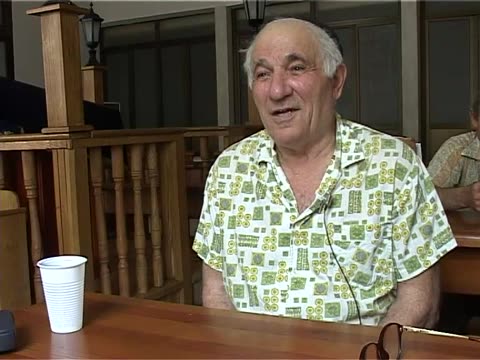
Opens with talk of a Jewish newspaper from Israel and a Yiddish paper in America, and of sending letters abroad. Geller says his mother taught him a little Yiddish reading and writing while he went to a Ukrainian school. Kerler asks about his mother and puts a few word questions. Geller also mentions the Sabbath kiddush and havdalah and the rabbis in town.
The catalogue label omits the schooling and the first word questions.
Geller discusses the Joint's aid and how people get help, and compares it with the war years. He says Polish Jews fled to the Soviet Union, and mentions his invalid's pension. Kerler asks about an idiom and some Russian-influenced words. Geller then begins an anecdote about a prosecutor and a tailor.
Also covers the Joint and an idiom question, and ends with the start of the tailor story.
Geller tells an anecdote about a prosecutor and a tailor who lived in the same house, with the tailor working for the state. Kerler tries to steer him back to the questionnaire.
Word questions on Yiddish forms such as breathing, a roadside inn and a courtyard. Geller says his Yiddish is plain and differs from that of Vilna and Poltava. They discuss streets of only Jews or only gentiles, and burial and funerals as a mitzvah. The passage also covers the minyan, kaddish, and ages, and ends with a courtroom anecdote.
Adds the talk about Jewish and gentile streets, burial as a mitzvah and the courtroom anecdote.
Questions on a word connected with the prophet Elijah and the opening of the door at the seder. Geller explains Passover pancakes made from matzo meal and potatoes, and the oven needed to bake them. Kerler and Katz also ask about Hanukkah latkes, buckwheat latkes, and goose cracklings.
Also covers Hanukkah latkes and the Elijah door custom.
Geller talks about Hanukkah goose cracklings and about those unwilling versus unable to observe, then describes baking matzo himself. He explains the roles of the rollers, the kneader, the perforator and the person who puts the matzo in the oven (the "shiber"). He distinguishes hand matzo from machine matzo, and says matzo was baked in Soviet times near an old synagogue. The passage ends with Kerler asking a few further word questions.
Adds the roles at the matzo oven and baking under Soviet conditions.
Word questions on forms such as "everything", with proverbs and sayings about the poor man and about being laughed at. Katz and Geller compare Yiddish and Polish words for cheese, "one and a half", and building a house. They also touch on a half matzo hidden at the seder, on documents, and on a riddle-like saying.
Adds the proverbs, the afikoman question and the building word.
Geller recalls going to the bathhouse with his grandfather on Friday before the Sabbath, the Uman bathhouse, and going afterward to the synagogue and making kiddush. He also mentions the women's mikveh. Kerler asks where the word for the bathhouse comes from and how people say "thank you".
Adds the Uman bathhouse and a word question at the end.
Kerler and Katz ask word questions, among them a word about the bride-price (?), words for the attic and for "grandmother", and a sour-sweet meat dish. Geller adds a Russian proverb about staying close to people, which he also renders in Yiddish. He says his Yiddish is the same in Piatka and in Kamianets-Podilskyi.
Adds the grandmother and attic words and the sour-sweet meat dish.