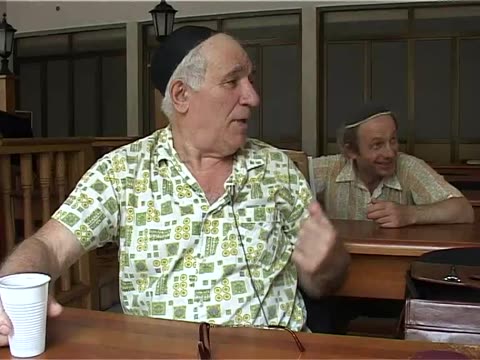
Geller answers dialect questions from Kerler and Katz, with comments from others present. Items include words for hair, a window pane, the word for 'give' and 'take' with differences among local speakers, the word for the person who hears, standing at prayer, and an expression about a child's birth. They also discuss whether the word for 'son' was used in Pyatka.
Geller tells a short anecdote about a mother sending a child to the shop to buy packets of tobacco (?), a story used to bring out dialect forms. Kerler then asks how the word for 'sun' is said and what verb is used for its shining.
Geller and those present look at a map for Pyatka and nearby places, naming a river and towns such as Berdichev and Chernyakhov (?). The talk becomes informal: what to eat, interrupted by Russian side remarks, the cassette recordings and a son's anniversary celebration. The interviewers promise to send cassettes of Yiddish songs and arrange the next meeting.
The team arranges a time to meet and speaks about copying, then Kerler opens the interview with Burshtein and asks his name and date of birth. Burshtein gives his Yiddish name Lozer or Leyzer and his father's name, Yoyel, and the Russian and Polish forms. He says he was born in 1929 in Govrove and lived there until the war began in 1939. He describes his childhood: kheyder, Polish school and a father who was a tailor.
Burshtein talks about his father's trade as a men's tailor and about Jewish life in Govrove, which was safe under Piłsudski and became worse after his death under Rydz-Śmigły. He recalls antisemitic boycotts, signs telling people not to buy from Jews, and a Polish baker's window caricature of a Jew in a prayer shawl.
Burshtein recalls people gathering at the school director's apartment to hear the radio and learning of Hitler's speeches and what was happening to Jews in Germany. Jews who had come from Germany told them of the situation and sang Yiddish songs in the streets. He listened to the songs as a small child who started kheyder at six.
Burshtein explains how a music teacher at the Zhytomyr Hesed learned that he knows Yiddish songs, and he wrote them out in Yiddish in her book. He is often invited to sing at the Hesed. He then takes up songs sung by Jews from Germany who came to the town, and begins to sing a song about a poor refugee, after Kerler asks whether they were Polish Jews returning from Germany.
Burshtein sings a Yiddish song about a poor refugee who has lost his luck and become a street singer. He says he knows many songs from Poland, including love songs. He then describes the prewar synagogues: the shoemakers and tailors each had their own prayer house, and there was one big synagogue where the kheyder boys would go.
Burshtein recalls that a Polish teacher pulled him by his sidelocks out of the classroom, and that the Jewish children were helpless. Kerler asks about the school, which was the Polish state school. He says the Poles were not friends, that leaflets called for killing Jews, and that Poles told Jewish parents they were spared only out of pity for the children. He mentions an uncle in Łomża and the family's life up to the outbreak of war in 1939.
Burshtein tells of the start of the war in 1939: Poles shooting from the roofs, the family's week of praying in the prayer house under bombing, and his father's decision to leave by night for an aunt's town about thirty kilometres away. He describes the flight past Polish cavalry, being taken in by Jewish families, then German roundups of Jews onto the square, when he was ten and escaped a soldier. His father and brothers were taken, his older brother was missing for days, and Germans threw bread to Polish prisoners while another photographed them. In the aunt's town a Jewish shoemaker negotiated with German officers for the family's safety.