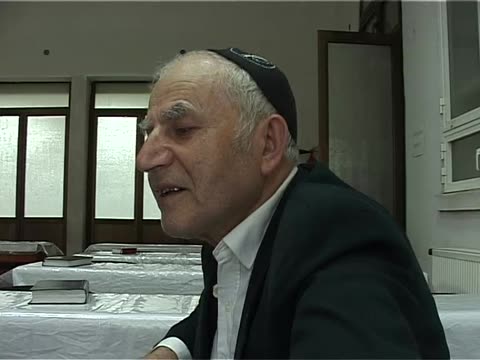
After a few lines of informal talk at the start, Geller recalls arriving in a town (apparently Ostrów Mazowiecka) in 1939 and lodging with Jews there. He recalls a former Polish teacher he wanted to approach while the German army was marching past. He then tells a story that Jews hid Piłsudski from the Bolsheviks in a study house, put tefillin and a tallis on him, and so won his lasting friendliness toward Jews. Katz asks about Piłsudski's death and his burial wish regarding Vilna. Kerler closes by asking where they stopped on the way with Geller's father toward the Russian side.
The catalogue says AHEYM project and life today; the transcript shows a wartime Polish memory and a Piłsudski story instead.
Geller narrates the journey with his father and brothers after leaving the Germans. They walk through burned villages and forest, meet Russian soldiers, and are taken to Zembrów (?), then Białystok. In Białystok they stay in a club and are hosted by local householders for Sabbath. They are then taken by truck to a commune near Babruisk, where his father works in a factory. He goes on to describe German-Jewish refugees in the 1930s whose songs he learned, and sings two of them. Kerler and Geller briefly discuss Yiddish and German speech, the ban in Russia on criticising Germany, and a Moscow Yiddish newspaper.
The catalogue says dialectology and Rabbi Wilgelm joins; the transcript shows a flight narrative and songs of German-Jewish refugees, with no dialectology and no rabbi.
Geller recalls reaching Babruisk in 1939 and telling people what the Germans were doing to Jews; they did not believe him. He describes Hitler's speeches and the cruelty of the Germans toward Jews. He then tells a story he says he read, in which a Romanian Jew promised Hitler's father a dowry that was never paid, so that Hitler turned against the Jews. Katz and Kerler question him on when he heard this and whether Hitler was Jewish, and Kerler mentions Adolf Shayevich. Geller then sings a Polish-era Yiddish song addressed to young men about love.
The catalogue says anecdotes from war and games; the transcript shows war anecdotes and songs but no children's games.
Geller sings a humorous Yiddish wedding song about a bride who marries a man for his dollars. The song has klezmer music at the wedding canopy, and the bride leads the groom by a string. The passage is entirely song and ends as he starts a new remark.
Geller sings a Yiddish song about love as a passion that burns the world. He says such songs were sung in Poland. Kerler then asks him about Zionist songs about a Jewish land that he had sung earlier, and Geller sings a song urging Jews to be patient until they all go to the Land of Israel.
The catalogue says Education; the transcript shows only songs and a question about Zionist songs.
Geller finishes the Zionist song and says it was sung for months just before the war. He then sings other songs from before the war, among them a homesick song, a prisoner's song and a love song. He ends with a street song of the 'Katarinke' kind about poor orphans. Kerler asks whether he knows another song, which Geller does not recognise, and comments on the kind of songs the performers sang.
The catalogue says arrival in Ukraine and work in Zhytomyr (Wilgelm's interview); the transcript shows only Geller's songs and comments on them.