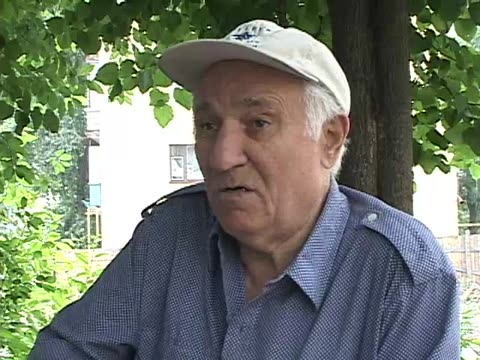
Opening exchange before the interview proper. Lemster and Geller clarify who is being interviewed, where he lived and in what years, and the interviewers mention another Geller met the day before. Geller says he lived in Pyatka until 1936 and had written down that the town had a synagogue and a beit midrash.
Geller talks about Pyatka before the war. Young people left the town in the 1930s for big cities, and he mentions a Jewish council (?) and Jewish craftsmen. His father Yankl worked in a factory, which closed during the hunger. Yankl went to look for work elsewhere, fell ill, returned in 1934 and died. His mother lived to 93 and kept house for four children. He then begins on his maternal grandmother, who had no child for ten years and went to a rebbe who promised her one child who would live long; the rebbe's name is not remembered.
Adds the father's death, the mother's age and the childless grandmother.
Geller names his maternal grandmother Etl and grandfather Mordechai, who was a ritual slaughterer. He tells of the Civil War attack on Pyatka around the eve of Rosh Hashanah, when the grandmother was shot, the family fled to Berdychiv, and the soldiers plundered the town. His father came from Khazhin near Berdychiv. The grandparents were from Pyatka.
Adds the grandfather's slaughtering, the grandmother's death and the father's birthplace.
Geller and Lemster compare how the town's name is said in Yiddish and in Ukrainian, and he places Pyatka about twenty kilometres from Berdychiv. He describes returning from flight to the plundered house, where nothing was left and the family was destitute. Lemster then steers toward Jewish life and the synagogue.
Adds the discussion of the town's name and its distance from Berdychiv.
Geller talks about his schooling. There was a Jewish school, but its lower classes were closed as pupils dwindled; his elder brother finished seven classes there in 1933, and he was moved to a Ukrainian school. He says non-Jewish neighbours spoke Yiddish, and mentions the killing of the town's Jews in 1941 and a list of the victims.
Adds non-Jewish Yiddish speakers and the 1941 killings.
Geller recalls prewar holidays, above all Passover. The family gathered at his grandfather's brother's home to bake matzo, and they cleaned the house beforehand. He describes the communal oven, his mother baking bread on Thursday for the Sabbath, and her blessing and burning of a piece of dough when she made challah. The passage ends as he begins on the 1928–29 kidnapping for the army.
Adds Sabbath bread and challah customs and the start of the khapers story.
Geller speaks about khapers who seized older schoolchildren from the school, taking them away; the text is fragmentary. He remarks that the worst antisemite can be a Jew.
Geller says he remembers one Jewish wedding, held in the large courtyard by the synagogue under the huppah. He recalls watching it, though not the details of the celebration. He then moves to Komsomol members who gathered older schoolchildren and threw stones at the synagogue on holidays.
Geller describes how, after the hunger, the beit midrash was turned into a carpentry workshop. A lame man, Itsik der Krimer, a veteran of the Japanese war, carried wood home at night, and a fire destroyed the building. Answering Lemster, he describes the Jewish fire brigade of the Pipchek (?) family, with its horses and pump, and says Jews and non-Jews helped each other and fought fires together.
Adds the carpentry workshop in the beit midrash and the fire.
Geller says the town's other inhabitants were Ukrainians with a few Polish families, and that no Jews remain. He describes a visit to Pyatka around 2005 with his daughter and grandchild, to his father's grave. The Jewish cemetery's gravestones had been gathered in one place and he could not find his father's. He also recounts the town's early history and a Jew from Berdychiv who began the settlement.
Adds the Ukrainian and Polish population and the cemetery's gathered gravestones.
Geller talks about his family today. He has a daughter and a son and grandchildren who are teachers, and he mentions a grandson in Kazan. He married in 1949 a woman from Zhytomyr, whose father was a tailor and mother a housewife. He speaks of an old-fashioned Jewish wife's duties and, in garbled lines, of a son's circumcision; Lemster then asks about cooking at home.
Adds his wife's family and the grandchildren's occupations.
Geller says people ate meat only once a week, and that life was hard and lived in fear and hunger. He married after the war and began to build a life, and he quotes a saying about people loving while God worries. Lemster then asks him to say more about Pyatka.
Geller recalls the synagogue with its women's section upstairs, and his grandfather's brother, who raised the children after the father died and took the child to synagogue each Sabbath. He describes Purim visits and paper masks. He lists his siblings: five children, one died of hunger, a sister in Ashdod, and a brother who went to America and died there. He mentions another Pyatka family in Zhytomyr and a wedding of a fish seller, then ends the interview with thanks.
Adds the siblings' fates and the Pyatka family still in Zhytomyr.
Burshtein sings Yiddish songs he composed himself, about his childhood home, about the town of Goworowo and the war, about hope, and about his mother. Kerler asks him about songs, including a coachman's song, and when and how he composed them. He says he composed the last song years ago, remembers lyrics from 1939, and has not written all of them down. A woman at the Jewish Agency office in Zhytomyr has transcribed twenty-two songs.
Burshtein talks about prewar Goworowo and its destruction. There was one large synagogue, where cobblers and tailors also had prayer rooms; the town had a police commandant, and bandits burned the synagogue and killed people. He mentions a letter from a man in Vilnius, and Kerler asks about Polish school. He then recites a Polish children's poem on washing in the morning.
Adds the annihilation of the community and the Polish school recitation.
Burshtein chats in Polish, with Lemster and others speaking Polish too. He says he is pleased to speak Polish and left school after four classes, before 1939. He names his birthplace Goworowo and nearby towns, and says he now has no one to speak Polish with. He mentions a letter from someone in Bobruisk and another Polish speaker in Zhytomyr, then recites rhymed Polish verse.