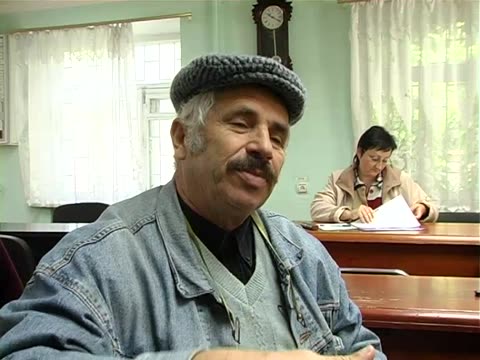
Fragmentary talk about hearing versus telling things and about what people used to hear. Lemster then asks whether a song comes to mind, and S3 names a song about the shtetl Goworowo.
The passage is mostly garbled talk about hearing and telling, ending in the naming of the Goworowo song.
S3 sings his own song about his hometown Goworowo (Govrove). It recalls childhood, the war, the graves of the fallen martyrs and renewed life. In Russian he explains that he composed it, and Kerler confirms it is his own shtetl. Lemster then starts asking about Jewish weddings, mentioning a custom of serving the groom and the in-laws.
Lemster describes a wedding custom of bringing a cake to the in-laws, who dance with it and pay money. Geller talks about weddings and about the advertising value of serving good food, giving a strudel recipe from his mother and a story about gefilte fish and taste. Lemster and Kerler ask about words heard elsewhere for the cake and about the "queen's bread" (challah) and Sabbath as a queen.
Besides the strudel, the passage has questions about the word for the wedding cake and about Sabbath as queen.
Discussion about the Jewish people and the sins attributed to them, with a story about the synagogue renovation and how the community kept faith. It turns to Ukrainian politics (the president with an American wife), inflation, and factories and bakeries closed in Zhytomyr. Kerler ends by asking Geller when he left Pyatka.
The passage covers the synagogue renovation and Ukrainian politics and inflation.
Geller says his family left Pyatka in 1936 and he lived mostly in Zhytomyr, where he worked in a factory. Yiddish was spoken at work, but now no one is left to speak it with. He describes his daughter, grandchildren and great-grandchildren, some at a Jewish school, and a granddaughter's concert. His wife was evacuated near Kazan, where his son lives, and he recounts visiting that place with a grandson. His younger brother died in San Francisco. Some stretches are in Russian.
Beyond the biography, he talks about Yiddish at work and in his family, his son's town near Kazan and his brother in San Francisco.
Dialectological questions from Kerler on verb forms ("he lives" and "hands over"), on the plurals "farshidene" and "beyde" and on an expression about an evil person. Geller then talks about Yiddish speakers in the region, among them an Itsik (surname unclear) and his wife, a former director of a Yiddish school. Kerler offers to take Geller home.
S3 sings songs about childhood memories, then "Bay mir bistu sheyn", with Geller commenting. Kerler asks whether they recall a Purim play, and a discussion of the dreidel follows. Near the end Geller begins a remark about the year 1944 and a yeshiva.
Geller talks about a yeshiva and a survivor of the thirteen students who studied there in 1938. This man, a rabbi's son, visited Pyatka a few years ago (2004 heard) and found only one Jewish house still standing. Kerler thanks him and they discuss the rabbi's address and directions, with a street named Dovzhenko mentioned.
The team arrives at the Nibulskiy house, where small dogs greet them. The host says he paints a little. Kerler explains they look for Yiddish speakers and want to set up two cameras and interview him and his wife separately, because they come from different districts. He lists the towns visited on the trip so far.
Nibulskiy places his hometown Pulen on the old road from Zhytomyr towards Novohrad, a few kilometres off. He calls it a Jewish holy place where his father, grandfather and grandmothers are buried. The town had about 350 Jewish families.
Nibulskiy says the Germans murdered Pulen's Jews. After the war the bones were dug up and moved to the Jewish cemetery, where a large monument stands. Kerler asks the year, which he gives as 1956. He and his father helped restore the memorials.
Kerler states the date and that this is one of their last two interviews in Zhytomyr, with Isaak Yakovlevich Nibulskiy. Nibulskiy gives his Yiddish name Itsik, which his mother used affectionately.
Nibulskiy recalls his great-grandmother Klare, who would ward off the evil eye from him with a spoken formula about three women on a stone and a stroking of the forehead. He explains that she was his grandmother's mother (grandmother Khaye Gitl).
The great-grandmother is also tied to grandmother Khaye Gitl.
Nibulskiy describes how his grandfather Avrom kept an open Sabbath table for poor guests for eighteen years. Visitors came from nearby towns, and a cholent from the baking oven was served with kiddush, silver cups for wine or brandy, tea and lekekh. The guests told stories, which he learned from his grandfather and father. He then begins to describe poverty in the Jewish shtetl.
The passage adds the cholent explanation, the seven cups and the stories told at the table.
Nibulskiy talks about poverty in prewar Pulen, with no factories and many poor people living on credit. A man bought furs and roosters in the German colonies to resell. His grandfather collected from the rich to bring Sabbath food to families like Nokhem the shoemaker's. He then tells a story of Shmilik, a bonder from Lithuania, who consulted the Baal Shem Tov (Reb Yisroel) and found gold in his oven, which led to a furniture workshop. Kerler asks about word meanings and the man's name.
The catalogue's Reb Yisroel appears in the transcript as the Baal Shem Tov, and the passage adds the furniture workshop, the sale of meat cuts and Kerler's word questions.
Nibulskiy explains the origin of the surname Nibulskiy through a landowner called Bulski and the 1861 reform. He names his grandfather Avrom Alter and his father Yankl. He then lists nicknames used in Pulen, such as Rivinke Brilen, Shlapak, Khezkl Lasutre, Sobalyev the dark one and Khayim Ash the cleaner. Kerler finishes by asking about Avrom Malke.
The passage adds the list of nicknames and the Alter versus Alters naming of the grandfather.
Nibulskiy clarifies the phrase "Avrom Malke" for his grandfather's Sabbath gathering. It lasted eighteen years until Soviet power, and the guests set out on Friday morning to arrive on Sabbath. Kerler asks about the wording and about Jewish-Russian ("shulish") Yiddish. Nibulskiy then begins a story about two wagon drivers, one refined and one coarse.
Nibulskiy continues the story of a quarrel in Pulen between two wagon drivers (or between occupations). The Makariv rebbe came on a Sabbath, with Sabbath candles burning on the table. He told one man to ask forgiveness, and a candle fell and went out when the man refused.
The rebbe settles the quarrel in a Sabbath scene with candles, and the passage breaks off before the resolution.