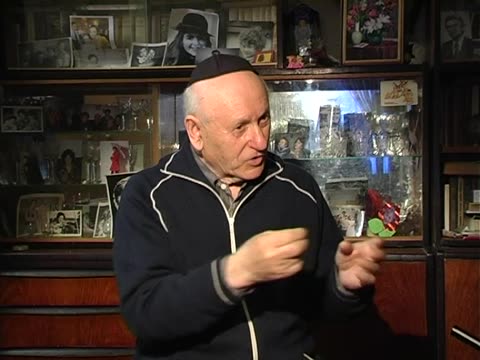
Nibulskiy tells how the Makarover rebbe, a guest in his grandfather's house, taught a stingy local man a lesson through a circumcision-related incident, after which the man became generous with charity. He also tells how his grandmother Gitl took his sickly father Yankl to the rebbe, who rubbed the boy's cheeks with his beard. The father lived to a great age and put on tallis and tefillin on weekdays.
The rebbe's visits were at his grandfather's house and include a story of a healing by the rebbe's beard.
Nibulskiy speaks about his observant father, his own cheder attendance, his wife's Jewish schooling and his self-taught Yiddish reading. He tells how the Makarover rebbe visited his great-grandmother in a nearby town, where she recovered after a fire. He describes his great-grandfather Shimunke, a farmer and crop adviser. He also tells of a Jewish lessee in Burakivka troubled by a German over hops, who went to the Makarover rebbe for help. Kerler asks about the Yiddish word for a village.
Also covers great-grandfather Shimunke and the wife's schooling and Nibulskiy's own education.
Nibulskiy gives the town's name as Chervonoarmiys'k since 1936 and describes the Czech and German colonies around it, where Jews traded. His grandfather, a tailor with four Singer machines, sewed for rich non-Jews. He begins to tell of an uncle who emigrated to Canada in the early 1920s (the year not fully clear).
Also the Canadian emigrant relative (uncle or brother, unclear) is introduced.
Nibulskiy talks about his relatives in Toronto, a journalist cousin named Benjamin Nobelman, with whom contact was lost after his father's death. Kerler asks what the town was called in the local language before 1936, and Nibulskiy gives a form of Pulena. He then offers to tell a story about the Berdychiv rebbe.
Adds the name Nobelman for the Canadian relatives and a question about the old local name of the town.
Kerler asks where Chervonoarmiys'k is located, and Nibulskiy gives directions from Zhytomyr on the road towards Novohrad-Volynskyi, about forty kilometres away, then a seven-kilometre asphalt road. Three kilometres before the town is the Jewish holy place with graves of those killed in the war, where his father lies.
Gives directions to the town and mentions the memorial site with the war victims' graves.
Nibulskiy describes the mass grave at the Jewish cemetery, with men on one side and women on the other, and says he visits to light a candle and recite a prayer. He recalls the killing of his grandfather by bandits, who cut off his beard and beat him. He mentions his brother who fell in the war and his parents, and that he himself did heavy construction work throughout the war.
Adds the cemetery visits and the brother who fell at the front.
Nibulskiy speaks about his difficult wartime work and what he did after the war: pedagogical school, then a pedagogical institute, painting and art history, working as a teacher for forty-one years. He says he has lived in Zhytomyr for thirty-one years and states his birth year as 1926 and his wife's as 1921. He then offers to tell more about the Berdychiv rebbe.
Adds his education and teaching career, and the years of birth of himself and his wife.
Nibulskiy tells a long story about the Berdychiv rebbe, who was jailed after being denounced, and whom Jews visited in prison for Sabbath kiddush. An apostate Jew sent by the tsar found it was so, and the rebbe told a tale of a foster son who became an emperor hostile to the Jews but changed his policy. He is asked about Rabbi Nakhman of Bratslav and then begins a story about the Velednik rebbe that he heard from a fellow institute student.
Besides the Berdychiv rebbe in prison, includes the emperor story and the start of the Velednik story.
Nibulskiy completes the story of a fellow student who was paralysed and cured after his wife went to the Velednik rebbe. He talks about visits to the Velednik rebbe's grave, where people laid coins, and shows a coin he carries with threads, with Kerler asking how a coin becomes a segulah. The word mashbie (?) is discussed, and he begins to say that his father taught him a prayer.
Adds the student's cure story and the explanation of how a coin becomes a protective object.
Nibulskiy recites the protective oath formula taught by his father Yankl, adjuring all creatures not to harm a named person, while Kerler asks him to repeat it for transcription. They discuss the wording and its Hebrew parts and the use of the mother's name. Kerler asks where he knows it from, and he says it came from his father and grandfather, a tailor.
Adds the dictation of the formula and discussion of the grandfather's and father's trades.
Nibulskiy says that on Sabbath he carried his grandfather's tallis and tefillin to the synagogue as a child, and that he can read prayers only in a Russian-language siddur. Kerler mentions that he has copied the prayer in Hebrew letters from his dictation, and Nibulskiy offers to give his Toronto relatives' address.
Adds the Russian siddur and the dictated text and address of the Toronto relatives.
Nibulskiy discusses non-Jews in Puliny who understood Yiddish, and how his grandfather spoke Hebrew words on Sabbath, naming a number of items. Kerler asks about Sabbath songs and the phrase 'a good Jew', which Nibulskiy explains as one who believes and prospers. He starts to tell of a Christian woman visiting the Velednik rebbe.
Adds Sabbath songs and the term 'good Jew' for a rebbe.
Nibulskiy tells how a childless Christian woman came to the Velednik rebbe on a Sabbath in the synagogue and asked for a child. The rebbe prayed for her, she bore a son and afterwards came every Friday to bring candles to the synagogue. The son later defended Jews in a pogrom, as his grandfather told him.
Nibulskiy starts anecdotes about the Makarover rebbe and Hershele Ostropoler, told by his father. In one, a woman asks for help with a daughter-in-law and Hershele, sitting on the rebbe's chair, advises a penny trick; in another, a young man who lay next to a non-Jewish woman on a train is told by Hershele to chew straw. Kerler comments on the stories from his own recollection.
Adds the first Hershele story about the woman and the penny.
Nibulskiy tells further Hershele Ostropoler anecdotes, including how he had a hat made and tricked innkeepers into feeding him by waving it, and one about tearing cloth for trousers by force. These end with a saying that things are not torn off without force, which Kerler asks about as a proverb.
Kerler and Nibulskiy discuss the proverb that is linked with the cloth story, repeating it and exploring its meaning, including a second sense about children and buying things under hardship. Kerler then asks about songs his parents sang.
Nibulskiy sings a short song attributed to the Makarover rebbe, comparing a Jew and a non-Jew drinking in a tavern. He explains it was dangerous to sing under the Soviets and that Jews avoided the word for non-Jew, saying 'peasant' instead. Kerler asks about words for peasant and Christian woman.