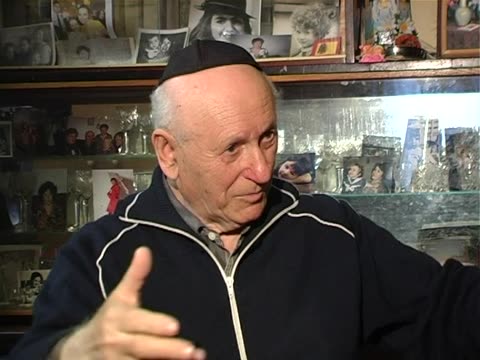
Nibulskiy tells a long legend, which he heard from his grandfather, about the Baal Shem Tov and a young couple who worked at a tavern and wanted to marry. Their stingy employer gave them money instead of a wedding. The Baal Shem Tov met them on the road and married them under a makeshift canopy of sticks. He then helped an injured nobleman's son, and the local landowners gave the couple land as a wedding gift. Kerler asks how a wedding canopy was called in his town and comments on the story.
The catalogue label is only 'Anecdotes'; the transcript shows the Baal Shem Tov legend and a question about the word for the wedding canopy.
Nibulskiy answers Kerler's questions about Purim before the war. He describes masks, gifts of food parcels (shalakhmones) and the Purim bearers who went around. A beggar and his family are mentioned, and children were given small coins. His older brother played the fiddle, and his daughter is an artist. Purim plays are discussed, and Nibulskiy says the Soviet authorities stopped them. He adds that his stories came from his grandfather and father.
The family detail concerns an older brother who played the fiddle and a daughter who is an artist.
Answers Kerler's questions about weddings. Nibulskiy says certain older wedding customs belonged to his parents' time, and that he remembers cookies dipped in wine at a wedding. Under Soviet rule Jewish weddings were not allowed. He recalls how matzo was baked at Passover and Kerler asks how Passover is said in his dialect.
Kerler thanks Nibulskiy and ends the interview. The two briefly discuss how words are pronounced and written in Yiddish and in the local speech, including a form heard in a nearby town. Nibulskiy mentions a relative who visited his grandfather and a grandchild living in a kibbutz in Israel. Kerler takes a portrait photograph.
The transcript shows a discussion of pronunciation, talk about a grandchild in Israel and a portrait photograph.