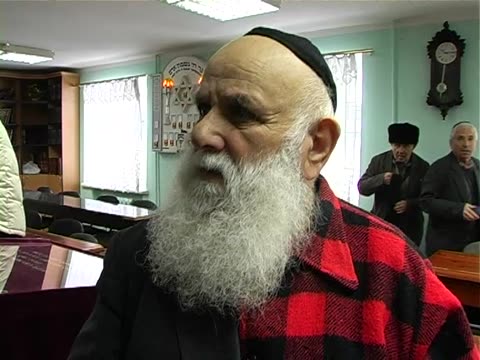
Informal greetings and banter with the community members, including talk about the cassettes and when copies will be sent. Kerler asks one man where he is from: a native Zhytomyr man born in Polikovka (?), he was at the Stalingrad front and returned in 1945. He recalls his father hiding his observance when he was about twelve, says he worked as a house painter, and explains that the name Motl comes from Mordekhai. The passage ends as Kerler asks about news from Pyotke.
The speaker says no Jews are left in Pyotke, only the cemetery, which he visits with his daughter and grandchildren; the mass graves of the murdered are there. He tells of the postwar trial of local policemen who took part in the killings, with long prison sentences and releases in the 1950s (the numbers of victims are unclear). He also mentions a list of Jewish families drawn up after the war, which he passed on to his children.
Kerler asks about his children's Yiddish: the daughter and the son both speak it, and the son lives in Kazan. He recalls a visit by the son in the 1980s (?) and a telegram of greeting from the Tatarstan prime minister's office, and gives the son's name as Yakov.
The speaker explains administrative geography: Pyotke belonged to the Vinnytsia region before 1937 and then to the Zhytomyr region, lying some kilometres from Chudniv (?) and from Berdychiv. Kerler mentions a man named Fishman. The speaker then reflects on faith, God and how the world has become confused, and says that people who broke away from their roots could be manipulated.
Kerler notes that the speaker was at the front for four years. He talks about the medals he received, including a later Israeli medal for Soviet veterans, which he says his children keep as a memento.
He talks about life today at 81 (?): the whole of life is problems, with the currency changes and the dollar. He recalls heating with gas and earlier going to non-Jewish villagers to buy straw for fuel, and calls life a foolish story.
Motl is mentioned as a partisan, and Kerler invites him to speak. The speaker says something about a synagogue shames and brothers; the passage is short and garbled.
Kerler asks what was done for Purim in Pyotke. The speaker and others mention baked goods, dreidels, masks, and the custom of drinking l'chaim and acting crazy on Purim. Talk then turns to the speaker's father and mother, though their fates are unclear.
Largely garbled talk among the group while arrangements are made. Kerler says he wants to ask the speaker about his four years at the front, and a medal from Israel is mentioned.
The speaker recalls 1941, when he studied at a technical school and joined a Komsomol destruction battalion. He remembers the first bombing of Zhytomyr on 3 July and the arrival of the first German on a motorcycle on 7 July, and says the Komsomol youth stayed in a village eight kilometres away. He then took a train toward Kazan, stopped about sixty kilometres short at a point where evacuees were given food and bread, and went looking for relatives.
He tells how he searched house to house in the Volga region and found his grandfather in a village on the Volga bank, recognising him by his fine beard; they were reunited there. Three months later, in 1942, he was drafted into the army.
The speaker describes serving in the cavalry at the front. He lost part of a finger in 1943, was wounded again in October 1944, and spent half a year in hospital before being discharged in May. He then went to join his grandfather, whom Kerler asks about; the name sounds like Usher Libelman (?). Other voices comment on the grandfather.
The passage begins with a man who attended cheder only twice a year, and Kerler asks how a certain word (heard as 'tshistyukhe' (?)) was used. It then shifts to the speaker's recollections of crises: his father's death, the first air-raid sirens in Zhytomyr in 1941, and the currency change. He says people come out of such problems stronger, and the passage ends in garbled talk.
Kerler asks whether the rabbi's children speak Yiddish; the two older ones study in a yeshiva in Moscow. The speakers joke about sharing money for the interview, and Kerler arranges to talk more. They end with a short question about the words for 'sick' and 'sleep' in Yiddish and German.
A second man joins; his grandparents came from Stanislav, he learned Yiddish from them, and he attended cheder in Belz. He talks about an American man of Pyotke origin (Averbukh (?)) whom he has visited, who travelled to Pyotke to see his family's house. The passage is partly garbled.
The speaker describes visiting Pyotke with Averbukh, a descendant of the town's rabbi, who lives in America. The old Jewish houses had been altered or taken over by non-Jews, and their age is discussed. He mentions that during the war this man was in Georgia.
The speaker tells of an underground yeshiva in Berdychiv and an archive of photographs of its students that was found after the war. He then recalls going to Pyotke with the rabbi's son to see his father's tombstone; he says many tombstones were removed and reused for building.
Kerler asks the speaker to travel to Pyotke with the team the next day, but he says he cannot manage the road. They compare the distance to Berdychiv. The others discuss a book that says Berdychiv, along with Jerusalem, Tiberias and Safed, is a place whose mention brings good fortune (a segulah), and Kerler asks for an email with its name.
The second man describes his family: grandparents on his mother's side, a Hungarian family named Brikhte (?), lived in Newark. A great-grandmother was born in a small town near Lviv (?), possibly near Belz. They go on to discuss a pronunciation of Yiddish and how stories grow with the retelling.
The speaker talks about family matters: an old rabbi who married a second wife, and a relative named Naftali, born earlier than the speaker. Kerler asks about Taykhman, who is in Uzhhorod (?) and returns in a week, and about phoning him.
The speaker mentions that the son in Kazan was greeted by phone in 1985 (?), and talks about Jewish girls supported by the synagogue and a yeshiva in Kazan. The rest, a discussion about a match for a young woman and her father, is largely garbled.