0:00
Greeting Nibulskiy outside.
Greeting Nibulskiy outside.
Entering house.
Kerler and Nibulskiy greet each other warmly at the door and the team goes inside. They exchange remarks about the winter cold, and Kerler introduces Yuri, who works with the team.
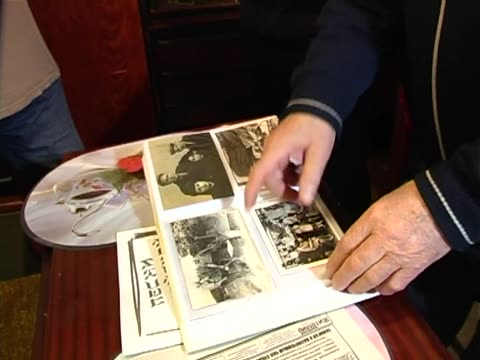
Showing photographs.
Nibulskiy shows family photographs and identifies the people in them. They include his father, who lived to about ninety-seven, his mother, and two aunts. He also shows his wife Yide, a daughter, a son-in-law, and a granddaughter who is a magazine editor. Photographs of a restored monument are also discussed, and some of the talk is in Russian.
Besides the photographs, a restored monument and the family members are discussed.
Formal introduction.
Kerler states the date, 4 January 2009, and the place, Zhytomyr, and introduces Nibulskiy, who gives his name as Itsik, son of Yankl. His wife Yide is a little older than he is, and they give their birth years. Nibulskiy begins to describe prewar Pulen, with more than three hundred Jewish families, many of them hungry and poor.
Jewish life in Pulen.
The research team enters the synagogue.
Nibulskiy describes the poverty of prewar Pulen: no bread, no firewood and no pensions. Some craftsmen earned a little, and small traders bought food from German villagers and resold it in town. People had nicknames. Shopkeepers kept credit books in which customers' debts were chalked up, and Kerler asks how the system worked. He also mentions the three prayer houses, those of the shoemakers, the tailors and the merchants.
Religious life.
Nibulskiy describes the pedlars' trays carried round at Hanukkah and how his father said Hanukkah was always muddy. He then explains the street without paving, with ditches and boards laid over them for walking.
The research team returns to the van.
Nibulskiy recalls going to his grandmother for Hanukkah money, carried through the mud on a youth's shoulders. He speaks of the three small synagogues, attended daily only by the rabbi and the old believers, and of carrying his grandfather's prayer shawl to the Sabbath service. His father wanted him to learn some Yiddish, but there was no cheder in the Soviet period, and he recalls the older cheder.
Yiddish song.
Nibulskiy recalls songs of the cheder and a song his mother sang, about farewell to the sweet flowers and vanished years. Kerler asks where he knows it from and has him repeat the words. He then begins to speak of his grandfather's Sabbath hospitality.
Sabbath celebration.
Nibulskiy describes his grandfather Avrom's Sabbath hospitality for poor visitors from nearby small towns: a large table, challah, a samovar, and kiddush with brandy. Stories about the Besht and the Veledniki and Makarov rebbes were told. He begins the story of a girl who lay ill and a father who rushed to the rebbe.
Anecdotes.
Nibulskiy tells anecdotes about the Makarov rebbe and his family. A fire burned down the house after the rebbe's advice, but the sick daughter, his grandmother, recovered. His great-grandfather Shimonke was a trader, and the rebbe stayed at his grandfather's house. Other stories are about a lessee at Burakuvka troubled by a German neighbour, the rebbe's way of answering by burning a written note, and a non-Jewish woman who asked the rebbe for a child. He also recalls a pogrom threat at Sukkot and a tailor's mishap.
Many stories beyond the Makarov rebbe: the lessee, a miracle for a non-Jewish woman, a pogrom threat, a tailor.
Grandfather's struggle as tailor and family.
Nibulskiy tells how his grandfather Avrom, a tailor, burned a hole in a customer's garment, and the Veledniki rebbe, who happened to arrive, advised him how to repair it. He then explains the family: his great-grandfather Shimonke and grandfather Avrom Alters, who was killed by the Germans in 1941 after refusing evacuation. Avrom was a synagogue warden and supported a poor shoemaker's family on the Sabbath. Nibulskiy compares this with the complaints about aid today.
The family tree and his grandfather's fate in 1941 are also covered.
Aynbinder family.
Nibulskiy says the Nibulskiys came from Lithuania. He tells about a poor family of binders, whose oven would not bake, who went for advice and returned with a pot of gold from a cracked oven. He then adds that the man opened a workshop in Pulen and became wealthy. Kerler asks about the name of the object and the term bonder, and about the rebbe's role.
The Nibulskiy family's origin in Lithuania is also mentioned.
Hershele Ostropoler.
Nibulskiy tells several anecdotes of Hershele Ostropoler's cleverness: tearing cloth with a cry, the saying about not tearing without force, and the hat story played on a rich man and an innkeeper. He then returns to rebbe stories, including a woman who asked how to deal with a daughter-in-law and a young man who slept beside a beast. Kerler asks about words and meanings.
Cultural terminology.
Kerler says they will return for more stories and puts questions, asking Nibulskiy about the dybbuk. Nibulskiy answers with a story of a nobleman and a sorcerer, which he will tell later. Kerler then asks for an account of the war years.
Life during the war.
Nibulskiy recalls that he was fifteen when the war began. His father worked in a hospital and could not leave. At his request, the military commissariat took Nibulskiy and his brother with a group of young people for evacuation. He went to Saratov and studied there.