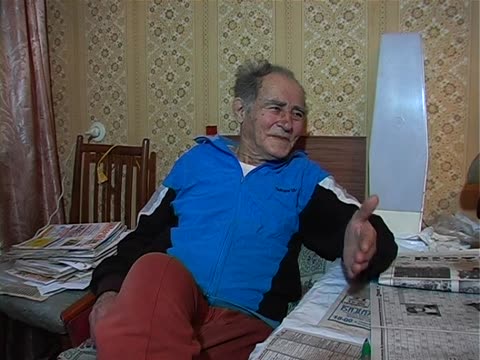
Shraibman tells of his friend Shlomo and the idea of arranging a wedding canopy (khupe) for him, which he declined. Kerler jokes about matchmaking and the Messiah, and then asks whether he has been to Israel.
Adds the friend Shlomo anecdote and the joking about a new match.
Shraibman says his aunt, cousins, daughter and granddaughter live in Israel and that he once wanted to move there. He would only visit as a tourist. His granddaughter visits him every year, and he sends money through Shlomo. He also mentions cousins' children in America who are not religious and keep inviting him to visit.
Adds the relatives in America and the money sent through Shlomo.
Shraibman recalls a custom of seating the bride at a Jewish wedding and the badkhn who sang to the guests and to the bride. He then reflects on the better and worse times he and his wife lived through, and on which period was best.
A short passage in which Shraibman says he and his wife survived and lived in a good village. He starts a story about a Jew coming to a rebbe by train, but it breaks off.
Kerler asks what the word Dybbuk means. Shraibman says it is the play and cannot be translated into Russian or Yiddish. He recalls the Yiddish theater before the war, including The Dybbuk and Sholem Aleichem plays, and notes that the theater after the war was Russian. He adds that young Jews took part.
Adds the Dybbuk word question and the contrast with the postwar Russian theater.
Kerler asks what the word golem means. Shraibman links it to Sholem Aleichem and gives a phrase about a "lamternem shisser" (?). They discuss Sholem Aleichem in Russian.
Shraibman and Kerler talk about Sholem Aleichem, who wrote mostly in Yiddish and was translated into Russian. Shraibman says he reads Russian but it enters his head in Yiddish. He quotes Motl the orphan as a favorite.
Kerler asks what the Jews called a cemetery. Shraibman gives a Jewish term, "heylik ort" (holy place), and they discuss the Christian cemetery and the word tsvinter (?). Kerler notes that the different names and places are being recorded.
Adds that this is a terminology exchange about the Jewish and Christian words for a cemetery.
Kerler asks what share of the town's population was Jewish before the war. Shraibman estimates about fifty percent. He says some non-Jews still speak Yiddish and that one woman still speaks it, in the town now called Volodarsk-Volynskyi. He tries to find her name and a phone number.
Adds non-Jewish Yiddish speakers and a woman, perhaps surnamed Firer (?), who still speaks Yiddish.
Shraibman goes on about the woman who still speaks Yiddish. She has no one to talk to, and they try to work out her age. He says she is from a non-Jewish family. Kerler thanks him.