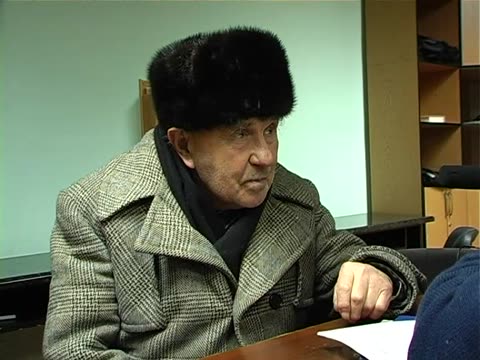
Kerler opens the recording with the date, 4 January 2009, and the place, Zhytomyr, in the synagogue. He then records the interviewee's official data: his Russian name Pyotr Shilovich Sandler, his Yiddish name Perets, and his Zhytomyr street address and telephone number (Korolenko Street, in the Russian).
Kerler continues the personal details: the Yiddish form of the patronymic, the birth year 1926, and a wish for long life. Sandler says he lived in Oltkonstantin before the war and remembers everything; Kerler asks whether he went to a Yiddish school.
Sandler recalls his schooling: four years in a Yiddish school, which later became a Russian one, and kheyder in the afternoon after school, with a rebbe who punished him. Kerler asks whether he remembers songs the rebbe taught, and Sandler begins to sing one.
Sandler sings the song about Itsik who got married. Kerler then asks which pronunciation of Yiddish sounds nicer to him, and whether he spoke Yiddish after the war, which he says he did less. Asked about his father, who died in Bukhara (?), Kerler turns to what the father worked at.
Sandler talks about his family. His father was a wigmaker and his grandfather David a shoemaker; his grandmother was killed when a ceiling fell in the old house. He had eight siblings, of whom two sisters live in Germany and a brother in Jerusalem, and he lists several by name. A second speaker then tells of a grandfather who headed the community just after the war, in 1945, when a synagogue was being built on Babin Street; the Krevitsky name comes up.
The catalogue's story of a grandfather who headed the community in 1945 appears here at the end of the family talk.
Informal exchange in which a speaker says he understands only a little Yiddish. Kerler asks whether he knows the surname Goldfaden, the father of the Yiddish theater, who came from Oltkonstantin. He also asks when the speaker last visited Oltkonstantin (last summer) and whether he goes to the cemetery, where his mother is buried and a brother's wife still lives.
Kerler asks whether Jews still live in Oltkonstantin and who there still speaks Yiddish. The answer is two women, one from Polonne and one named Roza Klein, and greetings are passed on. A second speaker then brings up Taykhman.
Names two Yiddish-speaking women in Oltkonstantin.
A speaker tells a story about a man called Taykhman, who in a town (Uzhhorod, per the catalogue) was lost in the dark and asked in Yiddish where the synagogue was. He did not know Russian and later learned it with someone interpreting. Kerler then asks Sandler to tell about Oltkonstantin before the war, in school and kheyder, and what children played.
Sandler recalls childhood games and toys in Oltkonstantin, saying (in Russian) that he is now 82. Kerler then asks about living standards and whether meat was eaten every day.
Sandler talks about food and home life. His mother was a capable housewife with eight children, and meat was affordable only once a week, for the Sabbath. He lists breakfast foods such as kasha, rice, tea and rolls. Kerler asks whether he spoke Yiddish after the war.
Sandler explains his language preferences. He did not like Ukrainian and liked speaking Russian, but says he understands Yiddish best. Kerler encourages him to speak Yiddish when he can.
Kerler asks what several Yiddish words and expressions mean: a dibek, a golem, a goy, and a "poylner goy" (?). Sandler gives his understanding of each, and Kerler asks about the languages spoken in Oltkonstantin.
Discussion of who spoke Yiddish in Oltkonstantin before and after the war. It was a Jewish town, and the speaker says even non-Jews spoke Yiddish, which Kerler questions, mentioning a non-Jewish woman he once interviewed. Kerler then asks about the best time of Sandler's life.
Asked about the best years of his life, Sandler discusses the Soviet leaders: life was good under Brezhnev, and he also mentions Chernenko and Stalin. They discuss whether Stalin meant to send Jews away and whether things got better after he died. Kerler asks whether he has relatives in America, and he says he has not.
A speaker, partly in Russian, recalls acquaintances and a friend who worked beside him selling goods at the Zhytny market in Zhytomyr and later left for America. He says he worked in trade, selling ice cream, beer and vodka, and mentions a letter he would have to find. Kerler explains the word zhytnie and then asks what it means to be a Jew.
The passage also covers the speaker's market trade and Kerler's explanation of a Russian word.
Kerler asks Sandler what being Jewish means. He answers that a Jew must remain a Jew, and discusses whether going to synagogue and praying is what matters. Asked for a message to American Jews, he wishes them long life, health, peace and no war, and talks about friendship between Ukraine and America and politics. Kerler thanks him and turns to the next interviewee.
Margolis gives his Yiddish name, Moyshe ben Yoysef, a kohen like his father, and his Russian name, Moisei Iosifovich Margulis. He says he was born in Zhytomyr. His maternal grandfather, Yosef Krivitsky, was a well-known cantor who lived and died in Zhytomyr with a large funeral, and his mother was called Inda in Yiddish. He says Yiddish was spoken at home, then gives his street address (Lysenko Street, formerly named for Sergei Lazo).
Margolis speaks about language and religion at home. Russian was spoken mostly, with some Yiddish words, and religion was suppressed under Soviet law. He recalls Passover matzo baking, and bringing flour to the synagogue. He then talks about his work, which ended when he became disabled in 1983 (?).
Margolis talks about his work and present circumstances: he once earned a living but now has no work, lives on a small disability pension, and has little to live on. Kerler asks about his grandfather, who attended synagogue, prayed and kept kosher.
Margolis speaks about his other grandfather, a ritual slaughterer who killed sheep and geese, and about kosher practice at home with special dishes. He and Kerler then go through Passover and festival foods, including a dish called akerts (?), kigenekh, and a fish dish his mother prepared by removing the bones and chopping the flesh. The interview ends with Kerler asking for the camera to be turned off.