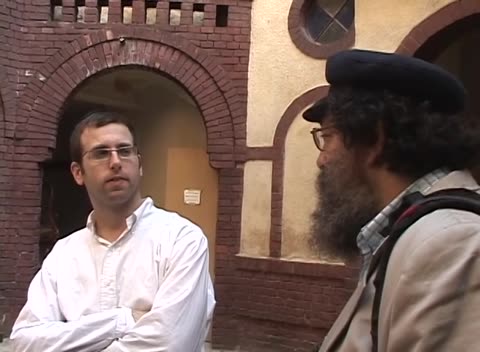
The team chats with Moyshe Bergman outside, while the camera collects footage of the building. They also discuss the contemporary community and yeshiva system.
Outdoors, the team chats with several men of the community about Yiddish. They discuss who speaks it, among Hasidim and Lithuanian-style Orthodox, in Israel and in Hungary. A speaker mentions someone from Mukachevo who now prays here, and the talk turns to Yiddish in the yeshiva system and shiurim given in Yiddish.
The talk is mainly about Yiddish use in the community and in yeshiva teaching.
The conversation inside the synagogue continues in a loose, fragmentary way. It touches on the American-funded project and the interviews being made, and on a man who speaks good Yiddish and whose name is given as Palen (?). Contacts, phone numbers and the community are discussed.
Names the project funding and the contact with a Yiddish-speaking man.
Chat with community members about particular men, some of whom pray here daily, and about who speaks Yiddish. The talk also covers young Orthodox people and who is or is not observant. Much of the passage is too garbled to follow in detail.
The team talks with Imber about his family, in particular the Imber name and two writers of that name, one possibly a Galician poet. Mentions of Lemberg and the ghetto occur, along with exchanging addresses and sending material. Photographs may be shown, but this is not clear in the transcript.
A discussion of local synagogues, with several speakers naming congregations and a statuska (?) synagogue. The talk also covers a rabbi named Levi (?) and Shabbat prayer, with garbled mentions of the building and its history. Details are unclear.
The team talks with Eduard Deblinger, born in postwar Vienna, about how he knows Yiddish and about Yiddish and Orthodox Jews in Vienna. Kerler explains the project of interviewing older Yiddish speakers, mentioning Ukrainian shtetls visited. There is an exchange of contact details and of his name.
Gives Deblinger's account of Yiddish in Vienna and explains the project.
A prayer service is filmed in the synagogue. The speech is mostly garbled or repetitive, with a Hungarian-language explanation of the project and its archive by one participant.