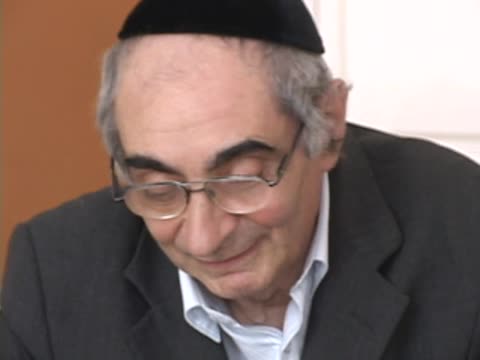
Deutsch explains how Torah verses were learned and translated in Budapest in his school days, giving the opening words of Genesis in that traditional manner. He and Kerler discuss the different terms for God. The passage ends with Kerler stating the date and the setting, the Jewish Theological Seminary in Budapest.
The passage is also a discussion of terms for God, ending with Kerler's introduction of the date and place.
The formal interview with Deutsch begins at the Jewish Theological Seminary in Budapest. He speaks about his teachings at the seminary. Deutsch also discusses regional dialects.
Deutsch describes himself as a teacher of Torah to children, following the weekly portion. He discusses Hebrew pronunciation in different Hungarian regions, naming Ungvár, Mezőkövesd(?), Munkács and Budapest, and compares how a holiday is named in each place. Kerler's questions about the Sukkot term prompt part of the discussion.
The talk is mainly on Hebrew pronunciation and holiday terminology in various Hungarian places, not just his own teaching.
Deutsch speaks about his education in Budapest, mentioning a school in a street whose name is unclear and the absence of a yeshiva in Budapest. He then says that his parents died in the war and that three brothers were left.
Deutsch speaks about his family and their fate during World War II. He grew up with two brothers. He then talks about his life after the war, including his life at an orphanage. Deutsch explains how they divided school classes between Yiddish and non-Yiddish speaking students. Before the war, Deutsch underwent eight years of schooling.
Deutsch tells of living in Budapest with his brothers and grandmother, and of his time from 1946 to 1951 in a children's home, apparently one run near Mezőkövesd(?) and Makó. The Yiddish-speaking and non-Yiddish-speaking children were taught separately, and most pupils learned the Bible without understanding it. He says that he finished eight classes and then had to work in a factory in Budapest, and he talks about his later studies.
Adds a children's home with a rebbe's family connection, the matter of Hebrew learned without understanding, and factory work.
Deutsch speaks about a man named Shlomo Grosberg(?) who helped him in the war, and whose father wrote for a Jewish newspaper. He then talks about his brother, a good goalkeeper, who has many children and grandchildren and is very pious.
Adds his brother, the footballer, and the brother's large religious family.
Deutsch provides personal information and speaks about his family. His mother was born in Budapest and worked at a soap factory. Deutsch's father was born in Vișeu de Sus, Romania and a follower of the Spinker Rebbe.
Deutsch gives his birth in Budapest in 1936. His mother worked in a factory in Budapest; his father came from Vișeu de Sus and was a Spinka Hasid who used a prayer house. His father's name changed from a Yiddish form in Vișeu to a Hungarian form in Budapest. Kerler then asks what language was spoken at home.
Deutsch recalls Hungarian as the language spoken at home, with Yiddish or German used by the parents when they did not want the children to understand. He speaks about his grandfathers and grandmothers, one grandfather having remained in Vișeu and a family connection to the Spinka rebbe. His grandfather and his brothers had a business making matches, and his father worked in a shop. He also mentions an uncle who was a card player.
Adds the match-making business and the Spinka connection.
Deutsch speaks about his parents' fate during the war. His father died in the Mauthausen concentration camp and his mother in the Ravensbruck concentration camp. Deutsch then explains Jewish life at the beginning of the German occupation of Budapest. He mentions Hungarian helpers to protect local Jews, before returning to his family's fate during the war.
Deutsch speaks of his parents in the war. His father worked at a brewery and was taken to a labour service, dying in Mauthausen, and his mother died in Ravensbrück. He describes the deportations from the Jewish quarter in Budapest, the Red Cross children's home, and the Hungarian fascists. He mentions an officer who helped hide the children and his mother and sister who worked in a kitchen.
Adds the Red Cross children's home and an officer who helped, as well as the work of his mother and sister in a kitchen.
Deutsch discusses his childhood memories and addresses prewar religious life. Deutsch sang in a choir at the synagogue. He then describes Sabbath services.
Deutsch recalls prewar Jewish life in Budapest: streets with many small prayer houses and the large Kazinczy Street synagogue. He sang in its choir with his brothers, and mentions the cantor Moshe Stern. He describes Sabbath services in the small prayer house as against the large synagogue, and the crowded holiday services.
Adds Sabbath services in small prayer houses and details on the cantors.
Deutsch speaks about the choir and cantors, naming Moshe Kraus, a cantor from Canada, and the Hungarian prayer tradition. He says he cannot sing himself. He then compares the Hungarian liturgical melodies. S3 and Kerler ask questions about two songs bought from a boy.
Adds named cantors and a discussion of a Hungarian song.
Deutsch is asked about a Hungarian Hasidic melody but says he cannot recall it. He explains that he knew little German, that his grandmother knew it, and that his parents spoke it to keep things from the children. He describes four years of cheder, where prayers were learned without translation and Bible stories about Saul, David and Goliath were told, and a children's illustrated book.
The melody does not appear to be sung in the transcript, and the passage turns to cheder and German.
Deutsch answers questions about the terms for "mother tongue" and about German, Hungarian and Yiddish in his family, noting his grandmother's German. He then speaks about children in villages knowing several languages and about Polish Yiddish speakers. He mentions a woman who lit Sabbath candles.
Deutsch speaks about prewar and postwar Purim celebrations. He explains that students played Purim shpiels in the Hungarian language at his school after the war.
Deutsch speaks about Purim before the war, when he studied the megillah and a Purim play was staged in Hungarian at his school under the headmaster, Adolf Deutsch(?). After the war he performed in half-Yiddish, half-Hungarian plays in several places. He cannot recall the plays, and Kerler asks him to repeat a piece.
Deutsch sings a Purim shpiel in Hungarian about the ghetto. He then speaks about his work after the war. Deutsch was a factory worker for 45 years. After his retirement, he began to teach.
Deutsch tries to recite a Purim play piece, with Kerler asking him to repeat it. He says that he worked in a factory for forty-five years in chemical engineering and, after retirement, began to teach, apparently after a professor who knew of his children's home background approached him. Kerler adds that he is learning Hungarian, counting to three.
Adds the forty-five years in a factory and the later teaching, with a Hungarian counting exchange at the end.