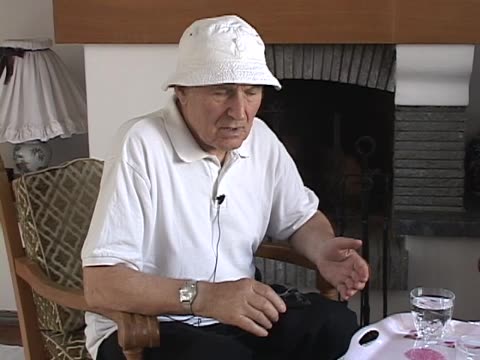
Pearl speaks about his life during World War II, specifically his escape from Tállya to Budapest, via Rátka by train in 1941. In Budapest, Pearl worked with machines at a military factory. Pearl then describes his life in Budapest.
From the machine transcript
Pearl tells how he left Tállya in 1941 for Budapest, travelling from nearby Rátka by train after a local incident involving the postman, the police and the rabbi (the details are unclear). In Budapest he worked repairing and installing machines and motors in a military-supervised factory. He says he knew from refugees arriving from Poland and Slovakia what the Germans intended. Kerler's questions fix the date as 1941.
The transcript adds an incident with the postman, the police and the rabbi, and his knowledge of events from refugees.
Pearl addresses his childhood memories, particularly games. He explains how to play nuts, before recalling a Hanukkah game.
From the machine transcript
Pearl answers Kerler's questions about his childhood games, football and a game played with nuts. He also recalls Hanukkah games, with the dreidel and cards, and says the children cast their own lead dreidels. He answers a question about Hanukkah food unclearly and turns to a Passover dish.
The transcript adds football and card playing, and the move from Hanukkah food to Passover.
Pearl speaks about holiday food customs. He describes how the Hassidic family Teitelbaum cooked a beetroot soup ("Tsibele") for the entire community for Passover.
From the machine transcript
Pearl describes the beetroot soup (tsibere) made for Passover. The Teitelbaum family, whom he says were relatives, cooked a large quantity for everyone, and families fetched it from them. Kerler asks about the dish, and they discuss the word for it and a related term.
The transcript adds the terminology discussion and his statement that the Teitelbaums were relatives.
Pearl addresses prewar Purim celebrations and shpiels, performed by children. He then recites a postwar Purim shpiel, sang in Romania.
From the machine transcript
Pearl speaks about Purim before the war, when families exchanged gifts of food and children performed a Purim play lasting about half an hour. He then recites a postwar Purim song sung in Romania, in which Stalin is praised and Germany's fall is celebrated. Kerler has him repeat it so he can record the words, and they discuss the Romanian words in it.
The transcript shows Kerler having the song repeated line by line to record it.
Pearl talks about contemporary religious customs and recites a prayer. The camera then collects footage of Pearl's apartment.
From the machine transcript
Pearl talks about present-day religious singing, mentioning a Sephardic prayer book and the Saturday-afternoon service. He recalls the night-long Simchat Torah celebrations of his youth. He also mentions that he will show the gravestones and a picture of the Belzer rebbe that he distributed. The camera then films his apartment.
The transcript adds the Belzer rebbe's picture and plans to show the gravestones.
Pearl shows a study on forced labor in the Bor copper mine, edited by Erhard Roy Wiehn. He then shows a photograph of himself, taken in 1941.
From the machine transcript
Pearl shows a study of forced labor in the Bor copper mine, published in both Hungarian and German, and discusses where it can be bought. He then shows a photograph of himself taken in 1941. He starts to tell how he was hired at a non-Jewish factory.
The transcript adds that the study exists in German and Hungarian editions and that he starts telling about a factory job.
Pearl describes his work at a factory in Budapest during the war. Pearl maintains that he never denied his Jewish identity. He then shows family photographs and speaks about his family. Pearl has relatives in America. Pearl also mentions his travels to Austria and Germany.
From the machine transcript
Pearl describes his job at a factory in Budapest during the war. He says he told the director and a young woman asking about his identity that he was a Jew, and was kept on. He shows gravestones and photographs of his parents and relatives, and mentions a grandchild and cousins in America. He says he visited America and attended congresses in Germany and France.
The transcript adds the encounter with the young woman and the director about his Jewish identity.
Pearl speaks about this life after the war and continues to show family photographs. He then talks about his family.
From the machine transcript
Pearl answers Kerler's question about speaking Yiddish after the war and shows photographs of his family, including a younger sister who did not return. Kerler asks to record the names of his siblings. The talk drifts into Hungarian with others and to Pearl's mother, who played piano and went to school in Košice. He shows a Yiddish Bible, the tsene-rene.
The transcript adds the mother's schooling in Košice and the Hungarian-language stretches.
Pearl talks about his copy of tsene-rene (Yiddish-language bible). He then speaks about his life in the forced labor camp and holiday celebration. Pearl also addresses how he survived on a daily basis.
From the machine transcript
Pearl talks about his copies of the tsene-rene and a prayer book that his grandfather owned. He found the prayer book in a synagogue after the family was taken to the ghetto, around Passover 1944. He recalls Yiddish speech, Sabbath prayer and Yom Kippur in a labor camp. He also describes how he made pots from scrap metal to survive, and he names grandparents.
The transcript adds the prayer book recovered after the deportation and the pots he made to buy food.
Pearl speaks about his family. He grew up with one brother and two sisters. Pearl's brother and sister live in France.
From the machine transcript
Pearl names his father's mother and speaks about his siblings, saying there were four children. His brother Zvi Hersh (Emil) lives in France, aged 85, and a sister lives in France. Another sister did not return from the camps. He then looks for the old books.
The transcript adds that his brother is 85 and lives in France.
Pearl shows his copy of the machzor (prayer book for the High Holidays of Rosh Hashanah and Yom Kippur), published in Vienna 1794. He then shows his copy of the tsene-rene.
From the machine transcript
Pearl shows a machzor published in Vienna in 1794 and says he found it. Kerler and Pearl look through a Hebrew text, and Kerler judges the age of another book, saying it dates from the end of the nineteenth century. They discuss other old books, and Pearl mentions that many families throw old prayer books away. He then shows his copy of the tsene-rene.
The transcript adds Kerler's dating of a second book and Pearl's remark about prayer books being thrown out.
Pearl speaks about his mother's observance. He recalls how his mother read the tsene-rene. Pearl then talks about his family, particularly his wife's work. Pearl raised a daughter and a son. He then speaks about his life today.
From the machine transcript
Pearl recalls that his mother read the tsene-rene on Sabbath afternoons and that his father's sister told the stories to the children. He speaks about his wife, who was a professor of analytical chemistry and wrote a monograph, and about his daughter, a physician. He mentions a recent health scare and says he is now better.
The transcript adds his wife's profession, his health, and the aunt who told the stories.
Pearl addresses his best moments during his childhood. He recalls family Sabbath celebrations. He then discusses the possibility of living in other countries and addresses the contemporary living conditions in Hungary.
From the machine transcript
Asked about the best time of his life, Pearl names his childhood, with family Sabbath meals and harmony at home until 1938. He did not want to emigrate despite an uncle in America; his son did leave. He says he is dissatisfied with the situation in Hungary today and with antisemitism, and he speaks about the wartime bombing of Budapest in 1944.
The transcript adds Pearl's views on emigration, his son living abroad and the political situation.
Pearl describes the first German bombing of Budapest in 1944 and the difficulty to find cover among locals due to antisemitism.
From the machine transcript
Pearl describes the first major bombing of Budapest in 1944. At the factory, a woman said the Jews were bringing the bombs and should not be allowed into the cellar, and he insisted that everyone go in. Otherwise he says he felt no antisemitism in the factory and was not afraid to say he was a Jew. Kerler then speaks Hungarian, and Pearl says he does not understand what is being asked.
The transcript adds the cellar dispute and Pearl's statement that he did not feel antisemitism at work.
Pearl answers dialectological questions from the AHEYM Yiddish linguistic questionnaire. He also addresses different regional Yiddish dialects and answers questions about cultural terminology.
From the machine transcript
Pearl answers questionnaire items on language. Kerler asks for the Yiddish words for "I believe" and for "cold" and "warm", and Pearl says how Yiddish differs from Hungarian Yiddish and from the speech of Lithuanian, Russian and Polish Jews. They discuss the terms goy, a farmer, a Yiddish phrase for trouble, and the difference between a rov and a rebbe. Kerler also asks about words such as dibbuk and golem, a rhyme and other cultural terms.
The transcript adds the discussion of Russian and Polish Jews' Yiddish and the rov–rebbe distinction.