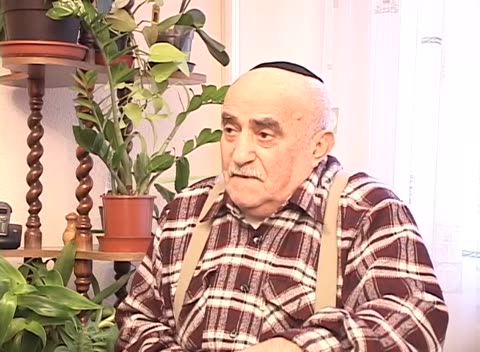
Blobshteyn provides personal information and addresses his childhood education. Blobshteyn attended a religious school (cheder) until the age of fourteen. He then did an apprenticeship in a clothing shop from 1937 to 1944.
From the machine transcript
Kerler notes the date, and Blobshteyn gives the Jewish calendar date and says he was born in Mukacheve in 1923. He lived in Mukacheve until the war. He attended cheder until fourteen, then was an apprentice and later journeyman in a clothing (confection) trade, from 1937 until 1944. He mentions that the Germans came in April 1944, the day before Passover, and that Jews were taken away the day after Passover.
Opens with the date and the Jewish calendar date, and mentions the arrival of the Germans.
Blobshteyn talks about his life during World War II, when Germany occupied Hungary in 1944. He explains how he was deported to NeuBanye 2:10, where he worked as forced laborer, building railway tracks for one year. Blobshteyn's parents and siblings were deported to Auschwitz. He was liberated in the Mauthausen concentration camp by the American army.
From the machine transcript
Blobshteyn describes being taken to a forced-labour site (the place name, which he says was in Romania, is unclear in the transcript). He and other young men born in 1923 built railway track for the Germans for about a year. He was liberated in Mauthausen in May 1945. The transcript does not clearly mention what happened to his parents and siblings in this passage.
The catalogue's sentence about his parents and siblings in Auschwitz is not clearly heard here; the place name of the work site is unclear.
Blobshteyn speaks about his life after the war. He returned from Mauthausen, via Prague, Bratislava and Pest to Mukacheve. Blobshteyn describes his short stay at a yeshiva in Pest. In Mukacheve, he reunited with his brother, who lives in America, as well as two sisters.
From the machine transcript
Blobshteyn recounts the return home from Mauthausen: first Prague, then by train via Pilsen and Bratislava to Pest. In Pest he prayed at a synagogue on Sabbath, and each returnee was given food, a place to sleep and money. In Mukacheve he met his brother, later in America, and the two sisters who had returned from Auschwitz. He then names a sister living in America, Feige Mermerstein, and says something about her husband.
Describes the stop in Pest as a synagogue visit with food and money; the yeshiva stay in the catalogue is not clearly heard.
Blobshteyn speaks about his siblings. He grew up with three brothers and three sisters.
From the machine transcript
Blobshteyn lists his siblings and their names and fates: seven children in the family, five of whom came home, two died in Auschwitz. Besides Feige (alive in America) there are brothers Wolf (Willy, died in America) and Naftali (died in Israel), and a sister Tsipre, who died in Mukacheve. The youngest brother was Berl, and another brother's Yiddish name he cannot recall. Kerler and Blobshteyn also discuss his own Hungarian and Hebrew names and double names.
Gives the siblings' names, their fates and name discussions, not only the number.
Blobshteyn talks about his family. His father was a kosher butcher and was born in Siltse. Blobshteyn's mother was born in Mukacheve. He then tells an episode of a cholera outbreak and burning of sick people during his mother's childhood.
From the machine transcript
Blobshteyn says his father David was a kosher butcher from Siltse, near Mukacheve, and his mother Sara Rivka a native of Mukacheve. His maternal grandfather came from Poland. He tells how his mother, in an earlier cholera outbreak, was said to have been hidden in an attic and sick people were burned alive, and how this gave her second name. He adds that his father, as a kosher butcher, depended on the rabbi, and that the family was large.
Names grandfather Itsik Leyb Fridman; the cholera story is told as family hearsay from the grandmother.
Blobshteyn speaks about Jewish life in Ukraine during the war.
From the machine transcript
Blobshteyn talks about Jewish families in the early 1940s, including a family with American relatives. Their journey to Kamianets-Podilskyi and a child's death in a car are mentioned. He recalls the 1941 roundup of Jews without Hungarian papers, including Polish ones, by Hungarian gendarmes, who deported them to Kamianets-Podilskyi, where they were shot. He notes a memorial there and a yearly commemoration.
Concerns the 1941 Kamianets-Podilskyi deportation and killings, and a memorial, not only 'Ukraine during the war'.
Blobshteyn speaks about his life after the war. When he returned, he began working as kosher butcher and stayed in this profession for fifty years. He moved to Budapest in 1992. Blobshteyn then addresses his childhood memories, including poverty and relations among Jews and non-Jews.
From the machine transcript
Blobshteyn says that after returning he worked as a butcher for fifty years under the Soviets in Mukacheve and then moved to Budapest in the early 1990s. He explains that Yiddish was spoken at home, Hungarian in the street, and Russian too. He describes childhood poverty, a mother who knew what was allowed to be given to Rusyn neighbors, and lack of pensions for Jews, and his father's difficulties under the Czechs.
Adds the languages spoken at home and in the street, and the poverty of the Jews.
Blobshteyn speaks about his family and Jewish life under Czechoslovak rule. His father joined the labor battalion of the Hungarian army in 1939.
From the machine transcript
Blobshteyn tells how his father, in Czechoslovak times, avoided army service because Sabbath would conflict with carrying arms, and how a friend who worked on Sabbath was in trouble. He recalls the Hungarian entry into Mukacheve and his father's call-up to a labour service in the 1940s. Blobshteyn mentions his own Russian, and Kerler and he discuss the Kleinbart family of Mukacheve and its members in America.
Adds Sabbath observance under the Czechs and the Kleinbart family; the year of the father's call-up is unclear.
Blobshteyn talks about postwar religious life in Mukacheve. He then talks about his education at the local cheder with his melamed (teacher) Friedman. Blobshteyn also attended a Russian school. He then describes his daily school routine, as well as holiday celebration, including Passover and Hanukkah, in cheder.
From the machine transcript
Blobshteyn compares postwar and present-day religious life (difficulty of getting a minyan) with the prewar cheder in Mukacheve, taught by a melamed named Fridman, with daily cheder and school hours and Hanukkah and Passover customs at cheder. Kerler asks about the languages of schooling; Blobshteyn says he attended a Russian school. Terms for the non-Jewish Christmas and New Year are also discussed.
Adds present-day minyan problems, the daily schedule and the Yiddish terms for non-Jewish holidays.
Blobshteyn talks about his childhood memories. He mentions that his mother followed rituals to diassociate her family from non-Jewish holidays.
From the machine transcript
Blobshteyn recalls his mother's practices on the non-Jewish New Year to ward off bad luck, such as placing a nail on the lard and keeping poultry shut in. He mentions the family's home slaughter of geese and the food made from liver. Kerler asks about the term for the non-Jewish New Year and Easter, and Blobshteyn recalls that the winters were snowy and cold.
Adds goose and liver food and the question about the term for non-Jewish Easter.
Blobshteyn addresses prewar Jewish life in Mukacheve. He recalls non-Jewish students in cheder. He then shares episodes from cheder routine and relationships between Jews and non-Jews.
From the machine transcript
Blobshteyn recalls prewar Jewish streets in Mukacheve, where Jews outnumbered non-Jews, and non-Jewish boys who attended cheder and whose mothers spoke Yiddish. He tells of summer lessons outdoors, the melamed napping, and boys bathing in the river Latorica. Kerler asks why non-Jewish children were in cheder, and the answer has to do with friendship. A non-Jewish neighbor and the tobacco factory are mentioned. Kerler starts a question about the father's shop.
Adds the bathing and the river Latorica, and non-Jewish neighbors' relations with the family.
Blobshteyn describes the work of kosher butchers in town. He then speaks about Rabbi Chaim Elazar Spira, who was his mohel, as well as prewar religious life. Blobshteyn describes collective matzo baking in town. He then speaks about contemporary religious life.
From the machine transcript
Blobshteyn describes the kosher butchers' courtyard with thirteen Jewish butchers under supervision, and Mukacheve's matzo baking in a dozen or so places with no machine matzo. He mentions the Rabbi Chaim Elazar Spira, his funds for the yeshiva, and a dispute over exemption of yeshiva students from military service, as well as contemporary religious life and the "Erlekh" fund (?). The English-language line and a loop at about 40:03 are recogniser noise.
Adds the butchers' courtyard, the yeshiva funding dispute and the military-exemption argument; the mohel detail is not clearly heard.
Blobshteyn addresses prewar Jewish life, including religious institutions. He then recalls the Rabbi Chaim Elazar Spira's son's wedding, as well as speaks about the Spira family.
From the machine transcript
Blobshteyn names the one yeshiva of Chaim Elazar (Spira) in Mukacheve, and bigger cheders, talmud torahs and a beis medrash, noting his late brother Wolf studied. He recalls the rebbe's son's wedding, when gendarmes beat him with rubber truncheons as he tried to run past. Kerler and he discuss Spira's family, including a daughter's daughter born on a ship, and grandchildren in Brooklyn and Williamsburg.
Adds the gendarmes' beating and the Spira descendants in New York.
Blobshteyn talks about the conditions of the cemetery in Mukacheve. He then talks about Rabbi Spira and addresses Jewish and non-Jewish relations. Blobshteyn then recalls other local religious figures.
From the machine transcript
Blobshteyn and Kerler discuss the old Jewish cemetery in Mukacheve, whose gravestones were destroyed or stolen after the war. Blobshteyn says the rebbe spoke only Yiddish and had a friendship with Czech president Masaryk. He tells of non-Jews who preferred to go to a rabbi (and not a non-Jewish authority) to settle disputes. The terms for a hasidic tsadik and an honest Jew are also discussed.
Adds Masaryk, non-Jews going to a rabbi, and the term for a righteous Jew.
Blobshteyn speaks about his life before the war. In particular, he describes journeys to Uzhhorod and Beregszász in order to watch soccer matches with friends.
From the machine transcript
Blobshteyn says he rarely left Mukacheve as a young man, but went by train or bus for football matches, to Uzhhorod and Berehove (Beregszász). Kerler and he discuss bus fares, kreuzers and the Czech crown, and Kerler asks about the Yiddish of Jews from smaller places who came to Mukacheve.
Adds bus fares and the word for the Czech crown.
Blobshteyn talks about Jewish communities in the surrounding villages. He then addresses food customs, including his mother's baking for Sabbath and fish dishes. Blobshteyn's family kept animals and therefore cooked meat during the week. Blobshteyn also mentions how his family obtained carp for the Sabbath meal.
From the machine transcript
Blobshteyn discusses Jews in surrounding villages (including the paternal village Siltse). His mother baked bread and cake for Sabbath and made plum pastries on Friday; the family ate meat in the week thanks to the father's trade and their own hens and cows. Kerler asks about dairy food, sour cream (smeyte), fish and herring, and Blobshteyn describes live carp from tanks and gefilte pike, and a Friday fish seller.
Adds poverty, herring, the sour cream term and Kerler's questions on Yiddish names.