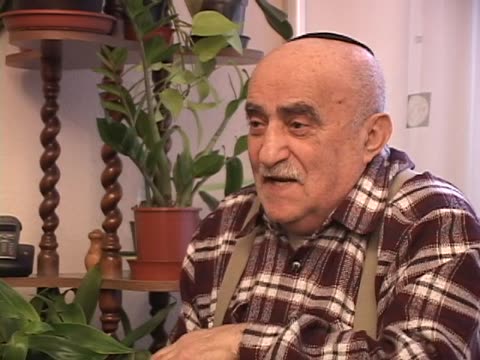
Opens with an exchange about Hungarian and Yiddish words, such as a term for the TV or a kind of drink (?), and the blessing after a meal. Blobshteyn then describes Hanukkah at home: goose, card games including twenty-one, dreidels, and gambling for money. He explains that children's study was forbidden on Hanukkah and on one other day of the year. Kerler's question about folk protection against the evil eye ends the passage.
opens with a short discussion of Yiddish versus Hungarian words, and mentions the ban on study
Blobshteyn addresses folk customs to avert the evil eye. He also discusses life during non-Jewish holidays. Blobshteyn remembers a non-Jewish local village idiot, who frequently came to a prayer house.
Blobshteyn describes remedies against the evil eye, including a red ribbon on children's wrists and sprinkling a child with water and charcoal. He discusses the 'bad year' and 'good year' and the nights of non-Jewish holidays, when Jews did not fear going out. He tells of a drunken non-Jew who made a disturbance in the klayzl (prayer house) one Friday night, was beaten and thrown out, and came on Monday to ask forgiveness. He ends by contrasting the hard-working boys of that time with those today.
the tale of the non-Jew in the klayzl is placed in the sequence of the evil-eye talk and non-Jewish holidays
Blobshteyn explains the name of a bread, apparently of Hungarian origin, and a dish eaten with it, with milk or fried onion, as food of the poor. Kerler asks about Hanukkah foods, and Blobshteyn names fried doughnut-like pancakes with jam, calling them by a name he says is Hungarian and Russian rather than Yiddish. They discuss whether the word has a k or a g. He says that turkey was eaten only at Purim.
Blobshteyn speaks about food customs on Purim and describes how he went to the rabbi to get the turkey blessed for the holiday. He then speaks about his mother's sewing, as well as spending Sabbath with family and neighbors.
Blobshteyn describes taking a live turkey with his brother to the rabbi to be blessed at Purim, and how his mother sold the turkeys after the holiday to buy shirts for the children. His mother sewed all the children's clothes on an old Singer machine. He describes Sabbath afternoons, when old women sat on benches in the street and talked, and says that girls also went to a special cheder taught by pious women. He recalls the decorative papercut (mizrekh) on the wall.
includes girls' cheder taught by women and the papercut decorations
Briefly discusses wall decorations in the home, including Purim items, papercuts and children's pictures, and the terms for Sabbath bread (challah versus barkhes). Blobshteyn then describes his father's place at the table and the respect given to him, including that no one sat in his seat.
the catalogue's 'cultural terminology' is limited to the term for challah
Blobshteyn recalls the Sabbath hymn he knew as a child and, at Kerler's request, tries to sing parts of it. He then sings Sabbath table songs (zemirot), with Kerler responding.
Blobshteyn speaks about prewar Purim celebrations. He describes how wealthier Jews went around with Romani musicians and performed Purim shpiels in the neighborhood in order to collect money. Blobshteyn then addresses food customs on Purim and then recalls Purim shpiels.
Blobshteyn describes Purim in his town: wealthier Jews went around with two Roma musicians and Purim players to collect money for matzo for the poor, while children went around with Purim plays and received small coins and sweets. He tells a story from his childhood about his mother hiding honey cakes and his taking the key. Kerler also asks about Purim plays, and Blobshteyn recalls the sung greetings and rewards.
includes a family story about honey cakes kept for Passover
Blobshteyn explains wedding customs: rich families held the wedding on Sunday, with a separate table for the poor and a jester (badkhn, 'gramer'). Two Roma musicians played at the chuppah. He then describes preparing for Passover: sewing and cleaning, making beet borscht in a large barrel, the matzo baking and cooking, and eggs. He mentions egg dishes, pickles and the Yiddish word for them.
Blobshteyn describes Sabbath food customs and then dishes in general. He also shares childhood memories of eating and drinking customs. In particular, he recalls how his religious tutor ate garlic.
Blobshteyn lists Sabbath foods, such as cholent with stuffed stomach kugel, and explains where cholent was kept at the baker's. He describes the Jewish street where he lived and typical foods, including fish, cholent, kugel, a dish called refenik (?) and plain dumplings. He tells how the religious tutor ate with his family on certain days of the week, and discusses brandy and a Passover drink called slivovitz and its kashrut. He mentions wine at Passover.
extends to brandy and wine on Sabbath and Passover
Blobshteyn addresses the prewar celebrations of Hoshana Rabbah and Simchat Torah. He then explains when children played nuts and also mentions other games.
Blobshteyn recalls Hoshana Rabbah and Simchat Torah: going to morning prayers, the hakafot with dancing, and the sale of honors for money. He then explains games children played with nuts at Passover and Sukkot, and mentions stealing nuts and a game with a spinning top.
Blobshteyn speaks about his education, specifically religious education with a private tutor and in cheder. He then speaks about childhood pranks on Tisha B'Av.
Blobshteyn talks about his religious education: the tutor in the 1930s and cheder, long hours in summer, and prayers recited without understanding the Hebrew. He says that the village melamed was chosen for being healthy and strong. Kerler asks about Tisha B'Av, and Blobshteyn explains that children threw burrs at girls' hair and beards, and a boy with long hair might have to have it cut.
Asked about a song on the coming of the Messiah, Blobshteyn says he cannot recall it and mentions the Hungarian song 'Szól a kakas már', associated with the Kolever rebbe. Kerler asks about a secret language used so that others would not understand, and Blobshteyn tells of a servant girl who knew Yiddish. They discuss mame-loshn as a name for Yiddish, and Kerler asks about non-Jews who became Jews.
covers a servant girl who understood Yiddish and the term mame-loshn
Blobshteyn speaks about prewar life and recalls non-Jews who converted. He then addresses postwar religious life and state persecution. Blobshteyn recalls interruptions of High Holiday services and mentions his friend, a chief police officer, who warned the community before planned antireligious activities.
Blobshteyn explains the word for a disturbance (krivaln?) and a story about a Jewish girl who left with a non-Jew, and talks about fire brigades and Jewish work on Saturday. He then speaks of religious life under the Soviets: synagogues taken, Yom Kippur services broken up, and fear of arrest. He says that his friend, the chief of the militia, warned him about planned antireligious actions, and that he was able to buy flats for his two children.
Blobshteyn talks about working as a kosher butcher after the war. He bought meat from a slaughterhouse chief who paid in a share, and he split it with two partners. He recalls another Jew who bought a calf and brought a shoykhet, was caught and sentenced to prison, and speaks about a Jewish family who lived opposite and later emigrated to Los Angeles.
Blobshteyn talks about his sister's husband, a famous wedding jester (badkhn) from Munkács who worked across America, his sister Feyge (Fayga) in Brooklyn, and her age and return home from the camp. He shows a family photograph with her sons and son-in-law. He tells about his own descendants, including a great-grandson who is seriously ill, and a visit to find a mother's gravestone near Solotvina.
identifies the brother-in-law as a badkhn and adds the photograph
Kerler asks Blobshteyn terminology questions, such as the plural of rabbi and rebbetsin, and forms of address for a rabbi. They also discuss 'Litvak', and Blobshteyn tells a story about travelling to America, where he met a Hungarian-speaking Jew in a restaurant and discussed food. It ends with food and drink words.