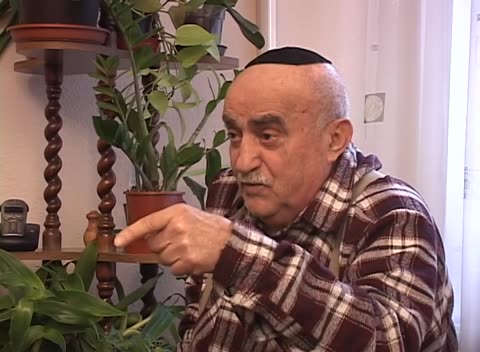
Blobshteyn tells of a trip to America to see relatives. The passage includes his religiously observant sister, a visit to a relative named Mermershteyn (?), and a Sabbath with his brother after about fifty years apart. He also tells of a young man sent from America to Lithuania who ate non-kosher food. Kerler asks what Hungarians and Russians were called in Yiddish and whether Ukrainians had a name, and Blobshteyn answers. He then begins on the emigration of Jews from Mukacheve and Torah scrolls being taken away.
Also includes a Kerler question about names for Hungarians, Russians and Ukrainians in Yiddish, and the start of the story about the Torah scrolls.
Blobstheyn addresses Jewish life in the 1970s, when Jews from Mukacheve prepared emigration. He then answers questions about dialectology and cultural terminology.
Blobshteyn describes how, in the 1970s, Jews leaving Mukacheve for America sold Torah scrolls. Only one poor scroll was left, and he criticises the Jewish traders who sold them. Kerler then asks about words such as 'to pack' meaning to deceive, a Russian-derived word for a trick, and words for a trickster, which Blobshteyn explains. Kerler also asks about kosher meat.
The catalogue's 1970s emigration topic is confirmed; the passage mainly concerns the sale of Torah scrolls and word meanings.
Blobshteyn recalls working as a kosher butcher after the war. A Jewish woman once bought meat that turned out to be treyf, and the episode shows how the sale was handled. He mentions that he went to pray every Sabbath. He then talks about his sister and brother-in-law, who lived in Mukacheve, and of the dwindling number of Jews after the war, and says he is now losing his sight. Kerler adds remarks about a planned visit to see him and about phone calls between them.
Also covers a sister and brother-in-law who stayed in Mukacheve, Blobshteyn's failing eyesight and Kerler's planned visit.
Blobshteyn explains several terms (golem, a non-Jewish house of worship, dybbuk) in answer to Kerler's questions. He goes on to compare Christian and Jewish teaching, including the weekly Torah reading and Sunday services. They then discuss the Christian claim to be the true Jews and the origin of the Arabs. Blobshteyn also recalls a Jewish butcher who was denounced and imprisoned, and a village man he knew as a child.
Adds a long discussion of Christianity, Abraham and the Arabs and a story about a denounced Jewish butcher, in addition to the terminology questions.
Blobshteyn speaks about prewar religious customs. He then shares a family episode, where his father, uncle, cousin and he went to see a rebbe in Keretsky to find help for his cousin. Blobshteyn explains that the rebbe cut his cousin's hair and he was able to walk out of the religious school (cheder) building afterward.
Blobshteyn recalls a rebbe in a village called Keretski (?) near Svalyava, to whom they took a sick boy, a cousin of his, along with his father and uncle. The rebbe had the child stand up and walk and, after three weeks, cut his hair so that he could go to cheder. He then describes Svalyava, where a cemetery lies on a hill and almost no Jews remain; two were left, one of whom died and the other left for Israel. Kerler asks for a further story or a song, and Blobshteyn says he remembers nothing and gives a brief remark on Hasidim and the rebbe.
Adds a description of Svalyava and its cemetery today, and Kerler's request for a song.
Blobshteyn recalls Yiddish songs from his childhood, as well as speaks about contemporary Sukkot celebrations in America. He then remembers Simchat Torah celebration in prewar Mukacheve.
Blobshteyn says he does not remember any songs, after Kerler asks. He describes lively dancing at Sukkot among pious Jews in America, where he has many friends. He recalls Simchat Torah in Mukacheve, where they formed circles and danced with three or four Torah scrolls while many children danced. Kerler then asks about a Yiddish periodical from Moscow.
Adds that the passage opens with Kerler's question about Zionist-youth activity in an attic and ends with the start of the question about Yiddish periodicals.
Blobshteyn talks about a journal and a newspaper in Mukacheve, saying there was a Yiddish one and that they mostly read Hungarian papers. They also discuss whether any Yiddish periodical appeared after the war. He then describes owning television sets in the 1960s, when he worked in an organization he calls Vinterak (?), and having three rooms. Kerler thanks him at the end of the visit.
Adds television and the owning of sets in the 1960s, and the closing thanks, to the press topic.