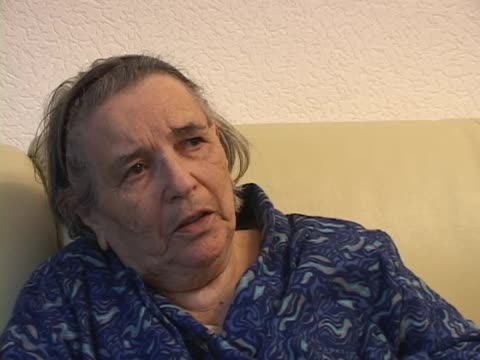
The team concludes the interview with Mester and the camera cuts to the interview with Tkach. She provides personal information and speaks about her family. Tkach's father was a musician and played the fidel, as well as conducted an orchestra until 1938.
From the machine transcript
After the questionnaire, Kerler states the date and place and begins the interview with Tkach in Chișinău. She gives her Yiddish name, her maiden name Berikhman and her parents' names. She was born in Lozova and was a small girl before 1938. Her father was a fiddler and conductor who studied at the conservatory and led his own orchestra. Her paternal grandmother had a house in Chișinău.
adds her parents' names, her year of birth and her grandfather's lazy name, which the catalogue lacks
Tkach speaks about her studies and work. She graduated from the Musicology Department of the Chişinău Conservatory in composition in 1952 and then pursued graduate studies in Moscow. She then returned to Chişinău to teach at the Conservatory. Tkatch then discusses her childhood memories of Lozova, as well as her family.
From the machine transcript
Tkach says she studied composition at the conservatory in Chișinău, did graduate study in Moscow, and returned to Chișinău. She recalls Lozova, where the family lived in a small house with a front porch and hemp grew nearby. She speaks of her grandmother, her grandfather's death and Passover, when she was taught the four questions.
Tkach addresses her family's obervance and then recalls Passover celebrations at home. She also speaks about holiday food customs. Tkach then speaks about her family. Tkach's mother was a homemaker and her father played several instruments.
From the machine transcript
Tkach describes how her family kept the holidays, including Passover with matzo and Purim with sweets. Her mother did not work and had a beautiful soprano voice. Her father worked hard and played several instruments, and was at the front during the war.
Tkach speaks about her family's life during World War II. She was evacuated with her mother to Namangan, Uzbekistan. She also addresses her father's work assignments. Tkach's family returned to Chişinău in 1945.
From the machine transcript
Tkach recalls the wartime evacuation to Namangan in Uzbekistan, where her father taught at a college of music from Moscow. He was urged to move to Moscow but chose to return to Moldova, and the family went back in 1945. She cannot remember the Yiddish songs her mother sang, and she remembers the war years as very hard.
Tkach speaks about her family and how her father taught her how to play fiddle and piano. She then speaks about her life and education after the war. Tkach also speaks about her work and Soviet Jewish colleagues. She states that she began composing Jewish music in 1989 and has written more than forty pieces of different genres.
From the machine transcript
Tkach says her father taught her violin and piano. She describes finishing school and the conservatory after the family returned, her composing and her contacts with composers across the Soviet Union. She began writing Jewish music in 1989, at the time of perestroika, for a singer who now lives in America. She says she has written dozens of Jewish songs, three pieces called Kaddish, a one-act opera and romances to poems by Moshe Lemster. The talk touches on the composers Weinberg and Shostakovich.
adds her work with other composers, her three Kaddish settings and her opera
Tkach addresses food customs and dishes. She then speaks about life after the war and recalls poverty among people until 1950. Tkach also describes the living conditions.
From the machine transcript
Tkach names Jewish dishes she makes, such as gefilte fish and kugel, learned from her mother. She describes hunger and hardship in Chișinău after the war until about 1950, queuing at night for bread. The family found their house destroyed and lived in a shed; she was given a flat only in 1970. Her father played classical music, and she does not remember Jewish music at home.
adds her late flat allocation and her mother's death
Tkach speaks about her family. In particular, she addresses her father's work. She then talks about postwar Klezmer music and differentiates between Moldovan and Jewish music.
From the machine transcript
Tkach is asked what Jewish music she first heard, naming instrumental pieces and a klezmer musician from Chișinău who later lived in Israel. She discusses how Moldovan and Jewish music are similar but not the same, with the doina and freylekhs as examples. Questions also cover Gypsy and Moldovan musicians, a Chișinău businessman and writer, and the music of Israel, Gershwin and Soviet composers.
adds the comparison of Jewish and Moldovan music and the talk of Gershwin and others