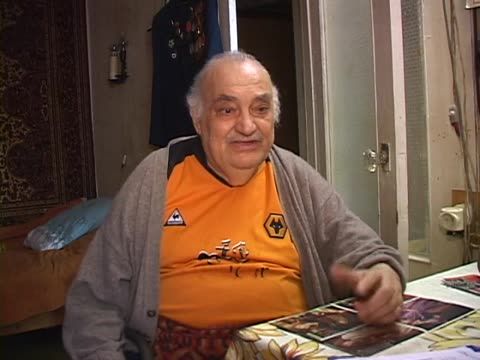
Fershtman provides personal information and talks about his family. They moved to Odesa when Fershtman was thirteen years old. Fershtman's father was also born in Pishchanka and worked as accountant in an artel. His mother was born in Kodema, Ukraine, and was already married once before. Fershtman grew up with two half-brothers and two brothers.
From the machine transcript
Fershtman gives personal information: the origin of his Russian patronymic and name Mikhail, his birth in Pishchanka, and the family's move to Odesa at about thirteen. He talks about his father, who was from Pishchanka and worked as an accountant in an artel. His mother was from Kodema (?), a housewife, whose first husband was killed by Petliurists. He describes his half-brothers and brothers, several of whom did not return from the front.
Details the siblings' fates and the first husband's killing by Petliurists.
Fershtman speaks about his life before the war. He recalls great poverty in his family during the Great Hunger in 1932/33. Fershtman attended a Yiddish school for six years. He then addresses his life in Odesa, where he also studied at a Yiddish professional school and graduated in 1940. He states that the school was run in Yiddish until 1938, before the official language was switched to Russian (38:00). Fershtman learned at the turnery department.
From the machine transcript
Fershtman recalls childhood in Pishchanka until the age of thirteen, including hardship and the great hunger of the early 1930s. He describes attending a Yiddish school there, then moving to Odesa and studying at a vocational school (Evrabmol (?)) as a turner and miller, graduating in 1940. He says teaching was in Yiddish at first and then switched to Russian, and the two interviewers briefly discuss the Yiddish terms for machine tools.
Includes the terminology of the machine trade and the Russian switch in the school.
Fershtman addresses his Yiddish school education in Pishchanka. He also mentions a Yiddish proverb and lists Yiddish literature he read.
From the machine transcript
Fershtman describes the Yiddish school in Pishchanka: all subjects, including mathematics, were taught in Yiddish alongside German and Ukrainian, and he names a teacher called Rabinovich. He and the interviewers discuss Yiddish and Ukrainian literature he studied, naming Sholem Aleichem, Mendele, Peretz and others, and he briefly tries a Yiddish saying. He says he can no longer read Yiddish. The passage ends with a question about his bar mitzvah.
Adds Rabinovich the teacher and the literature he learned, and a Yiddish saying.
Fershtman speaks about Jewish life in Pishchanka before the war. He also remembers his childhood friends and languages of communication. Fershtman then talks about his family.
From the machine transcript
Fershtman talks about Pishchanka before the war, including its schools, the many Jews there and the Jewish head of the village soviet, a tailor. He recalls speaking only Yiddish with childhood friends until the move to Odesa, and then losing his Yiddish after switching to Russian. He says he does not remember his grandparents, and that neighbours called him by a patronymic formula. He also gives some Yiddish sayings.
Adds the languages he spoke and the Jewish head of the village soviet.
Fershtman addresses life before the war and recalls non-Jews who spoke Yiddish. He then describes childhood games.
From the machine transcript
Fershtman is asked about non-Jews who spoke Yiddish, and his answer is unclear in the transcript. He then recalls children's games in Pishchanka, such as running and fighting games, and tries a counting-out rhyme. The passage ends with the start of a question about holidays at home.
Adds the children's games and counting-out rhyme.
Fershtman speaks about prewar holiday celebration at home. He again addresses his education at the Yiddish school and also talks about prewar religious life. Fershtman mentions his relative Berl Fershtman, a local Yiddish writer.
From the machine transcript
Fershtman describes holidays at home before the war, including Sabbath, Passover and separate dishes for milk and meat. He talks about attending school on Sabbath or Sunday (he is unsure), going to the synagogue and kapores, and not having been taught to pray or recite blessings. He mentions that his relative Berl Fershtman wrote in Yiddish and studied in Odesa, and the interviewers suggest looking for his publications.
Adds the writer relative Berl Fershtman and religious observance.
Fershtman speaks about prewar cultural life, including Yiddish press and library. He then returns to prewar holiday celebration, including Sukkot and Purim.
From the machine transcript
Fershtman speaks about prewar culture in Pishchanka, including a Yiddish newspaper and library with books by Mendele and Peretz, which he borrowed. The talk then turns to Sukkot, with a sukkah, and to Purim, including sending gifts to relatives. A brief exchange about a person named Berl or Moshe follows.
Adds Sukkot and Purim customs and the gift-giving.
Fershtman speaks about his family and recalls songs from his childhood. He then speaks about his life in Odesa, including school education.
From the machine transcript
Fershtman is asked about songs his mother sang; he recalls only Ukrainian songs recorded on a tape recorder and no Yiddish ones. He then speaks about Odesa after 1938, where the language of school and daily life moved to Russian even in the vocational school. He mentions that there was a Yiddish theater in Odesa.
Adds the shift from Yiddish to Russian in Odesa.
Fershtman speaks about prewar cultural life in Odesa, including the Yiddish theater, where his cousin worked.
From the machine transcript
Fershtman speaks about the Yiddish theater in Odesa, where his cousin Polina Osievich (?) worked as an actress or singer. He recalls few details of what she performed. He also answers questions about the newspapers he read in Odesa and about his work at the factory.
Adds the cousin Polina and the newspapers he read.
Fershtman talks about his life in prewar Odesa. He worked at a 44:44 factory. Fershtman then talks about his life during World War II. He evacuated to Central Asia in 1941.
From the machine transcript
Fershtman talks about working life in Odesa as a young man and then about the war: his older brother brought a certificate, and they left by ship in 1941 for the evacuation. A passage of side talk between the interviewers follows, and the interviewer asks him to continue about the evacuation.
Fershtman talks about his life during the war in Khujand (formerly: Leninabad, Tajikistan). He worked as electrician at a theater until his military draft in December 1942. Fershtman was trained as tanker until 1944 and went with a tank battalion to the front in 1945. He then describes his battles and mentions his military awards. Fershtman finished the war in Kumbino.
From the machine transcript
Fershtman describes the war: evacuation to Leninabad in Tajikistan, work as an electrician at a Tajik theater, and being drafted into the army in December 1942. He trained as a tank driver, received tanks in 1944 and went to the front in East Prussia, where he says he was shot at three times. He mentions medals and finishing the war around Gumbinnen (?), and the interviewer begins to ask when he came to Chișinău.
Adds the front in East Prussia and the question about Chișinău.
Fershtman talks about his life after the war. He continued his military training in Odesa and Floreşti. Fershtman moved to Chișinău in 1956 after his military service. He then worked at a factory from 1958 until his retirement in 1991. Fershtman also mentions traveling abroad.
From the machine transcript
Fershtman describes postwar service: he was called up again and trained at courses in Odesa. He was a tank platoon commander in Florești and then at a tank regiment in Chișinău, and stayed there from 1956. He worked at a factory (instrument-making) until retirement in 1991. He says he has had no one to speak Yiddish with, mentions veteran status, and travel abroad to Finland, Germany and Bulgaria, as the best times of his life.
Adds Yiddish isolation in Chișinău and his trips abroad.
Fershtman speaks about his life today.
From the machine transcript
Lemster asks about Odessa anecdotes, which Fershtman does not recall; the talk turns to a cassette of his mother's songs held by a relative, which Lemster offers to copy. Fershtman then speaks about his health and life today: a prostate operation in 2005, an eye operation, back and limb problems, expensive medicines, and difficulty walking alone.
Adds the cassette with his mother's songs.
Fershtman talks about his life before the war.
From the machine transcript
Lemster asks about Odesa humour and what Odesa youths did. Fershtman says that this had gone with the old days, and that he lived in Odesa only until 1941. He briefly mentions his years at the front and in Moldova and the interview ends with thanks.
Adds the closing remarks and thanks.
The camera records Fershtman's military awards.