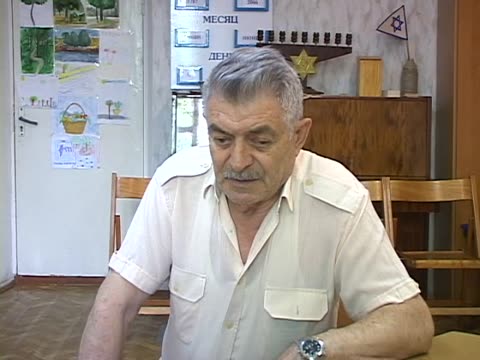
Butorski provides personal information.
From the machine transcript
Butorski says he was born in Bender, which was then called Tighina, and that he is registered in his passport as Boris, with the surname Butorski. He confirms that he lives in Bender.
Butorski provides personal information and talks about his family. His father was a painter and then owned a hotel, because his vision began to fade before the war. Butorski grew up with a brother, who lives in Israel. Butorski mentions that he lived in Israel for nine years. After the war, he attended a hairdresser vocational school and then learned to be a cutter at a supplier. He worked there until 1967. Before his retirement, he worked at a 5:36 technicum.
From the machine transcript
Butorski gives his Yiddish name Berl and his birth date in 1930, then speaks about his parents and grandparents. His father Shmuel was a painter, and when his sight failed he kept an inn in Bender until it was taken from the family in 1941. His mother was a housewife, and he names his grandparents. He has one brother, who lives in Israel, and Butorski himself lived there nine years. After the war he trained as a barber and later as a cutter, and he worked in a technical workshop until retirement.
names his mother and grandparents; the inn was taken in 1941 and the family was moved to another street
Butorski discusses his childhood memories, including his mother's cooking. He also addresses holiday celebration. He attended a Romanian school for four years. His father hired a private religious tutor, who taught Butorski at home.
From the machine transcript
Asked about his childhood, Butorski recalls the stove and hearth where his mother prepared the meal and the table, and her blessing of candles. He remembers his father going to synagogue on holidays and waiting to be last when donations were made. He attended Romanian school for four years, with no Yiddish teaching. At home a teacher, not called a rebbe or melamed, taught him and his brother a little Yiddish. He mentions that he later spent nine years in Israel.
the hearth and his father's synagogue habits; the house teacher taught Yiddish
Butorski talks about his family, as well as holiday celebration.
From the machine transcript
Butorski remembers his brother's bar mitzvah, when he first put on tefillin, as a holiday in the house. He describes the ceremony in the synagogue, the small treat of brandy and a bit of food afterwards, and the family gathering. He also recalls children playing with nuts on holidays.
the bar mitzvah celebration and children's nut games
Butorski addresses prewar Jewish life in Tighina. There were fifteen synagogues in town, according to him.
From the machine transcript
Asked about the Jewish street, Butorski says Bender was largely Jewish, with some eighty percent Jews among about thirty-two thousand people before the war. He says there were some fifteen synagogues in town, one on his own street, and that some were later turned into schools. He mentions a Jewish school and a talmud torah.
the population figures and the synagogues turned into schools
Butorski discusses his childhood memories and mentions his childhood friends. He then talks about holiday celebration, including Sabbath and food customs. He shares his mother's recipe for gefilte fish.
From the machine transcript
Butorski says his childhood friends were Jewish children and that he was in a Soviet school, not a Yiddish one. He recalls Sabbath at home with candle-lighting and the food his mother cooked, including gefilte fish and chopped herring. He gives her gefilte fish recipe in detail, then speaks of other dishes such as cholent, kugel and kishke, and compares her cooking with his wife's.
gefilte fish recipe and other Sabbath dishes
Butorski talks about his family. He recalls how his aunt sang Yiddish song. Butorski's mother moved to Israel before 1991 and he visited her in 1988. He also addresses holiday celebration, including Passover and Purim.
From the machine transcript
Butorski says his mother did not sing, but an aunt sang Yiddish songs. He recalls his mother's later life in Israel, which he visited in 1988. He speaks about Hanukkah, Rosh Hashanah and his role at the Passover seder, and about Purim treats and singing at home, but he does not recall masked Purim players.
Hanukkah and Rosh Hashanah, and the Passover questions
Butorski talks about life before the war. He recalls a Christian friend who converted to Judaism for his wife. Butorski also discusses sport clubs.
From the machine transcript
Answering Lemster, Butorski recalls a Russian baker friend who married a Jewish woman, converted, and spoke Yiddish. He says he knows of no Jewish organizations or parties before the war, only the Maccabi sport club, and he recalls no Jewish theater or libraries.
Maccabi sport club and the question of Jewish organizations
Butorski talks about his life during World War II. He describes how his family went into evacuation. His father organized a horse and wagon and they drove to Tiraspol, where they stayed for two or three days. Butorski continues that his family hid in train cars underneath cow fur and was headed to the Rostov province. He explains how they lived in a house, which previously Germans inhabited, for three months. Butorski's family evacuated further to Stalingrad, where they lived until the end of 1941; before evacuating further to Makhachkala, Russia; Baku, Azerbaijan, (where they stayed for one month); Türkmenbaşy (Krasnovodsk), Turkmenistan; Tashkent, Kyrgyzstan; and Pavlodar province. In the Pavlodar province, his family worked on a kolkhoz. Butorski worked the field between the end of 1942 and 1944. He states that his family returned from evacuation in 1944.
From the machine transcript
Butorski recounts the evacuation from Bender in 1941. His father hired a wagon and the family went to Tiraspol, then by open railway cars to the Rostov region and Stalingrad, where he worked on a tractor team. From there they went to Makhachkala, Baku, Krasnovodsk and Tashkent and ended on a kolkhoz in the Pavlodar region. He describes his work in the fields and fishing, and says he returned in October 1944.
details of stops on the route and fishing on the kolkhoz
Butorski talks about his return to Tighina in 1944. His family moved into his grandfather's house and his father fixed it up. He then explains how Butorski's grandfather died during evacuation and his father returned to Odesa with him on a horse and wagon in order to bury him there.
From the machine transcript
Butorski says that on return the family had no house of their own and moved into his grandfather's house, which his father repaired. His grandfather died in Rozalne (?) during the evacuation, and his father took him to Odesa, where he was briefly suspected of being a spy, and buried him. His grandmother later died in evacuation.
Butorski talks about his life after the war. Instead of finishing his school education, Butorski was an apprentice at a hairdresser artel for five/six months and then learned to be a cutter at a shoe factory in 1946. Butorski served in the military between 1950 and 1953. After his military service, Butorski joined the shoe factory 40:33 again and worked there until 1976. Until his retirement, he worked as a 40:40 technician. He moved to Israel in 1995, where he and his wife lived for nine years. Butorski then explains why he returned to Moldova. He raised three sons; two live in Israel and one lives in Canada.
From the machine transcript
Butorski tells of his life after the war. His schooling was interrupted, he worked briefly at a hairdresser's workshop and then learned cutting in a shoe factory in 1946. After army service in the early 1950s he returned to the factory and later worked in a repair-technical workshop until retirement. He went to Israel in 1995 with his wife and lived there nine years. His wife died there after operations, and he returned to Moldova. He has three sons, two in Israel and one in Canada, and he visited Canada.
his wife's death in Israel and his stay in Canada with a son
Butorski talks about life today. He then answers questions about cultural terminology and talks about his family.
From the machine transcript
Butorski speaks of his present life, living alone and with two sons abroad. Lemster asks about the meaning of several Yiddish terms, such as dybbuk, golem, 'a good Jew', Litvak and Polish Jews. Butorski mentions his father's grave and relatives in Poland and America. He also says he now speaks Yiddish at home and in a small group of ten people, and that he spoke only Yiddish with his family earlier.
the terminology questions and relatives in Poland and America
Butorski discusses traditional weddings. He recalls his brother's wedding in 1946 and performances by Sidi Tal.
From the machine transcript
Butorski talks about Jewish weddings in Bender: the chuppah, the groom singing in the synagogue, and the music and dancing. He recalls his brother's wedding in 1946 and a Jewish woman performer who came to sing, whose name is garbled in the transcript. He also mentions matchmakers and says he was once a matchmaker at a wedding.
the matchmaker question
Butorski talks about life today and then answers dialectological questions from the AHEYM Yiddish questionnaire.
From the machine transcript
Butorski says he cannot remember what his parents told him, and asks Lemster not to press him about the years before 1941. Lemster then asks dialectological questions about words such as the Yiddish for 'winter', 'field' and 'holy place', and about 'cemetery'.