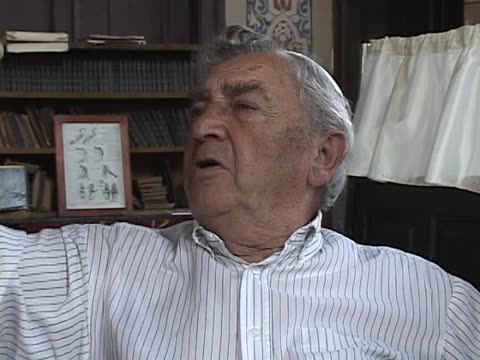
People › Lazar (Moshe-Leyzer) Freund › conversation

Lazar (Moshe-Leyzer) Freund

Oradea 5 June 2007 Interviewed by Dov-Ber Kerler, Moisei Lemster 25 min · 1 part on 1 tape two sources agree
Loading the player…
  1. MDV 289 9:26–34:11 · 25 min · archive.org · a part of the tape
Passages

9:26

The formal interview with Lazar Freund begins. He provides personal information and speaks about his family. His father was born near Sighetu Marmației and was a tailor. Freund grew up with one brother, who died in Auschwitz.

From the machine transcript

Freund answers whether the town's old name had a Yiddish form, mentioning the word for a mine, and then gives his name, Yiddish name Moshe-Leyzer, and birthplace. He says he lived in Baia Mare until the war. He gives his father's name (Barukh Bendit), his father's birth year and his father's origin near Sighet, and says he was a tailor. He gives his mother's maiden name and first name (Perl) and her birth year (1898), and says he had one brother, who died in Auschwitz. He recalls one grandfather, his mother's father. Lemster also explains the project to him.

Adds mother's name and the explanation of the project and the interviewee's need to leave for the doctor.

14:44

Freund addresses different Yiddish dialects. He then discusses his childhood memories. He attended a Jewish school in Oradea and attended a cheder and Talmud Torah school in Baia Mare.

From the machine transcript

Freund compares the Yiddish of Transylvania, Maramureș and Moldavia, tying differences to Austro-Hungarian influence, and mentions rebbes. He recalls attending school and cheder, and the Jewish lyceum in Oradea after the war (1944–45?). He says Hungarian was spoken at home, though both parents knew Yiddish. He says his father took him to prayer from age five and studied in Talmud Torah, and that his father was not a hasid.

Adds the dialect comparison and language use at home, and his father's attitude to hasidic rebbes.

18:45

Freund speaks about prewar life in Baia Mare. He then briefly addresses Purim celebrations, before talking about his life during World War II. He was a forced laborer in 20:01 and returned to Oredea in 1947. Freund got married in 1952 and does not have any children.

From the machine transcript

Freund says there were no Yiddish speakers among non-Jews in Baia Mare, and that he spoke Hungarian with friends and Yiddish only in cheder. He briefly says he took part in Purim plays as a child. He was deported in 1944 and put to forced labor, returning in 1947; he married in 1952 and has no children. He says Hungarian is mostly spoken in Transylvania, with some Romanian, and that Romanians object to this.

Adds language use among friends and with non-Jews, and the Hungarian–Romanian language debate.

21:17

Freund addresses Purim and Sabbath celebrations, in particular zemirot.

From the machine transcript

Freund says he cannot recall Purim play pieces. He talks about his father singing Sabbath songs (zemirot) while sewing at home. He says his mother baked challah for Friday night and that Sabbath was observed strictly. He did not attend Jewish weddings before his deportation, and there are no weddings or circumcisions among Jews there now.

Adds challah and Sabbath meal customs and the absence of weddings and circumcisions today.

24:00

Freund briefly speaks about his life after the war. He worked as an accountant. He also answers questions about cultural terminology.

Questionnaire after the war Work and tradesCultural terminology MDV 289 · MCO
From the machine transcript

Freund briefly says he worked as an accountant after the war, including in the Ceaușescu period. He answers terminology questions: the Yiddish name of the town (Gros-Wardein, i.e. Grosswardein-type form), the word dibbuk, which he knew from a Yiddish theater performance by a Bucharest troupe visiting after the war, and the word golem.

Adds the dibbuk and golem questions and the Yiddish theater visits to Romania.

26:04

Freund speaks about his religious education and prewar Jewish life in Baia Mare. He then addresses holiday celebration before and after the war. Freund also talks about postwar circumcision until the 1960s.

From the machine transcript

Freund says he studied Chumash, Rashi and other texts in cheder, not yeshiva, and talks about prewar Jewish life in Baia Mare: about 22,000 inhabitants then, about 2,000 Jews, and one large synagogue plus a Sephardic-style study house. He says he still keeps holidays strictly. He says that until about 1960 Jews circumcised their boys, after which it decreased because parents no longer taught their children Jewishness.

Adds Jewish population figures, synagogue and rabbi, and postwar decline of circumcision.

29:20

Freund speaks about contemporary Jewish life and Jews who made aliyah.

From the machine transcript

Freund talks about the Jewish community today: 765 registered members but only about 300 real Jews, many of mixed marriage. He answers Lemster that many left for Israel after the war, mainly because of the communist and socialist regime, whereas few emigrated before the war. He then says he has to leave.

Adds reasons for emigration to Israel after the war.

31:16

Freund speaks about prewar Jewish life and institutions in Baia Mare.

From the machine transcript

Freund responds to Kerler's request to describe prewar Jewish life in his town: it was a beautiful life in which people helped each other. He lists institutions: a synagogue, rabbi, judge, two slaughterers, a cheder with a teacher, a Talmud Torah, a mikveh with bathhouse, and no yeshiva (the nearest was in Sighet or Satu Mare). He says difficulties came with the antisemitic regulations.

32:44

Freund answers dialectological questions from the AHEYM Yiddish linguistic questionnaire.

From the machine transcript

Freund answers a few questions on Yiddish forms: the second-person pronoun and verb forms 'you come', a short sentence about a coachman and an angel, and the word for tooth. Kerler thanks the host, and Lemster and Freund close the interview.