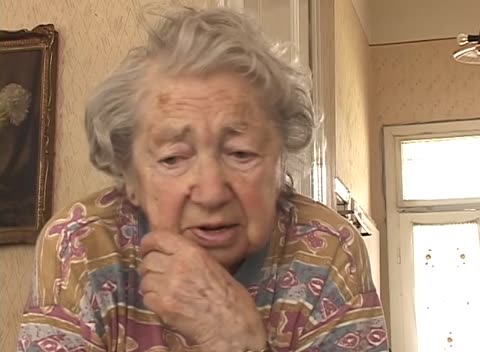
The chat moves outside and Mehler speaks about her family. Her grandson lives in Australia and she also has relatives in America. The camera then collects footage of Vatra Dornei on the way to the next interview with Bercovici.
From the machine transcript
Outside, Mehler talks about her family, mostly in garbled speech. A grandson is in Australia and she has family in America. She explains in Romanian why she does not move abroad: she does not know the language, has no pension from there, and has her daily occupation. The team then talks in Russian and Yiddish about finding the route to Bercovici's house.
Includes why she does not emigrate, and the team's talk about the route.
The team greets Bercovici outside her home and set up the interview with her.
From the machine transcript
The team meets Bercovici outside her house and introduces itself. Kerler says he is from Moscow originally and lives in America; they explain their work recording memories of life there before the war. Bercovici invites them to sit and asks where they are from and who they are.
Bercovici touches upon her life during World War II. She was deported to the Transnistria region, Mohyliv-Podilskyy ghetto in 1941. Bercovici explains that she lives in her childhood home. She then speaks about her family. Her mother survived the Mohyliv-Podilskyy ghetto. Her father, who died in the Mohyliv-Podilskyy ghetto of starvation in 1944, was an engineer. Bercovici does not have any children.
From the machine transcript
Bercovici says she was deported to Transnistria, to Mohyliv. She was born in this house and still lives in it. Her husband returned with her, and she gives her ages and the death years of her family: her mother Zonia Shtern in 1969, her husband, and her father David Shtern, an engineer, who died in Mohyliv in 1944. The interviewers introduce their colleague, and Bercovici mentions a friend in New York and her own age.
Gives the names and death years of her parents and husband, and a friend in New York.
Bercovici discusses her childhood memories and prewar Jewish life in Vatra Dornei. According to Bercovici, four thousand Jews lived in Vatra Dornei. She attended a Romanian school. After the war, Bercovici was a physics and chemistry teacher at a high school.
From the machine transcript
Bercovici says she went to a Romanian school, then the university, and later taught physics and chemistry at a school. About four thousand Jews lived in Vatra Dornei before the war, mostly pious; now eight or ten remain and she is the oldest. She says she speaks German and understands Yiddish, but speaks it poorly.
The Jewish population before and after the war, plus her teaching career.
Bercovici speaks about her family. She married her husband in the Mohyliv-Podilskyy ghetto. Bercovici speaks about her life after the war. She and her husband returned from the ghetto in 1945 and moved back into her childhood home.
From the machine transcript
Bercovici says she married in Mohyliv, in Transnistria, and then they lived in Vatra Dornei. Her husband was from Maramureş, spoke Hungarian and Romanian, and died aged 94. They returned in 1945; nobody lived in the house in her absence and they found only a table, chairs and a sideboard. She spoke German with her mother and Romanian with her husband.
Covers the return home in 1945 and what was found in the house.
Bercovici talks about prewar Jewish life in Vatra Dornei. She recalls visits of the Vizhnitzer rebbe to the local spa during summers.
From the machine transcript
Bercovici talks about prewar Jewish life in Vatra Dornei, a spa town with enough Jews for a Jewish life. The Vizhnitzer rebbe from Chernivtsi came each summer. She cannot say more about the rebbe; she then names another rebbe, Margoshes (?), who was in Transnistria and later in New York, where he died.
Adds a second rebbe, named Margoshes (?), who went to Transnistria and then New York.
Bercovici speaks about her family's life in the ghetto and recalls how her sister brought home bread for her work as pharmacist. She then addresses her childhood memories and mentions her visit to Israel in 1973.
From the machine transcript
Bercovici speaks about Transnistria: they did nothing there; her sister worked, with a daily bread ration, and her father starved to death in 1944, two weeks before liberation. She says her friends in Vatra Dornei spoke German and Romanian, that she went to a Romanian school, and that she read German books. She also mentions her visit to Israel in 1973 and friends there.
Adds her friends' languages, her reading, and the Israel visit; the pharmacist job is not clear.
Bercovici shows the team her German encyclopedia. In Romanian, Bercovici then discusses her childhood memories, including holiday celebration and cultural performances. In particular, she addresses Purim celebrations. Bercovici speaks about her family.
From the machine transcript
Bercovici shows the team her German encyclopedia and a prayer book, and the conversation moves to Romanian. She talks about her friends, Jewish and Catholic, and the synagogue. She says her mother was observant and her father less so, and that Passover was kept at home. Travelling Yiddish theater came from Chernivtsi; she recalls a Purim for children and an Atlas grandmother who died in Mohyliv, and the Stern family from Siret and Poland.
Includes the German books, a synagogue, her grandparents, and her friends.
Bercovici provides information about her family and provides personal information.
From the machine transcript
Bercovici answers questions about her grandparents. She did not know her paternal grandparents, and her maternal grandfather was an estate administrator who went to Transnistria with the family (the transcript is unclear on how this is said). The conversation touches on relatives in Germany and Israel and on a German-language writer in Israel (Hedwig Brenner, name partly clear). Bercovici gives her Jewish and Romanian first names and says she was named after an uncle who died in the First World War. The passage ends as Kerler and Lemster turn to the evil-eye custom.
Adds the grandparents' occupations, relatives abroad, the writer in Israel, and the naming after an uncle.
Bercovici addresses folk and religious customs and talks about her education. She attended a Romanian secondary school in Chernivtsi and the pedogagical institute at the Iaşi university. Bercovici worked as high school teacher for seventeen years and then at a local bank until retirement.
From the machine transcript
Bercovici is asked what was done against the evil eye and says she does not believe in it and calls it superstition. She says she has gone to the synagogue for the memorial prayers (yizkor, in the transcript as 'Ischer') since her father died in Transnistria in 1944, and on the holidays. She describes herself as a good Jew but not religious and says she cooks ordinary food. She then recounts her schooling: lyceum in Chernivtsi, a university in Iași, and work as a teacher (dates unclear) and later at the national bank. The conversation ends with her saying that she has been interviewed before.
Adds the father's death in Transnistria, her synagogue attendance, cooking, and the bank job.
Bercovici speaks about her life today and shows newspapers.
From the machine transcript
Bercovici and a second woman bring up a published article and a Bukovina Jewish newspaper (Shtime) published in Israel, which Kerler says he knows. The interviewers thank her and prepare to leave. Bercovici says she knows French, not English. The talk covers her life today only in passing.
Adds the Bukovina newspaper and the languages she knows, and the leave-taking.
The camera collects footage, while the team travels from Vatra Dornei to Cluj-Napoca.