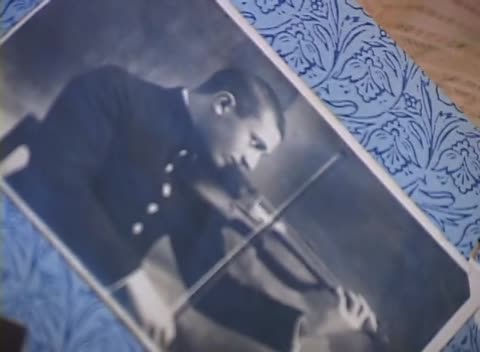
In her house Mehler shows photographs to the team, mostly in Romanian with some Yiddish. She identifies her daughter, her grandchildren in America, her parents and her husband, and her father's last photograph. He was killed in the Iaşi pogrom, and her husband died suddenly. The interviewers ask about her wedding and the wedding documents; her husband had been deported to Transnistria.
Her father was killed in the Iaşi pogrom and her husband had been in Transnistria; the wedding and its documents are discussed.
Mehler speaks about her family. Her mother was born in Iaşi. She grew up as an only child and raised one daughter. Mehler then speaks about Jewish life in the region.
Mehler speaks about her mother, who came from Iaşi but went to school in Dorohoi, and about summers there. Jews sat outside their gates on Sabbath and spoke Yiddish. She names her mother's Romanian name as Clara. The talk turns to her daughter's marriage, her husband from Siret, and the German-like Yiddish of the Suceava area and Mihăileni.
Also covers her mother's language, her daughter's marriage, and the dialect of the Suceava border area.
Mehler speaks about Jewish life after the war in Vatra Dornei, where she moved in 1955. She also addresses the fate of the Jews in the region during and Jewish life after the war.
Mehler describes Jewish life after her arrival in Vatra Dornei, mostly in Romanian. The Jews of the Bukovina region were deported to Transnistria in 1941. The rich sometimes bought themselves out, and one family avoided deportation by faking illness. After the war many returned to find nothing and emigrated in a mass departure, up to about 1961. She also talks about prewar Jewish trades and the good relations before Antonescu, and about the Romanian Jewish leadership. The passage ends on Ştefăneşti.
Includes the Transnistria deportation, buying out of deportation, trades, and the communal leadership.
Mehler describes the Ştefăneşti rebbe as a holy man and miracle worker. She also mentions the Paşcani rebbe and compares them with present-day rebbes. She mentions a more recent rabbi, Rose, and her own work as accountant and secretary of the community, with the keys. The team thanks her and ends the formal interview, discussing how a German journalist's interview of her was published.
Also covers the community's present-day rabbis and the interviews she has given.
Winding down after the interview, Mehler and the team talk about a woman born locally who is a ritual slaughterer's daughter in a village, and about phone numbers and an address. Mehler phones a visitor, giving directions, in Romanian. Her daughter is 40 years old; the visitors are described as professors from several countries.
The chat moves outside and Mehler speaks about her family. Her grandson lives in Australia and she also has relatives in America. The camera then collects footage of Vatra Dornei on the way to the next interview with Bercovici.
Outside, Mehler talks about her family, mostly in garbled speech. A grandson is in Australia and she has family in America. She explains in Romanian why she does not move abroad: she does not know the language, has no pension from there, and has her daily occupation. The team then talks in Russian and Yiddish about finding the route to Bercovici's house.
Includes why she does not emigrate, and the team's talk about the route.
The team meets Bercovici outside her house and introduces itself. Kerler says he is from Moscow originally and lives in America; they explain their work recording memories of life there before the war. Bercovici invites them to sit and asks where they are from and who they are.
Bercovici touches upon her life during World War II. She was deported to the Transnistria region, Mohyliv-Podilskyy ghetto in 1941. Bercovici explains that she lives in her childhood home. She then speaks about her family. Her mother survived the Mohyliv-Podilskyy ghetto. Her father, who died in the Mohyliv-Podilskyy ghetto of starvation in 1944, was an engineer. Bercovici does not have any children.
Bercovici says she was deported to Transnistria, to Mohyliv. She was born in this house and still lives in it. Her husband returned with her, and she gives her ages and the death years of her family: her mother Zonia Shtern in 1969, her husband, and her father David Shtern, an engineer, who died in Mohyliv in 1944. The interviewers introduce their colleague, and Bercovici mentions a friend in New York and her own age.
Gives the names and death years of her parents and husband, and a friend in New York.
Bercovici discusses her childhood memories and prewar Jewish life in Vatra Dornei. According to Bercovici, four thousand Jews lived in Vatra Dornei. She attended a Romanian school. After the war, Bercovici was a physics and chemistry teacher at a high school.
Bercovici says she went to a Romanian school, then the university, and later taught physics and chemistry at a school. About four thousand Jews lived in Vatra Dornei before the war, mostly pious; now eight or ten remain and she is the oldest. She says she speaks German and understands Yiddish, but speaks it poorly.
The Jewish population before and after the war, plus her teaching career.
Bercovici speaks about her family. She married her husband in the Mohyliv-Podilskyy ghetto. Bercovici speaks about her life after the war. She and her husband returned from the ghetto in 1945 and moved back into her childhood home.
Bercovici says she married in Mohyliv, in Transnistria, and then they lived in Vatra Dornei. Her husband was from Maramureş, spoke Hungarian and Romanian, and died aged 94. They returned in 1945; nobody lived in the house in her absence and they found only a table, chairs and a sideboard. She spoke German with her mother and Romanian with her husband.
Covers the return home in 1945 and what was found in the house.
Bercovici talks about prewar Jewish life in Vatra Dornei, a spa town with enough Jews for a Jewish life. The Vizhnitzer rebbe from Chernivtsi came each summer. She cannot say more about the rebbe; she then names another rebbe, Margoshes (?), who was in Transnistria and later in New York, where he died.
Adds a second rebbe, named Margoshes (?), who went to Transnistria and then New York.
Bercovici speaks about her family's life in the ghetto and recalls how her sister brought home bread for her work as pharmacist. She then addresses her childhood memories and mentions her visit to Israel in 1973.
Bercovici speaks about Transnistria: they did nothing there; her sister worked, with a daily bread ration, and her father starved to death in 1944, two weeks before liberation. She says her friends in Vatra Dornei spoke German and Romanian, that she went to a Romanian school, and that she read German books. She also mentions her visit to Israel in 1973 and friends there.
Adds her friends' languages, her reading, and the Israel visit; the pharmacist job is not clear.
Bercovici shows the team her German encyclopedia. In Romanian, Bercovici then discusses her childhood memories, including holiday celebration and cultural performances. In particular, she addresses Purim celebrations. Bercovici speaks about her family.
Bercovici shows the team her German encyclopedia and a prayer book, and the conversation moves to Romanian. She talks about her friends, Jewish and Catholic, and the synagogue. She says her mother was observant and her father less so, and that Passover was kept at home. Travelling Yiddish theater came from Chernivtsi; she recalls a Purim for children and an Atlas grandmother who died in Mohyliv, and the Stern family from Siret and Poland.
Includes the German books, a synagogue, her grandparents, and her friends.