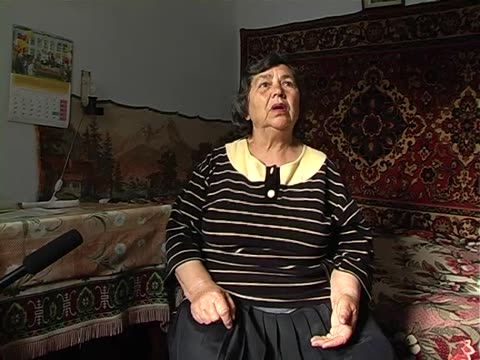
The team greets Gorberg, nee Shnayderman, outside her house and sets up the interview with her.
From the machine transcript
Greeting and setting up outside Gorberg's house. She says she has no one to speak Yiddish with and mostly speaks Russian; the interviewers encourage her to speak Yiddish, and Kerler greets her warmly. Her dog and her remark about a neighbour come up before the interview begins.
includes talk of her dog and her lack of Yiddish speakers
Gorberg talks about her life before and during the war. She grew up with two brothers. Both of them emigrated and lived in America and Australia respectively. Her family moved from Balta to the Dnepropetrovsk oblast during the Great Hunger in 1933, where they lived until the outbreak of World War II. Then her family attempted evacuation to Kazakhstan. Gorberg explains how they only reached the Dnieper River, which was already occupied by the Germans. Gorberg continues that two friends rescued them at night and saved them from a mass shooting. In Kazakhstan, Gorberg worked on a kolkhoz. Her father passed away in Kazakhstan.
From the machine transcript
Gorberg talks about where she was born and her early life, and about her two brothers, one of whom lives abroad. Her family left Balta for a village in the Dnipropetrovsk region during the famine of 1933, then fled in 1941. She tells how the Germans overtook them at the Dnieper and how they escaped a shooting at night, then travelled by train to Kazakhstan. There she worked on a kolkhoz while her father and brothers were taken into the army, and her father died there.
adds the escape by night and the fate of her brothers after the war
Gorberg talks about her family. She raised two sons, who live in Israel and Khmelnytskyy. Her father, grandfather, and great-grandfather were tailors. Her father was born in Kodema and her mother in Balta. She then talks about her life on the kolkhoz before the war and her evacuation. Gorberg attended at a Yiddish school for two years, on the kolkhoz “Chervona zirka” in the Dnepropetrovsk oblast, Stalindorfskiy region. Her mother worked in agriculture. Her family evacuated from the kolkhoz in 1941. Gorberg explains how two friends helped them escape and they washed themselves with milk on the way.
From the machine transcript
Gorberg gives her name and her family's names: her mother Esther, her father Bentsik (Benyamin), and her married name Gorberg. She speaks of her two sons, her father the tailor born in Kodyma (?), her mother from Balta, and her mother's later life in Rîbnița. She attended a Yiddish school for two years and worked on the Chervona Zirka kolkhoz. In June 1941 the family left by cart with the cows; two young men helped them, and bombing left them covered in earth and washed with milk.
adds her name and family names, her sons, and her father's birthplace
Gorberg talks about her life after the war. Her mother moved to Rîbnita, Moldova, and Gorberg celebrated a traditional Jewish wedding there in 1951. She then recalls her life before the war on the kolkhoz and her education. Gorberg attended a Yiddish school for two years, then a Ukrainian and a Russian school. She finished seven years of schooling in evacuation in Kazakhstan. Gorberg addresses her family and Sabbath celebrations.
From the machine transcript
Gorberg talks about her mother in Rîbnița and says she had a traditional wedding with a huppah in 1951; she recalls few details of the wedding. She discusses her two years at a Yiddish school, her later Ukrainian schooling, and her birth date. She mentions her father's tallis and his prayer, and says that the family's Sabbath observance has faded, though she herself lights candles. Kerler steers her back to the past after she begins describing her present reading.
adds the 1951 wedding details, Sabbath candles and her father's prayer
Gorberg discusses her return to Balta in 1945 and her life after the war. When her family returned, they did not have a place to live and moved in with her brother in Odesa. In Odesa, Gorberg learned to become a confectioner, to help out her brother, who was a war invalid. According to Gorberg, the job prospects for confectionary work were more promising in Rîbnita, Moldova, where her paternal uncle lived. In Rîbnita, her father recommended that she become an accountant as a specialized profession. Gorberg was trained in Chişinău for one year. After Gorberg graduated, she was sent to a kolkhoz in the region of Rîbnita as part of a working assignment and worked there for two years. After Gorberg got married, they moved to Balta in 1951. In Balta, she established herself as a planner and then an accountant. She worked in export for forty-four years.
From the machine transcript
Gorberg tells of returning in 1945 to find no home, and moving to her uncle in Odesa, where her brother learned confectionery after being disabled. The family moved on to Rîbnița, where she trained in accounting in Chișinău and worked on a kolkhoz. After marrying she returned to Balta in 1951 and worked as a planner and accountant for decades. She says there was no shoykhet, synagogue or Yiddish cultural life in Balta; Kerler asks about the singer Nekhama Lifshitsaite (?) or similar visiting artists.
adds the absence of a shoykhet, synagogue and Yiddish performances in Balta
Gorberg talks about food customs, she remembers from her mother. She then talks about Jewish cultural life before the war and food customs today. She then talks about her family, in particular her husband’s, before Gorberg discusses life today. She lived with her mother-in-law for thirty years.
From the machine transcript
Gorberg talks about her mother's cooking for weddings and holidays and gives her own method for gefilte fish and fish cutlets. She also speaks of Purim foods and a Purim play at the kolkhoz, Yiddish songs, and winemaking at her dacha. She talks about her husband's family and her thirty years in her mother-in-law's household. Her husband was a vulcanizer who drank, and he died in 1990s (?). Lemster and Kerler ask about food terms such as potato pancakes and the Yiddish word for grapes.
adds the gefilte fish method, wine making and her husband's work and drinking
Gorberg answers questions about cultural terminology, before she shows family photographs.
From the machine transcript
Gorberg answers a few terminology questions: she does not know dybbuk, and gives answers for golem and meshumed. She says that in her home Russian was spoken, so her children know no Yiddish, and that her son in Israel noticed her Yiddish books. She mentions a Yiddish primer given by a teacher, then Lemster and Kerler look at family photographs; she shows her husband, the club and the Yiddish play.
adds the questions on dybbuk, golem and meshumed and the turn to family photographs