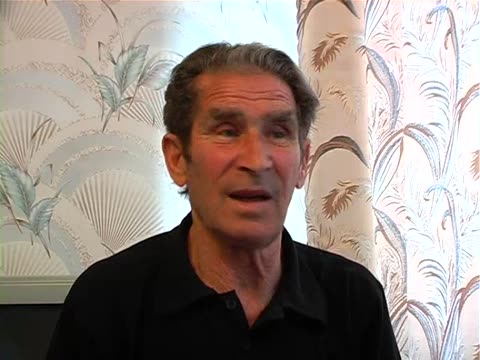
The second part of the tape is a formal interview with Semyon (Shimen) Iosifovich Epelman, born 1939 in Balta. The team greets Epelman at his apartment and sets up the interview with him.
From the machine transcript
Greeting and setup at Epelman's apartment; Kerler invites him to sit and asks his birth year, 1939, and gives his name and Russian patronymic. Kerler states the date, 20 May 2008.
Epelman provides personal information and talks about his family. He grew up with a twin Brane, four more brothers and four more sisters. Brane moved to Israel. His father, born in Balta, was a coachman. After the war, Epelman worked a stoker.
From the machine transcript
Epelman gives his parents' names, Yosef and Tela (?), and says he was born in Balta as one of ten children, with a twin sister Brane who now lives in Israel. He names his many siblings, says that not all of them know Yiddish, and tells that his father and grandfather were coachmen who took passengers to the station. His mother was a housewife, and the family lived on the other side of town near a prayer house (?). Lemster asks about the grandfather's name and work and about his own work as a stoker.
adds the full list of siblings, the grandfather Hershl and his trade
Epelman talks about his life during the war. He was imprisoned in the Balta ghetto for three years. As a child, Epeleman witnessed the murder of relatives in 1942. His family shared a house in the ghetto with four other families. Most of Epelman’s family survived the war.
From the machine transcript
Epelman recalls the three years in the Balta ghetto, where the family was confined with others in a house near the hospital. He remembers German soldiers; as a child he saw his father's brother's wife and a child shot by Germans in 1942, and an old man killed. The rest of his family survived the war.
adds the killing of his aunt and cousin as he witnessed it, and the housing in the ghetto
Epelman talks about postwar Jewish life. Epelman recalls a kosher butcher working until 1967.
From the machine transcript
Epelman talks about Jewish life in Balta after the war: there were many Jews then, but few remain. He attended a Russian school, and recalls a shoykhet named Davidye (?), who lived on Kuznechna Street and worked until the mid-1960s (?), and who no longer circumcised after the war.
adds the Russian school and the shoykhet's street and name
Epelman talks about prewar Jewish life, in particular weddings. Epelman then talks about postwar religious life. He then talks about his family. He raised two children. Epelman recalls celebrations of Yom Kippur at his grandfather’s, who would tell stories. He also recalls his grandfather praying.
From the machine transcript
Kerler asks about Jewish weddings in Balta before the war and Epelman answers questions about a wedding-related term. Epelman describes the postwar synagogues and kosher slaughter in Balta, and says he never learned to pray. He says he learned Yiddish from his grandfather and father and has two daughters who do not speak it. He recalls his grandfather's Yom Kippur gatherings, the rhymes he told to the grandchildren, and how he prayed with tefillin and tallit.
Includes elicitation of a wedding term and a question about non-Jews speaking Yiddish and a Hershele Ostropolier reference.
Epelman talks about life after the war. He started working at a coal factory at 13. He explains how he had to support his big family, despite his young age. Epelman was then trained as a stoker and worked with coal. At the age of 19, Epelman started his military service and returned from Moscow to Balta in 1960. He addresses antisemitism in the army and explains how he was sent to a different unit to be separated from a fellow Jew.
From the machine transcript
Epelman recounts starting work at 13 after the war, despite initial refusals, and training as a stoker on locomotives. He served in the army near Moscow for two years, ending around 1960. He tells how he was moved to another unit away from a Jewish soldier, and mentions that antisemitism was widespread in the army but later stopped. Kerler and Lemster ask follow-up questions.
Gives the specific army episode and the posting near Dubna (?).
Epelman recalls a Yiddish song about poverty. He then answers questions about cultural terminology. Epelman then talks about his family and food customs, as well as postwar holiday celebrations. He then discusses folk customs.
From the machine transcript
Epelman recalls a Yiddish song about hardship and then answers questions about words and expressions: thanks, forgiveness, a curse term, words for floor and festive greetings. He also covers Kerler's questions on food (potato latkes, kugel, matzo, filled fish, sweet foods) and holidays at his grandparents' home, including Hanukkah money and the four questions. He ends by describing the folk practice of 'speaking away' (curing) the evil eye, as done by his mother.
Adds a long run of word elicitation, languages he speaks, and the folk healing practices.
Epelman talks about life after his military service. He recalls stories from friends and Jewish occupations.
From the machine transcript
Epelman recalls the Yiddish-speaking Jewish carters he worked beside at the coal depot in the 1960s, and tells a joke about two of them and their wives. Kerler and Lemster ask about Yiddish words for horse feed, covered carriages, watchmakers and water carriers.
Adds the carters' anecdote and the word elicitation.
Epelman talks about his siblings’ life after the war. They live in Israel, America, and Kryvyy Rih. Epelman has been married to a non-Jewish woman for fifty years. He then talks about Jewish occupations, in particular the fate of a violin maker during World War II.
From the machine transcript
Kerler asks about each sibling: they live in Israel (Beersheba), America and Kryvyi Rih, and most do not speak Yiddish. Epelman says his wife is Russian and they have lived together about fifty years. He then answers questions about Jewish trades and tells what he heard of a violin maker whose hands were beaten when Germans rounded up Jews. Kerler and Lemster also ask about Slavic-derived words and expressions.
Adds the siblings' names and places of residence and the violin-maker story.
Epelman talks about life today and discusses cultural terminology.
From the machine transcript
Kerler and Lemster put further questions about words and sayings, such as a light passenger, a winter or summer fool, being sick, and an honest or pious Jew. Epelman has little to add about the future of Yiddish. The interviewers thank him and close the interview.
Includes the expressions asked and the closing thanks.