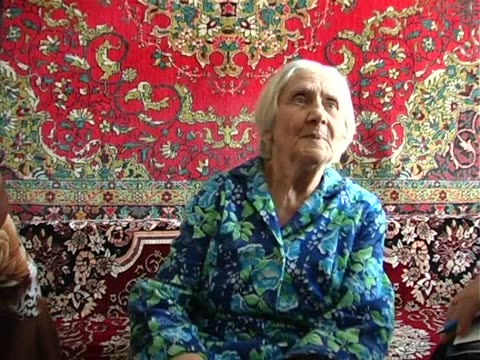
The camera records town footage, before the team, together with Shekhter’s wife, greets Khasidovich, nee Akselrod, in her apartment and sets up the interview with her.
From the machine transcript
Greetings and introductions at the start of the interview: the interviewers give their names, and Khasidovich and a second woman speak Yiddish with them. They discuss Khasidovich's children and grandchildren in Israel, who do not understand Yiddish or Russian, and the place in northern Israel near the Lebanese border where they live (Malot (?)). The camera is checked and Kerler asks where she was born.
The transcript shows introductions and talk about her family in Israel; the town footage mentioned in the catalogue is not visible.
Khasidovich provides personal information and talks about her family. Her parents were born in Fastiv.
From the machine transcript
Khasidovich gives personal information: she was born in Fastiv, her maiden name was Akselrod, and her official surname is Khasidovich. Her parents Berl and Beyle were both from Fastiv. She gives her address and talks about the street's former and present names, her name Fania and her age (her birth year was registered as 1915 for work reasons). She says that she and her family stayed in Fastiv through the war.
The transcript adds her maiden name, the address and street names, the registered birth year and that she was in Fastiv through the war.
Khasidovich talks about her life during the war in the Fastiv ghetto. Khasidovich’s brother, two sisters, and parents were executed in the “mini Babi Yar” of Fastiv. Khasidovich survived the massacre. She then talks about her family. Her father worked as a tailor. Khasidovich talks about her education at the Yiddish school, where she studied for four years, before continuing her studies at Russian school. Khasidovich got married at 18 and she worked in a shop after the war.
From the machine transcript
Khasidovich says that her parents, brother and sisters stayed in Fastiv and were killed, while she survived. Lemster asks whether there was a ghetto, and she names her siblings and says that her father was a tailor, her mother a housewife and her grandfather a wigmaker; the grandmother's name is discussed. She describes four years at a Yiddish school before moving to a Russian school, her marriage to Dudye (Davidke) and his work in construction, and a civil wedding with no huppah. The passage closes with Kerler asking what life was like in Fastiv in her childhood.
The transcript adds the names of her siblings and grandparents, her husband's name and trade, and that she had no huppah.
Khasidovich discusses her childhood memories and talks about her family. She raised three daughters, one of whom lives in Israel. Her husband died fighting at the front.
From the machine transcript
Khasidovich says she barely remembers her childhood and describes how young people used to walk and gather, in contrast to today. She talks about the synagogue and prayer house near the militia building, about the cinema and theater, and about the languages she spoke with Jewish and non-Jewish friends and at home. She then talks about her three daughters, two in Fastiv and one in Kyiv, and a daughter's family in Israel; Lemster closes by asking about Jewish holidays at home.
The transcript adds the synagogue and cinema in Fastiv and language use at home and with friends.
Khasidovich talks about holiday celebration and prewar Jewish life in Fastiv. She then talks about life today and holiday food customs.
From the machine transcript
Khasidovich talks about Jewish holidays before the war, about the former Jewish street in Fastiv (Kyivska Street) and about how she is now the only Jew in her building. She answers questions about whether non-Jews spoke Yiddish and about her mother's cooking, including gefilte fish, how it was made and what fish were used, and also a dish of meat with vinegar. Kerler asks about Purim: she names the Purim pastries and says she has forgotten the Purim songs and does not know the word purim-shpil. She and the interviewers then talk about how life was before and how young people behaved, and Kerler asks about visiting Yiddish theater.
The transcript adds the Jewish street, Yiddish and non-Jews, and the Purim questions (food, songs, purim-shpil).
Khasidovich talks about Yiddish culture before the war, including Yiddish theater. She then talks about a war memorial, which she attended to commemorate her husband. Khasidovich then talks about her life after the war. She was a caterer in a theater and then a sales assistant at a bakery until 1983. Khasidovich mentions her family, in particular grandchildren.
From the machine transcript
Khasidovich says she remembers little about Yiddish theater or Yiddish singers before the war. She talks about her husband, who did not return from the front, and about the war memorial where he is buried, which she visited with her children and grandchildren. She recalls working in a theater buffet and then selling bread in a bakery shop until she retired. She lists her grandchildren in Kyiv, Fastiv and Israel, answers a question about Sholem Aleichem, and says that she hardly leaves her apartment now.
The transcript adds the memorial visit and the question about Sholem Aleichem; the hardships of being a widow with three children are also described.
Khasidovich talks about reading books and her family. She then talks about Yiddish songs, before discussing Jewish life in postwar Fastiv.
From the machine transcript
Khasidovich answers questions about reading: before the war she read Yiddish prayer books and Yiddish books, she cannot read Yiddish now, and she says she read little because of work and her children. She says she attended the Yiddish school for four classes, and Lemster asks about Peretz Markish. She remembers some Yiddish songs that she sang, then tells how few Jews returned to Fastiv after the war and how she remained a widow and busy with her work and children.
The transcript adds Peretz Markish and the few Jews who returned after the war.
Khasidovich talks about her life during the war in Fastiv. She and her three daughters hid in a basement.
From the machine transcript
Khasidovich talks about the war years in Fastiv: she stayed in town with her small children and hid with them in a cellar, saying survival was a matter of fate. She mentions the killing site (garbled in the transcript, possibly Babi Yar in Kyiv), says she has no friends left from before and that her children are her only family, and describes working in the bakery at night to feed them. She says that non-Jews also helped her and that she helped others. Lemster closes by asking about Jews who visited the bakery.
The transcript adds help from non-Jews and her postwar work hardships; the Babi Yar reference is unclear.
Khasidovich talks about her work at the bakery after the war and addresses postwar circumcision. She then talks about her traditional wedding.
From the machine transcript
Khasidovich says that Jews who came to the bread shop spoke Yiddish with her. Kerler and Lemster ask whether challah was sold there and what kinds of bread and rolls were baked. They also ask about circumcision after the war, which was done secretly, and about her wedding: she says there was a huppah led by a rabbi, with her parents present, and describes the food at the wedding, including pastries and fish. The passage ends with questions on dialect vocabulary, for example the word for sunflower seeds, and on songs, dances and musicians.
The transcript adds the challah/bread questions and vocabulary items (sunflower seeds) as well as wedding food and songs.
Khasidovich answers a number of dialectological questions from the AHEYM Yiddish linguistic questionnaire. She also talks about life today and the Great Hunger in 1932. According to Khasidovich, her family did not suffer from the famine. She lived in Israel for one year.
From the machine transcript
Dialect questions covering words such as the one for a convert (meshumed), a Christian, the name for Stalin and a place name; also the local convent. Khasidovich says she has always lived in Fastiv except for one year in Israel with her daughter, where she says life was better than here. Kerler asks about life before the war and about the famine of 1932–33, and she says that she and her children did not suffer hunger. The passage ends with Kerler asking when her eldest daughter was born.
The transcript adds the questionnaire words on converts and Christians and says she is a lifelong resident of Fastiv; her year in Israel is covered in more detail.
Khasidovich talks about Jewish life before the war, especially the Great Hunger in 1932.
From the machine transcript
Khasidovich answers questions about the prewar period. She says her family managed with what they had and were not badly hungry. Asked whether Jews died of hunger, she says it was rare, perhaps two or three. She does not remember pogroms under the Soviets, though a pogrom around 1919–20 is mentioned. She says Jews in town were craftsmen such as shoemakers and tailors, builders and other specialists, and she is unsure whether any were militiamen. She is asked to explain a proverb about many trades and few blessings, and glosses it as everyone having his own work.
Adds questions on pogroms, Jewish occupations (shoemakers, tailors) and a proverb about trades.
Khasidovich talks about her life during the war in hiding.
From the machine transcript
Khasidovich speaks about the war years. She says some Jews hid because they feared being taken into the army, and that people hid from the Germans. Kerler and Lemster press her on who took her parents (the Germans) and who brought her food while she hid. She says many Jews of Fastiv perished and few remained. She says some people helped them, among them Jews who were with the Germans, and that bread was distributed in other ways. She mentions a family that did not hide and was lost.
Adds questions on who took her parents and who brought food, and the fate of Fastiv's Jews.