People › Iosif L'vovich Geller › conversation

Iosif L'vovich Geller

Izyaslav 10 June 2007 Interviewed by Dov-Ber Kerler, Moisei Lemster 62 min · 1 part on 1 tape
Loading the player…
  1. MDV 457 0:00–1:01:54 · 62 min · archive.org
Passages

0:00

Town footage of Iziaslav and meeting with Geller

FootageInformal life today MDV 457 · MCO
From the machine transcript

Brief arrival chatter with Kerler, who mentions a bottle brought as a gift and recalls an earlier visit to the town; the town footage is not visible in the transcript.

The transcript shows only a short remark about a bottle and an earlier visit.

1:49

Begin of interview and family

From the machine transcript

Kerler and Lemster recall Geller's earlier remark that his parents served with Kotovsky. Geller says his father was a strong man, and he describes his grandfather, a Kolno Hasid who prayed with two pairs of tefillin and was called to make up a minyan in Kishinev. He says he was born in Kuz'myn in Krasilov district, while both parents came from Kishinev, where relatives emigrated to Israel. There is also Russian talk with a woman about photographing a rooster.

The transcript adds his grandfather's Hasidic prayer practice, his birthplace in Kuz'myn and parents from Kishinev.

5:37

Life today and showing photographs in military uniform

From the machine transcript

Talk is interrupted by the photographing of a rooster and photographs from a trip to Israel shown by the woman of the house. Kerler tries to recall the name of a town between Ostrog and Zaslav, and the Slavuta district is named. Geller then shows his police colonel's uniform and medals, and Lemster asks about his role with Kotovsky's brigade.

The transcript shows photographs of Israel, the uniform and medals; it also includes a search for a town name.

11:47

Postwar life in Slovute and life today

after the warlife today Daily life (general)Life today MDV 457 · MCO
From the machine transcript

Geller says he worked in Slavuta in the police for three years until 1951, with many Jewish clients. He tells how his wounds from the war were missed by X-rays and doctors for years and were only confirmed later, to the surprise of the commission. He also gives his birth year, 1923, and mentions where Kuz'myn lies relative to Krasilov.

The transcript adds his wounds that went undetected for years and his birth year.

19:53

Putting on uniform

From the machine transcript

Mostly a social interlude: Geller is told to put on his uniform later, the group drinks compote, and the woman recites a Russian poem about hands. There is joking about drinking and about Jews not fighting.

The transcript shows chat over compote, roosters and a poem, not the uniform being put on.

24:37

Kartovski partisan brigade and family

From the machine transcript

Geller answers questions about Kotovsky's brigade. His mother served as a nurse and his father was a soldier. He says Kotovsky was a strong character and may have spoken some Yiddish. After the civil war his parents settled in Kuz'myn where he was born; his father was a shoemaker who met an old comrade in Staro-Konstantinov.

The transcript adds his father's shoemaking and Kotovsky's Yiddish; the mother's nursing and the Bessarabia question also come up.

29:17

Life at the beginning at WWII and evacuation

From the machine transcript

Geller tells of the start of the war: his father went to Kishinev while the mother took Geller and his sister and evacuated. His father returned to Kuz'myn to look for his son, but the Germans were near, and the transcript does not make clear his fate.

The transcript shows his father went to Kishinev before the war began and then returned to Kuz'myn.

31:31

Family and work

From the machine transcript

Geller says the family returned after evacuation. His mother later died in Moscow while visiting his sister, and he put up a monument at the Russian cemetery. He names his mother as Leike (?) Markevich. He has lived in Izyaslav since 1951, and he says he worked three years in the economic crimes unit in Slavuta.

The transcript adds his mother's name and burial in Moscow.

34:37

Postwar life and work

From the machine transcript

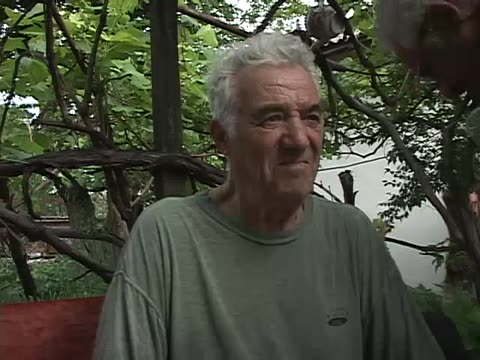
Geller talks about police work and about thieves, with no Jews among them. Asked about his mother's songs, he says he was too young to remember. He tells how he later led the automobile and motorcycle society for years, describes his car and his pension, and his Yiddish learned from his parents in the Yiddish-speaking town of Kuz'myn. His first wife Feyge died in 1991; her parents were killed in the war. He remarried after meeting a woman by chance, they registered and have been together some fifteen years. He mentions his son in Moscow, his garden, and the Colorado beetle.

The transcript adds his later career at the automobile society, both marriages, his pension, and his Yiddish.
48:48

Yiddish dialects and anecdotes

From the machine transcript

Kerler and Lemster ask about the local Yiddish of Kuz'myn and whether it was Podolian or Litvish. Geller says nothing definite, and mentions the word forms for mother and father. He locates Kuz'myn relative to Slavuta, Zhytomyr and Proskurov, and tells a Jewish anecdote about a rich man and a police protection offer.

The transcript adds the questions on Litvish versus local speech and the anecdote.

53:37

Food customs and showing Kuzmin on map

From the machine transcript

Geller says he does not remember whether his mother cooked mamaliga and answers questions on food terms such as mamaliga and papshoy. He says he met no antisemitism at work. Kerler and Lemster find Kuz'myn on a map near Staro-Konstantinov, and Kerler judges the speech to be Podolian Yiddish.

The transcript adds the question about antisemitism at work and the dialect judgment.

56:51

Yiddish song and best moment in life

From the machine transcript

Geller sings a Yiddish criminal song about a girl named Khaske (?) in a factory. Kerler identifies it as a criminal song in mixed language. Asked about the best period of his life, Geller says it was better under Soviet rule and that he is now materially content on his pension. He says he keeps no livestock now but kept chickens and rabbits before.

The transcript shows the song is a criminal ballad, and his answer is about Soviet times and present material comfort.