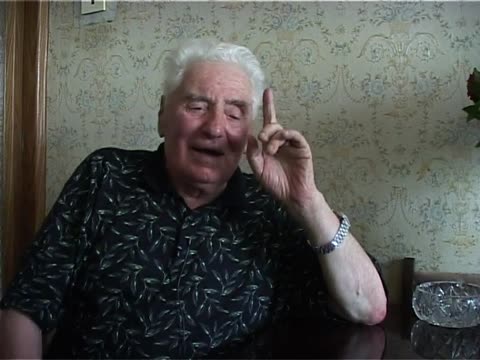
People › Arkadii Isaakovich Gelman › conversation

Arkadii Isaakovich Gelman; Abram Davidovich Kaplan

Kam'yanets'-Podil's'kyy 18 May 2003 Interviewed by Dov-Ber Kerler 2.9 h · 3 parts on 3 tapes proposed
Loading the player…
  1. MDV 461 0:00–59:32 · 60 min · not online — MCO
  2. MDV 462 0:00–54:35 · 55 min · not online — MCO
  3. MDV 463 0:00–1:02:12 · 62 min · not online — MCO
Passages
MDV 461 0:00–59:32

0:00

Interview

From the machine transcript

Gelman gives his Yiddish name and birth date in 1921 and says he lived in Kam''yanets' until the war. He describes his parents and grandparents, including a maternal grandfather who traded in Kitaygorod (Ketaret), and names his three siblings. He then recalls his childhood: leaving a Jewish school after four grades during the 1933 hunger, selling coal he gathered at the station, and his father's hospitalisation. He tells at length of his Red Army service, from the first bombing in 1941 through hospitals, a long march and tank-unit service, to the advance on Berlin in 1945, and mentions a decoration, work in Germany afterwards, and his later work buying cattle. Kerler's questions then turn to prewar Sabbath and holiday life in a poor household: meat versus challah, the mother's blessings, driving for others on Sabbath, the town's trades, the Jewish street, ritual slaughter, Passover preparation, Jewish and non-Jewish friends and neighbours, Hanukkah foods and the bathhouse and mikveh. These parts include terminology for shops, trades and foods.

The catalogue label is only 'Interview'; the transcript shows family background, hunger, war service, postwar work, prewar Sabbath and holiday life, trades, and terminology.

MDV 462 0:00–54:35

0:00

Interview

From the machine transcript

Kerler asks about non-Jews who converted to Judaism. Gelman recalls two brothers, shoemakers from the Pozamke (?) area, one of whom became a Jew and kept Jewish observance more strictly than born Jews. He then mentions villages in Russia of converts. Kerler asks about prewar Jewish sports clubs, the Kamianets yeshiva, Zionists and Hasidim, and Gelman remembers little beyond what his mother told him about Zionist meetings. He speaks about keeping yortsayt for his parents at home or in synagogue after the war, his one year in cheder, and his inability to read Yiddish letters. From about 12 minutes Kerler turns to dialectological questions. These cover the meaning of idioms, the Litvak (Lithuanian) Yiddish versus local speech, regional names for Jews, greetings and farewells, and many individual words (body, household, food, colors, adverbs, kinship, time words). The questionnaire also has sentences to translate. At the end a second person speaks Russian about a certificate, a prize and a son who is a sugar-factory director.

The catalogue gives only a label; the transcript shows converts, personal observance and a long questionnaire.

MDV 463 0:00–1:02:12

0:00

Interview

From the machine transcript

Outside Gelman's house and on the drive to the old town, a speaker (probably Gelman) with Kerler discusses a small prayer house and the old buildings of the Jewish district of Kamianets-Podilskyi, when they were demolished and when the synagogue was closed by the Bolsheviks. At the former Great Synagogue, now a restaurant, they talk about its origin under Turkish rule and its later history, and local Russian speakers describe its fires and restoration, the old town, the prison, the burnt archive and the church. The speaker (apparently Gelman) tells how his family fled in the war, the sister died on the way and the father died in 1943 (?), and he found his mother and a brother on returning in 1946. From about 26 minutes Kaplan, in Mohyliv-Podilskyi, tells Kerler about the Jewish museum, the community room, the old cemetery with its tzadikim and the synagogue's weekly and Passover events, and about Polish volunteers, the monuments to victims of the camps and ghetto (Pechora, Skazyntsi), his army service and communism, and how prayer continued in homes until a synagogue opened in 1948. He discusses prewar Jewish numbers, synagogues, hasidim and shoykhets, relations with the Baptists who took over a synagogue building, the community leadership, and a critical view of Joint, Hesed and Sochnut aid and of emigration.