24:39
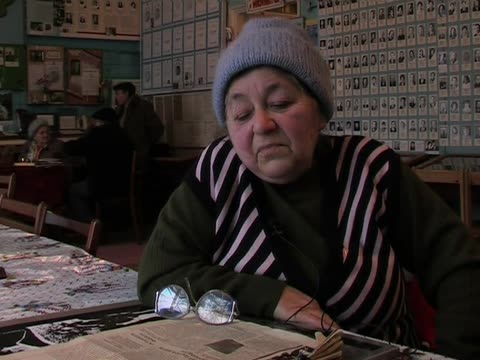
The rest of this tape consists of a formal interview with Berta (Betya) Aronovna Vaisburd, who was born in 1931 in Mohyliv-Podil’s’kyy. While her father, Arn, a factory worker, was born in Mohyliv-Podil’s’kyy, her mother Gitl was born in a very small village nearby. Without siblings, Vaisburd is an only child. During the war, Vaisburd was in the Pechera camp along with her mother, aunt, paternal grandmother Reyzl, and cousin, the latter of whom was in charge of burying the camp’s dead in the forest. One night in 1942, this cousin smuggled Vaisburd, her mother and her aunt (her grandmother had died in the camp earlier) in a wagon generally used for carrying corpses. At first, the family hid in Sharhorod, and then returned to Mohyliv-Podil’s’kyy, where they squatted in abandoned houses, and then were sheltered in a cellar by a Christian neighbor who knew Vaisburd’s mother from her village. Although this cellar was used as common storage by many families, Vaisburd and her relatives were never given up. Eventually, Vaisburd’s mother and aunt found an abandoned one-room house, where they and seven other kids lived until the war’s end. Vaisburd remembers in particular going to the local Russian market in disguise in order to buy food. Vaisburd also shares her few memories of the Pechera camp experiences, such as when people were shot for trying to get drinking water from the river. Vaisburd then turns to the pre-war period, describing her grandmother, and the different foods she would make for shabes. Before the war, Vaisburd’s family raised geese, a multi-purpose affair she describes in detail. She also shares her family’s recipe for gefilte fish. Her paternal grandfather died on the way to America. After the war, Vaisburd studied in Tashkent, where she married a non-Jew. She has two daughters, one of whom lives in Mohyliv-Podil’s’kyy, and another in Israel; her grandchildren live in Canada. Vaisburd also recalls her mother’s folk remedies against the evil eye and the one pre-war Jewish wedding she attended, the most memorable aspects of which were the food, her mother’s relatives and the klezmorim. Throughout the latter part of the interview, Vaisburd also answers the research team’s questions related to linguistics and dialectology. Cities and towns mentioned on this tape: Mohyliv-Podil’s’kyy, Chernivtsi (city), Chernivtsi (Kleyn Tshernovits), Nemie, Pechera, Sharhorod, Murafa, Tashkent, Beit She’an.
Vaisburd gives her name, birth year and birthplace and speaks of her parents, her father at a factory, her mother from a nearby village, and her grandparents. She was in the Pechera camp with her mother and grandmother. Her grandmother died there, and a cousin who buried the dead smuggled them out. She recalls hiding in Sharhorod and then in Mohyliv-Podil's'kyy, in a cellar kept by a Christian neighbor and in a one-room house shared with other children. She also recalls going to the market disguised. She then describes her grandmother's baking, Sabbath food, fattening geese, gefilte fish and Purim, and questions on devils, evil eye, songs and the one prewar wedding she remembers. After the war she studied in Tashkent and married a non-Jew; one daughter lives in Israel (Beit She'an) and one at home. Many of her answers respond to Kerler's and Lemster's questionnaire items.