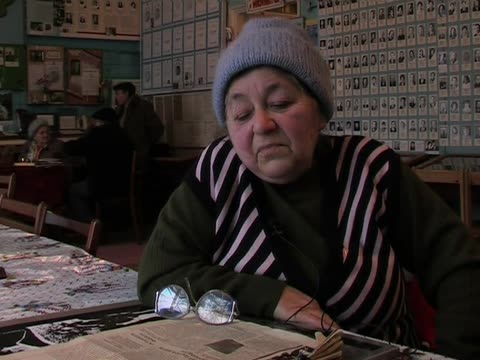
Vaisburd tells how she escaped from Pechera at night with her mother and about twenty other people, running for two hours and bribing two policemen who threatened to return them to the camp. She lost her parents in the woods, was found by a local woman, and then by a cousin who had led them out. The family then stayed two or three weeks in Sharhorod with a woman named Khane, where her mother baked bread and pea pastries; Vaisburd explains how the pastries are made and baked. She then recalls the return to Mohyliv, where her father was drafted at Chernivtsi (Kleyn Tshernovits), and the Romanian police stopped them, where her mother passed as a Christian by crossing herself and praying, and the earlier roundup, ransom and deportation by train. Kerler and Lemster ask about local place names, the shoykhet and local Jewish figures, and her Russian studies. From about 13:00 the passage becomes mainly the dialectological questionnaire, partly in Russian, covering words for dawn, apostate, Christian and peasant, greetings and thanks, household and food terms, adverbs, body words, verbs, adjectives, and sentences to translate.
Most of the passage is questionnaire work, and it also covers the shoykhet, Sobol and Vaisburd's Russian studies.