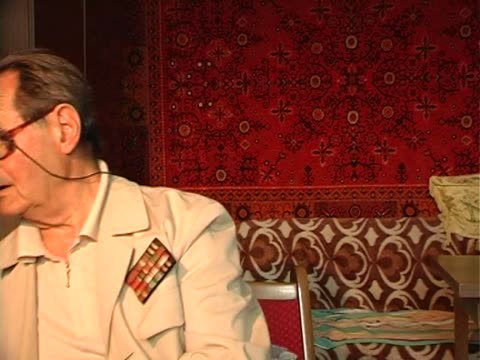
The second part of the tape includes an interview with Miron (Meyer) Yakovlevich Endelshtein, born 1925 in Bolgrad, Romania. The team meets Endelshtein on the street and sets up an interview with him.
From the machine transcript
The team meets Endelshtein and arranges the interview. He is invited in, says he understands Yiddish but has no one to speak it with, and the interviewers agree to talk and photograph him.
Endelshtein discusses his education. He studied at a Talmud Torah school until 1938 and then attended a Romanian school. Bolgrad was ruled by a Romanian fascist government in 1938 and became part of the Bessarabian region under Soviet occupation in 1940.
From the machine transcript
Endelshtein states that he studied at the Talmud Torah until 1938, then at a Romanian gymnasium. He mentions the fascist Iron Guard coming to power in Romania, fleeing to Bessarabia and the arrival of the Soviets in 1940. Kerler then asks where he is from.
Names the Iron Guard and the Soviet arrival in 1940 and ends with Kerler's question about origin.
Endelshtein provides personal information and talks about his hometown Bolhrad, Odesa District, with a Jewish population of approximately 5000 out of 28,000. According to Endelshtein, one thousand Jews were killed in the synagogue in 1938.
From the machine transcript
Endelshtein gives personal information: name Meyer (Russian name Miron Yakovlevich), the street in Mykolayiv, and birth in the 1920s in Bolgrad, near Akkerman and in Bessarabia, then ruled by Romania. He describes the Jewish population, now only about twenty people, and the killing of Jews in the synagogue, including children thrown into a pit. He says the building is now a church and that he installed a memorial plaque there, and he mentions the prewar Jewish population of about five thousand.
Gives the synagogue killing in detail, a memorial plaque, and the present small number of Jews, beyond the catalogue's population and killing figures.
Endelshtein talks about his family. After Endelshtein was released from his military service in 1945, he returned to his hometown and reunited with his grandmother. He also addresses contemporary Jewish life in Mykolayiv. His mother was a nurse and his father a clerk.
From the machine transcript
Endelshtein talks about his family: his grandfather Zise is buried in Bolgrad, and after demobilization in 1945 he found his grandmother there; she died soon after. He says there are almost no Jews in Bolgrad and few Yiddish speakers in Mykolayiv. His mother Menukha died in 1978; she was a nurse; his father Yakov worked in a bank.
Gives the names of his grandfather and parents and says Yiddish speakers in Mykolayiv are few.
Endelshtein talks about his return home after the war. He explains how his family left the keys to the apartment with neighbors, before they evacuated. Although their neighbors stole everything in the house, they returned documents and photographs after the war. He then shows several documents, including his mother’s diploma, as well as family photographs.
From the machine transcript
Endelshtein describes returning after the war and meeting a neighbor to whom the family had left the apartment key when they evacuated. He says she took the documents and later returned them, though the house was looted. He shows his mother's documents, including a diploma, and family photographs of his grandparents, parents, sister in New York, and a brother who was killed.
Endelshtein talks about prewar Jewish life in Bolgrad and contemporary Jewish life.
From the machine transcript
Endelshtein says prewar life in Bolgrad was good, with a Jewish community. He then speaks about the lack of Yiddish speakers today; he uses Yiddish with the rabbi, whose name is Gottlieb (?). He also mentions an earlier rabbi who drank.
Adds the current and former rabbi and the loss of Yiddish speakers.
Endelshtein talks about his family, in particular his grandfather, and addresses prewar religious life. He recalls how he attended the New Synagogue. Endelshtein then discusses holiday celebrations at home, including Passover with singing. He sings the beginning of Chad Gadya.
From the machine transcript
Endelshtein talks about his grandfather, a cooper whose customers came from Moldova and Bessarabia, and about the house. He recalls the New Synagogue, a Torah scroll sent by Queen Marie of Romania, and putting on tefillin at thirteen. He describes a Passover seder at his grandfather's house with ten children and sings the opening of Chad Gadya.
Adds the grandfather's craft, the Torah scroll sent from Bucharest, and a sung Chad Gadya.
Endelshtein talks about his family. His mother’s family lived in Odessa. He then discusses his childhood memories and recalls the beginnings of Romanian fascist rule. Endelshtein describes how he and his classmates had to go to the barber, who shaved a cross on their head. Endelsthein describes the population structure, consisting of Jews, Bulgarians (the majority), Romanians, Moldavians, and Roma. He studied with Bulgarian students at a Romanian school and addresses the positive relationship among the students. He remembers non-Jews who spoke Yiddish.
From the machine transcript
Endelshtein names his grandmother Leah and his father's siblings, and says his mother's family came from Odessa. He remembers Bolgrad's Jewish shops and institutions and the beginning of the fascist period. He describes classmates being shaved with a cross and being one of three Jews left in his class. He describes the town's population of Bulgarians, Gagauz, Romanians and Roma, and good relations with the Gagauz and Bulgarians, including a few non-Jewish Yiddish speakers.
Adds the Gagauz and Bulgarian neighbors, the Jewish school room in the gymnasium and the number of his father's siblings.
Endelshtein discusses prewar life Bolgrad. He recalls how his non-Jewish classmates attended synagogue services with him. Endelshtein then talks about Jewish life, including occupations and education.
From the machine transcript
Endelshtein describes how non-Jewish classmates sat in synagogue with Jewish pupils, and that few Bulgarians spoke Yiddish. He lists Jewish trades such as knife makers, tailors and shoemakers, and says Jews spoke only Yiddish at home. He explains the Talmud Torah and Romanian gymnasium education, and recalls fragments of Romanian and Yiddish songs.
Adds trades, languages used, and fragments of songs.
Endelshtein discusses Yiddish songs and local synagogues in Bolgrad. He shows a picture of the synagogue, where Jews were killed in 1938.
From the machine transcript
Endelshtein recalls Yiddish children's songs and the old and new synagogues in Bolgrad. He shows a picture of the synagogue, and says a Jewish newspaper piece he wrote describes it; about a thousand people were killed there and it is now a church. He describes children putting on tefillin before school in the small prayer room.
Adds the synagogue's capacity discussion and the children's morning tefillin.
Endelshtein recites the Morning Prayer and describes religious customs among his family before the war. He mentions how he continued to say the prayer during his military service.
From the machine transcript
Endelshtein recites the morning prayer Modeh Ani and the bedtime Shema as his grandmother taught him. He describes his grandfather's tefillin and his own bar mitzvah preparation. He says he kept up the prayer during army service in the war.
Adds the grandfather's tefillin, the bedtime Shema and the grandmother's teaching.
Endelshtein discusses food customs and holiday celebrations, as well as prayers.
From the machine transcript
Endelshtein describes his mother's Sabbath food (chicken soup with noodles, challah, chopped liver, peppered gefilte fish with horseradish) and fasting on Yom Kippur. He is asked about Kaddish pronunciation and the synagogue in Mykolayiv. Lemster asks where he was born and discusses Bolgrad's status, the writer Batashansky (?), and then asks about the war.
Endelshtein talks about life in Bolgrad at the beginning of World War II.
From the machine transcript
Endelshtein talks about the start of the war in Bolgrad, with Germans arriving in the first days and then Romanians. He says Jews were sent from Bessarabia to Transnistria, and mentions Bemaniovka (?).
Endelshtein talks about his family after World War II, when he returned from his military service in 1945. He was involved in the memorialization of Jews who were killed in the synagogue and mass shootings during the war.
From the machine transcript
Endelshtein speaks about Romanians sending Jews from Odessa, Bessarabia and Moldova, and about relatives left in Bolgrad. He returned in 1945 and tells of memorials to people shot in Mykolayiv and at another place. He says Kaddish is recited there. Kerler asks how the word Kaddish was pronounced at home; there is a brief exchange about a book on Bolgrad, and the question moves to Purim.
The catalogue says he returned in 1945 from military service; the transcript adds the pronunciation of Kaddish and a book about Bolgrad.
Endelshtein discusses holiday celebrations, particularly Purim, and food customs. He then recalls traditional weddings.
From the machine transcript
Endelshtein answers questions about Purim in prewar Bolgrad: foods such as hamantashn-like pastries, reading the megillah, goose, and children's masks and play. He mentions a Jewish klezmer, Blender (clarinet), and the Purim-shpil. He then describes Jewish weddings, with the rabbi at the huppah, two rabbis in town, musicians, and a badkhn-like entertainer, and says that many of his classmates went to synagogue.
Beyond Purim and weddings, it covers klezmer musicians and the question of who attended synagogue.
Endelshtein talks about contemporary Jewish life in Mykolayiv.
From the machine transcript
Endelshtein talks about Jewish life in Mykolayiv today. He says young Jews marry Russians, that few attend the synagogue or events such as Victory Day, and that there is no one to speak Yiddish with. He mentions a Jewish school with about 180 children, many of whom have only one Jewish parent, and refers to Israel and Chabad. Lemster asks about Jews who went to Argentina from Bolgrad, and the question then turns to his army service.
Adds mixed marriage, the Jewish school, and the question of Argentina.
Endelshtein talks about his military service during the war, which he began in 1944, and his life during the war prior to the Red Army. As soon as the Germans invaded Bolgrad, his family escaped via Stalingrad, Kalmikye, Saratov, Svertlov, Orgentsh Kharenskover oblast Uzbekistan (there drafted and trained for two months. Then he served in West Ukraine, including Kerembol, volkskaya oblast, Chernivtsi, then Romania: Pleshtch, then Hungary: near Budapest, Uipesht (battle), he was injured. He finished his service in Dnepropetrovsk. He then talks about his military honors. He was in the division of cannon shooters with six other Jews.
From the machine transcript
Endelshtein tells where he was when the war began in Bolgrad. His family fled via Stalingrad and Saratov to Uzbekistan, where he was drafted and trained. He served in western Ukraine, Romania and Hungary, was wounded near Budapest, and was in hospital at Dnipropetrovsk. He names medals, including one for Budapest, serving as a machine gunner, and says six Jews were in his company. He says he felt no antisemitism in the army and tells how an officer helped with the registration of his name.
Adds the exchange about antisemitism, the name change, and finding no Jews in Hungary.
Endelshtein talks about his life after the war. He reunited with his mother in Dnepropetrovsk at the hospital. Endelshtein studied at the Moscow Institute for Folk 22:17, which he finished in 1950. During and after his studies, Endelshtein worked at a bank. He was the 22:50 of a bank for 64 years in Voznesenski, Russia.
From the machine transcript
Endelshtein says that after the war he found his mother in Dnipropetrovsk, his father having died, and no one left in Bolgrad. He studied at an institute in Moscow, finished around 1950 (?), and worked at a bank as cashier and controller. He was sent as bank manager to Voznesensk and worked in banking for 64 years, as he says. He says he had no one to speak Yiddish with.
Adds the lack of Yiddish speakers after the war.
Endelshtein talks about contemporary Jewish life in Voznesenski, as well as during the Soviet period. He then discusses the idea of Communism itself and in relation to Jewishness.
From the machine transcript
Endelshtein says about 80 Jews live in Voznesensk, none speaking Yiddish, and Kerler and Lemster say where they are from. He tells of a visit to the Moscow synagogue and a Jewish calendar he was given. He discusses Communism and Jewishness, saying he was a Communist and still a Jew, and that Communist ideas were good. The talk covers belief in God, a cousin who was a Communist imprisoned in Romania, and Trotskyism.
Adds the Moscow synagogue visit and a cousin imprisoned in Romania.
Endelshtein talks about his family and prewar Jewish life Bolgrad, in particular halutzim. He grew up as an only child. Endelshtein also mentions meeting a Jewish girl, who gave him a prayer book. The girl took the book from her grandmother after a mass shooting.
From the machine transcript
Endelshtein says he had no siblings. He is asked about Hasidim, Zionists and halutzim in Bolgrad before the war, and says his uncle left for Palestine in 1939 (?). He tells of meeting a Jewish girl who gave him a prayer book that came from her grandmother, who was killed in a shooting. The book was identified in Moscow as a Lithuanian siddur and he mentions Yad Vashem. He says his mother was found in Dnipropetrovsk, and gives the Bolgrad Jewish population before the war.
Adds the Zionist movement and halutzim, his uncle's departure and the siddur's origin.
Endelshtein talks about his family and life after he moved to Mykolayiv in 1980. He raised two daughters, one of whom lives in Israel.
From the machine transcript
Endelshtein says he came to Mykolayiv in 1989 (?) because he was ill and his children worked at a factory there. He has two daughters, one in Israel and one in Mykolayiv. Lemster asks about remaining Yiddish speakers there; he mentions a veteran in his 90s who speaks Yiddish, and talks about the veterans' council and a telephone number for him.
Adds the search for another Yiddish speaker and the veterans' council.
Endelshtein discusses Yiddish cultural life in prewar Bolgrad.
From the machine transcript
Endelshtein is asked about Yiddish theater visiting Bolgrad before the war: troupes came from Galați and Chernivtsi, and non-Jews also attended. He was a child and recalls little. Kerler asks about stories of Hershele Ostropolyer and dream interpreters, which he does not recall. The conversation closes with asking about Jews near Mykolayiv and the lack of Yiddish speakers.
Adds Hershele Ostropolyer stories, dreams and a search for Jews near Mykolayiv.