The first part of the tape is footage of the Odesa orphanage “Leah’s house.” The team takes a tour of the house and the administrators explain in Hebrew and Russian the history of the building, which used to be a factory, as well as provides information about the orphanage. The orphanage is also used as boarding school with children from Ukraine, as well as neighboring countries. The team speaks to several students in English and Russian.
From the machine transcript
Footage of a tour of the Odesa Jewish orphanage and boarding school "Leah's house". Staff explain the building, the internal money and shop, the classrooms and the children's origin from Ukraine, Moldova, Russia and Belarus; the visitors speak with pupils and staff in English and Russian. The pupils speak about their subjects (mathematics, Hebrew, English), whether they have been to Israel or America, and their contact with their parents. Much of the Yiddish text is garbled.
Adds the long conversations with pupils and staff in English about their studies, origins and contact with parents.
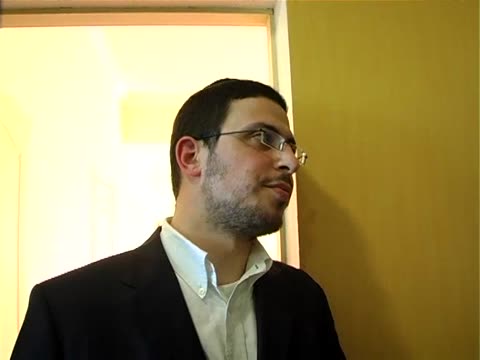
The second brief part of the tape is the beginning of a formal interview with Isaak Naftulovich Tokar, born 1920 in Zheludok (near Grodno), Byelorussia. The team greets Tokar in his apartment and sets up the interview with him.
From the machine transcript
The beginning of the interview with Tokar in his apartment. Greetings and the first name, and the interviewers' seating, are heard; the interview proper has not begun.
Adds that the only content is the exchange of first names and invitations to sit.
Tokar talks about contemporary Yiddish press.
From the machine transcript
Tokar talks about the Yiddish press he receives or wants from America: he describes a misunderstanding in which a request for a sponsored subscription to a newspaper was taken as begging. Kerler explains the American practice of finding sponsors. Tokar says he cannot use the Algemeyner Zhurnal because it is mostly in Hebrew and religious, and asks for the Forverts instead. The passage ends with Lemster and Kerler beginning the interview proper and asking where he was born.
also covers the sponsorship misunderstanding, the Forverts request and how Tokar got Kerler's contact
Tokar provides personal information and talks about his family. In particular, he talks about his grandfather. His father served in the Imperial Russian Army and participated in revolutionary activities in 1905. His grandfather dressed him in girl’s clothing and sent him to Paris in order to evade punishment. He returned after two years and then served in the army during World War I, where he spent time in German captivity in Germany. His father’s profession was a painter, but he later owned a convenience goods store.
From the machine transcript
Tokar gives his birth in Zheludok near Lida, then in Poland and now in Belarus, in 1920, and says the family name is Tokar. He talks about his maternal and paternal grandfather, a builder for a count, and his mother, a baker's daughter. His father served in the Tsarist army, took part in 1905 revolutionary activity and fled to Paris, then served in the First World War and was a German prisoner, and was a miller by trade who later kept a grain shop. His family perished in 1942.
adds the grandfather's work for a count and the parents' names and birth years
Tokar talks about life under Soviet occupation in 1939 and then the war years. He describes how the Germans set up a ghetto in 1942 and how people organized a resistance force. According to Tokar, more than one and a half thousand fighters were shot. Tokar was imprisoned with his younger brother and they managed to escape on bicycles. He explained how they escaped. They stopped in Byelitsa because his brother had to return to fix his bicycle. After Tokar found out that his mother would not let his brother leave again, he continued the escape by himself to his aunt’s house in Kharkiv. His brother was sent to the Lida ghetto and ultimately joined the partisans. Tokar reunited with his brother in 1944 and learned that his brother survived an attempted suicide and was flown through the front to a Russian hospital.
From the machine transcript
Tokar describes the destruction of Zheludok under the Germans: resistance, burning of the town, a ghetto with a Judenrat, and the mass shooting of more than a thousand Jews. He tells how he escaped by bicycle with his younger brother, how the brother turned back and he went on alone to an aunt in Kharkiv. His brother Gedalye was moved to the Lida ghetto, joined the partisans, tried to shoot himself, survived, and was flown through the front to a hospital in Russia. They met again in 1944–45, and Tokar says he himself was disabled at the front.
Tokar talk about his life during the war and his military service. He explains how he, together with his co-workers from a factory, evacuated from Kharkiv to the north Caucasus. He was drafted into the Red Army there and was sent to Crimea 21:00. He talks about a lost battle on Crimea and how he was wounded in March 1943.
From the machine transcript
Tokar recalls his wartime service: evacuation from Kharkiv with his factory to the North Caucasus, his wish to go to the front and his draft into the army. He describes the Crimean landing and the offensive by an army without tanks or aircraft, his wounding in March 1943, and the liquidation of the whole army in April, which he escaped by chance because he was already wounded.
adds the evacuation of the factory and the date of wounding
Tokar talks about his education. He attended a Yiddish school for four years and then completed his education at a Polish school. After graduation, Tokar attended a professional school in Lida to become a locksmith. Tokar then worked at the Lida Footwear Factory. He was on vacation when the war broke out in 1941.
From the machine transcript
Tokar answers a question about his childhood and education: four years at a Yiddish school, then a Polish school, then a vocational school in Lida for locksmith, and work at a large Lida factory making rubber footwear. He was on leave when the war began in 1941.
Tokar talks about his life during the war. He states that his parents and sister were shot on May 9, 1942. He then discusses prewar Jewish life in Zheludok and neighboring towns, including educational and political institutions, as well as sports clubs (Tarbut school, Poale Zion, Hashomer Hatzair, Mizrakhi, Algemeyne Tsiyonistn, Betar, Kholes Hatzair). He recalls enmities between Yiddishists and Hebraists.
From the machine transcript
Tokar says his parents and a sister were shot on 9 May 1942 and that he later met his brother. He describes Jewish life in Zheludok and nearby towns: two Jewish schools, Zionists, Yiddishists and Hebraists with quarrels between them, and no Bundists in his town. He lists parties and groups elsewhere, such as Tarbut, Poale Zion, Hashomer Hatzair, Mizrachi, General Zionists, Betar and Khalutz Hatzair, and answers Lemster about sports clubs and Maccabi.
adds the sister's name (garbled) and Lemster's question about Maccabi
Tokar talks about his education at a Yiddish school and his father’s cultural engagement as a school board member.
From the machine transcript
Tokar talks about his Yiddish school: subjects taught in Yiddish with some Hebrew and Humash. His father sat on the parents' committee, which organised theatre performances and revue concerts to raise money, with dramas including Sholem Aleichem and other Yiddish writers.
Tokar discusses prewar holiday celebration, in particular Purim. Tokar remembers modernized Purim celebrations. He then talks about prewar religious life. According to Tokar, more than one and a half thousand Jews lived in Zheludok. He recalls antisemitism before the war. He then talks about contemporary politics in Poland.
From the machine transcript
Tokar describes how Jewish holidays were kept before the war even by non-religious Jews, and recalls a homemade toy gun at Purim. He says literary accounts of the Purim-shpil describe something old and that most Jews were secular. He speaks of study circles, burial society, two study houses, about a thousand five hundred Jews in Zheludok, and fewer gentiles. He recalls prewar Polish antisemitism, then comments on postwar Poland and the Jedwabne killings.
adds Tokar's skepticism about the Purim-shpil in the literature and his comments on Poland
Tokar talks about his life after the war. Since he could not find work in his hometown Zheludok, he moved to Scucyn and got married there in 1954. In 1956, Tokar and his wife, a doctor, moved to Odesa, where his parents-in-law lived. He then talks about his wedding and his friends, who joined the partisans during the war and emigrated.
From the machine transcript
Tokar tells of his life after the war: unable to live in Zheludok, he moved to a town near Shchuchyn, where a small Jewish group formed that later emigrated. He married in 1954 a doctor sent to work there, with a civil registration and a dinner party but no huppah. In 1956 they moved to Odesa where her parents lived. He recalls partisan friends who left via Poland to Israel and says emigration was closed to them.
adds the wedding details and the partisan friends who emigrated
Tokar talks about his family. He raised a daughter who works as an accountant. He then talks about prewar cultural life, including libraries. He then talks about his contemporary work, leading a Yiddish language and history circle at the community center.
From the machine transcript
Tokar speaks about his family today: his wife recently died, his daughter is an accountant who stayed in Odesa while her husband went to Israel, and a cousin lives in Shchuchyn. He recalls two Yiddish libraries in prewar Zheludok, and describes the Yiddish circle he leads at the Odesa Hesed, where he reads Dubnow and Sholem Aleichem and Yiddish poems and sayings. He again asks for the Forverts, and the interviewers explain how he was reached through a contact.
adds the daughter and cousin, prewar libraries and the Forverts request
Tokar describes his military awards and decorations. He then talks about his life after the war. Although Tokar was trained as a locksmith, he could not work in his profession after the war. He attended courses in finances and worked as a finance inspector in Dushanbe* (Stalinabad). In Odesa, he worked at a factory and cooperative association. Tokar then talks about the monthly Sovietish Heimland and cultural life during the postwar Soviet period. He also addresses prewar Yiddish literature.
From the machine transcript
Tokar answers questions about his military decorations and says that after the war he could not work as a locksmith because of his disability. He took courses, worked as a finance inspector in Stalinabad and the district, and in Odesa worked at a factory and a cooperative. He discusses Sovetish Heymland, Soviet Yiddish writers he disliked, the rebirth of Yiddish culture after Stalin, the murder of Mikhoels and the Jewish committee, and the prewar Yiddish press and libraries.
adds the war disability, postwar jobs and the Soviet and prewar literature discussion
Tokar talks about his family, in particular his father. Tokar attended religious services on holidays with his father. His father was born in Zheludok.
From the machine transcript
Tokar answers questions about his father: he went to synagogue on holidays and sometimes on Sabbath, and Tokar went with him as a boy. He does not know where his grandfather was born. His father was born in Zheludok.
Tokar talks about his military service and his injuries, as well as addresses antisemitism. He fought in the artillery division as officer of observance. He started out his military in Ordzhonikidzevskaya, near Vladikavkaz, joined by other Jewish evacuees.
From the machine transcript
After a break for a glass of water, Tokar answers questions about his war service: he was wounded in Crimea and nearly lost his arm. He served as an artillery reconnaissance observer, and was drafted at Ordzhonikidze near Vladikavkaz, where there were few Jews apart from some evacuees. He says there was bitter antisemitism among the soldiers, and the interviewers then talk about where they live (Israel, America).
Includes the interviewers' talk about where they live and work.
Tokar talks about life today, before talking about his life after the war. He attended evening courses at a Construction Institute for six years. His wife worked as the doctor for the district.
From the machine transcript
After joking about beards, Tokar talks about his health since his wife died: a doctor, prescriptions and a volunteer who comes twice a week to cook. He says there were no good times before or after the war, mentioning the crisis in Poland. After the war he studied in the evenings at a construction institute for six years. He says his wife, born in Odesa, was a district doctor, and that her relatives live in the United States.
Also covers his illness, a community volunteer who cooks for him, and the interviewers' beard joke.
Tokar talks about contemporary Jewish life in Odesa. He also talks about his wife.
From the machine transcript
Tokar describes Jewish communal life in Odesa today: the several synagogues and Chabad, the lack of a single Jewish committee, and Joint-funded aid such as food cards, medicines and the Hesed. He then names his wife as Maria (?) and says her mother, who came from Grodno and spoke Yiddish, died in the 1970s.
Tokar talks about prewar religious life in Zheludok. He then talks about his religious education. Tokar’s father hired a private tutor. Tokar then discusses life today, including journals published by the community.
From the machine transcript
Tokar says prewar Zheludok had a community with a rabbi, ritual slaughterers and a cantor, but no slaughterer after the war. He recalls his father hiring a private tutor, studying Bible, putting on tefillin at thirteen, and later studying at a trade school in Lida. He then discusses the Jewish newspapers he reads in Odesa, including a Chabad paper, and what he knows of Israel from the press, while Lemster asks about Hershele Ostropolyer.
Adds the newspapers he reads and the opinions on Israel.
Tokar talks about life and politics today.
From the machine transcript
Tokar gives his opinions on politics and Jewish life today. He thinks American Jews are divided between parties and are assimilating; he is hostile towards black Americans, whom he describes as often Muslim and antisemitic; and he says Jews are split into many parties. Kerler mentions Barack Obama. Lemster then asks him for a poem, and he says he remembers many Yiddish songs but cannot sing, naming a few titles.
The passage ranges to American Jewry, race and antisemitism, and Yiddish songs.
Tokar recalls poems he learned during his childhood and talks about life today.
From the machine transcript
Tokar recites the opening of a children's poem and says he remembers its author as Abraham Reisen (?), but not for the poem about the green trees; he mentions Bialik's poem written after the Kishinev pogrom. Asked whether he will see Katz, he says he is angry at him over a letter. He complains about a Yiddish newspaper editorial office that would not send him a copy without a sponsor, and Lemster asks to photograph him with the Forverts.