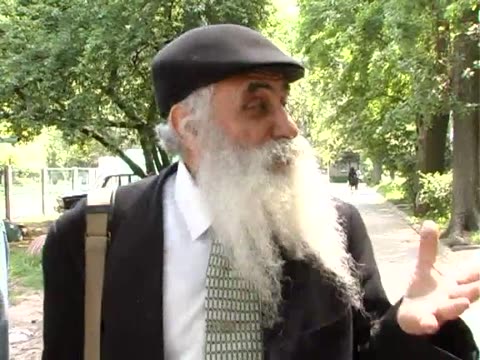
The first part of the tape includes town footage with a tour of the Odesa community led by Rabbi Zev Shpunt. Rabbi Shpunt talks in Russian about the community in Odesa and surrounding towns. The team walks toward the Odesa yeshiva, passing other community buildings.
From the machine transcript
Walking toward the Odesa yeshiva, the rabbi (Shpunt, per the catalogue) speaks in Russian about the Kherson area before the war, when Yiddish was official in a Jewish district, and about a Yiddish-speaking non-Jewish driver. He recalls how a 1988 concert led to a Yiddish class, then to a Jewish society whose first chairman he became. The society reclaimed a former synagogue building, he went to a Moscow congress of communities, and the Lubavitcher Rebbe's emissaries were involved. He also mentions Yakov Gruzberg and the poet Avram Katsev, and says his Odesa work began when Avraham Wolf invited him to the yeshiva.
Most of the talk concerns the Kherson community and its Yiddish circle, not Odesa and surrounding towns.
The team enters the yeshiva and school, before Rabbi Shpunt gives a tour in Russian and talks about the students.
From the machine transcript
At the yeshiva premises the rabbi describes in Russian his Sunday class of adult beginners, aged from about 38 to about 70 and funded from his own money. They study Torah with commentary and the laws of Jewish life. He tells how he grew up in Kherson after his parents' evacuation, and his father's war wound. He recalls that he went to Avram Katsev with his poems at 37, which led him to learn about Jewishness and to study in a Jerusalem yeshiva and kollel. He and Kerler discuss Katsev's life as a Yiddish poet and teacher, and then the group moves toward the school.
The rabbi's own biography, the Kherson link and the discussion of the poet Katsev go beyond the tour of the buildings.
The team continues the tour with Rabbi Shpunt, leaving the school building and headed to the next brief interview with Leonid Moiseyevich Vainbrand. He talks about the local community members.
From the machine transcript
Leaving the school, the rabbi says that tens of thousands of Jews live in Odesa, about a thousand of them in the Tairov district. He recalls meeting the Lubavitcher Rebbe in 2001 and a large Hanukkah event in Kherson with latkes served by yeshiva students. He tells how he moved from Soviet activist to religious worker, and he recounts a conversation with a host family in America. As they approach the building he explains that he found the housebound elderly man they are visiting through a charity fund's list, and that he keeps a mezuzah and siddur.
Besides the community members, the rabbi tells of his meeting with the Lubavitcher Rebbe, a Hanukkah event in Kherson and his own turn to religion.
The team enters Vainbrand’s apartment and greets him. Vainbrand (Yeyne) provides personal information. He was born 1919 in Valedniki (Novi Velidnyky).
From the machine transcript
The team arrives at the apartment and greets the host. Kerler asks where he was born; he answers Valedniki (Veledniki). Kerler asks whether he can tell about the Valedniker tsadik and about his childhood, and then asks where he spent the war.
Kerler already asks about the Valedniker tsadik and the war years.
Vainbrand talks about his life before the war. He moved to Murmansk, Russia, in 1935. He tells anecdotes about the Valedniker Tzaddik, Vainbrand remembers from his childhood. His father was also born in Valedniki.
From the machine transcript
Vainbrand says he spent the war in Murmansk and left Valedniki in the mid-1930s (year uncertain). Asked about the Valedniker tsadik, he recalls that people came every year to his grave in a small house near Avrech. He tells a story, as he heard it, of a girl who was healed and began to speak after her mother prayed there. His mother, and not his father, told such stories, although his father was also from Valedniki. There was no booklet of the tales at home, only a siddur and other Yiddish books.
Besides the tsadik anecdotes and the move to Murmansk, he gives a healing story and says his mother was the storyteller.
Vainbrand talks prewar religious life at home. He then talks about his education at a Yiddish school and his family.
From the machine transcript
Vainbrand says he recited the morning prayer and the Shema as a boy, and lived in Valedniki until 1935. He describes two schools there, one Yiddish and one half Yiddish and half Russian. Instruction was in Yiddish, and he spoke Yiddish at home with his mother. He says the town had a beys-medresh and a kloyz. Kerler remarks that few people still remember the tsadik of those years.
The passage also covers school languages, the language spoken at home, and the town's two houses of prayer.
The formal part of the interview begins. Vainbrand provides personal information and talks about his family. His father was cobbler. He also shares his childhood memories. He grew up with three brothers.
From the machine transcript
The formal interview begins. Vainbrand was born in 1919, and Kerler wishes him health to 120. His father, Moyshe Dov, was a shoemaker, and his mother Libe was a housewife who did not work. He had no sisters and three older brothers, whom he names as Yankl, Khayim, Ruven and Avrom (he himself was the fourth). He did not know his grandparents. He put on tefillin until 1935.
The passage names the parents and brothers and says he had no sisters.
Vainbrand talks about his education at a religious and Yiddish school. He attended a cheder before he joined a Yiddish school at the age of seven. Vainbrand then talks about his bar mitzvah.
From the machine transcript
Vainbrand says he went to cheder from about age three or four, and began Yiddish school at seven. After that he no longer attended cheder. He remembers his bar mitzvah as a small gathering of about ten men, with a festive meal his mother prepared, a little strong drink and cake. He says there was no Torah scroll at home, only a siddur, and he recites a blessing for Kerler.
Vainbrand discusses holiday celebrations, in particular Purim. He then talks about prewar religious life in his hometown.
From the machine transcript
Asked about Purim, Vainbrand recalls that his mother made hamantashn, and that there was play-acting and singing. Children were dressed up by their mother, as on the Sabbath. He then describes prewar religious life in Valedniki, with two or three minyans in the kloyz and in the beys-medresh. He says the beys-medresh was large and perhaps wooden, and that he studied there in Hebrew, but he does not remember what. Kerler then brings a prayer book with the Valedniki rite.
The passage also covers prewar prayer houses and minyans, and the setup for the prayer-book reading.
Vainbrand reads from a prayer book and addresses prewar religious life in Valedniki taking place in different prayer houses. He remembers how his mother provided shelter for pilgrims, visiting the Tzaddik.
From the machine transcript
Vainbrand reads aloud from a prayer book and tries a Kaddish for the interviewers, who praise his reading. He explains the difference between the kloyz and the beys-medresh, saying the beys-medresh stood near the centre and the kloyz was up on a hill. The town's Jews were Hasidic and visited only their own tsadik's grave. Pilgrims from distant cities stayed at his mother's house, which stood on the road, and she served them tea and cookies.
Vainbrand answers questions about cultural terminology and recalls pilgrimage to the Tzaddik. He then talks about contemporary religious life.
From the machine transcript
Asked about the term for a 'good Jew', Vainbrand says the town had one, the tsadik, to whom Jews came every year, once even from America. Kerler tells him the grave in Valedniki now has a fine building and that Hasidim still go there. They discuss Rabbi Zev Shpunt, who led the team there, and which synagogue Vainbrand attends: the large city synagogue, since he can no longer walk. He says he is about ninety.
The passage turns to Vainbrand's present synagogue and his age, as well as the tsadik's grave today.
Vainbrand talks about his life during the war. He served in the Red Army for seven years until 1949 in the artillery division in Murmansk. He then talks about his education after school graduation and his family. He worked as an accountant. He raised a son and a daughter, who lives in America.
From the machine transcript
Vainbrand says he served seven years in the army, on the Northern front near Murmansk, in the artillery, and that he holds an order. He worked as a bookkeeper, and a school question leads him to say he no longer remembers much. He has a son, who is in the apartment, and a daughter living elsewhere (the transcript suggests the States), as well as grandchildren.
The transcript does not clearly give the 1949 discharge date, and the daughter's location is uncertain.
Vainbrand talks about prewar cultural life and his education. He attended a Yiddish school for seven years. He also addresses prewar holiday celebrations, in particular Simchat Torah and Passover. Vainbrand remembers how his mother baked matzos at home.
From the machine transcript
Vainbrand says there was no visiting Yiddish theater in Valedniki, and that children staged their own singing and dancing in Yiddish. He studied in Yiddish for seven years before the Yiddish school was closed in about 1933, and then went to a Russian school. Subjects included Hebrew, grammar and literature, but he cannot recall the songs. He remembers Simchat Torah as a joyful holiday with dancing and children carrying flags and candles. For Passover his mother prepared a kosher oven and baked matzo at home.
Vainbrand talks about Passover celebrations, including food customs. He then talks about his religious school (cheder) education.
From the machine transcript
Vainbrand talks about Passover preparations in his childhood home: the mother baked matzo for other families, who brought their own flour, and the attic held the Passover dishes. He describes how utensils were made kosher with heated stones in a pit of water, and the burning of leavened bread by the rabbi at the synagogue. Kerler then asks about the rabbi and his cheder teacher, who was also a shoykhet from whom the mother had meat for Sabbath. Vainbrand recalls the teacher's face but not his name.
Adds the kashering of utensils, the burning of leavened bread, and his recollection of his cheder teacher.
Vainbrand discusses food customs, in particular gefilte fish.
From the machine transcript
Vainbrand answers questions about the Sabbath fish his mother made: gefilte fish, cooked in a pot over layers of onion, with potatoes on top. He says he adds no sugar, and Lemster asks about pepper and beets. He still makes it himself and the grandchildren like it. Kerler then asks about the rebbe and the tsadik, but he remembers nothing.
Adds Lemster's questions about ingredients, and that Vainbrand still cooks the dish today.
Vainbrand talks about traditional weddings during the prewar Soviet period. He then addresses prewar religious life, including Sukkoth celebration, as well as answers questions about cultural terminology.
From the machine transcript
Vainbrand speaks about weddings and the wedding canopy during Soviet times, the shoykhet who was also a circumciser, and the study house with its tables and benches. Kerler asks questions about the words batlen, dybbuk and golem and about stories of the Valedniki rebbe, mostly answered with no recollection. The talk turns to the synagogue and the Sabbath routine of carrying a prayer book, to the sukkah built beside the house, and to the town bathhouse and mikveh near a small river. Lemster asks whether people feared the Communists.
Adds the study house, the mikveh and bathhouse by the river, and the questions on dybbuk and golem.
Vainbrand touches upon Yiddish literature. He then talks about his family, in particular his wife. He then talks about prewar life and recalls a non-Jewish boy who attended a Yiddish school. During the war, he became a police officer and worked as a translator for the Germans.
From the machine transcript
Vainbrand says he read Yiddish books, among them Sholem Aleichem, and recalls the journal Der shtern (?). Kerler asks about Yiddish spoken after the war, and about his wife, who was also from Valedniki; he gives her family name, his own name and patronymic as in the passport, and his Yiddish name. He then tells of a non-Jewish boy who studied at the Yiddish school and, during the war, worked with the Germans as a translator.
Adds the personal-name questions and the German-employed translator; the catalogue says Vainbrand himself became a police officer, but the transcript indicates it was the non-Jewish boy.
Vainbrand talks about his postwar wedding and his son’s circumcision.
From the machine transcript
Vainbrand says he married after the war, and Lemster asks whether a wedding canopy was used and, after Vainbrand directs him to a photograph, about the son's birth. He says there were two shoykhets in town and one was the circumciser. His son married in Odesa under a canopy. He reflects that no one is left who remembers these things, and begins to speak of kosher meat.
Adds the son's marriage in Odesa and the reference to photographs.
Vainbrand talks about prewar Jewish life and how his family prepared for Sabbath. He then mentions his mother’s matzos baking. Vainbrand then talks about his family.
From the machine transcript
Vainbrand speaks about how meat was salted and about his father buying a calf in the village and having it slaughtered in Valedniki. Kerler asks about his mother baking matzo for others, who brought their own flour, and about the perforating wheel. Vainbrand says his parents died before the war. He tells how he and his wife attended the same school and married in Valedniki, and he praises her.
Adds the salting of meat, the calf bought for slaughter, and the death of his parents before the war.
Vainbrand talks about visiting the rebbe’s grave in Valedniki and his life after the war. After Vainbrand returned from his military service, he joined his wife in Ovruch.
From the machine transcript
Vainbrand speaks about visiting the rebbe's grave in Valedniki and about his wife's burial, which the transcript places in a town whose name is unclear. After the war he came to live where she lived. He feels he has lived too long and mentions his age. He gives his father's trade as shoemaker and his wife's father's as a rope-maker (?), and answers questions about the Chernobyl rebbe and the Khabne preacher with no recollection.
Adds the wife's burial, the fathers' trades, and the questions about Chernobyl and Khabne.
Vainbrand addresses anecdotes from Hershl Ostropoler and reads from the prayer book.
From the machine transcript
Vainbrand says he cannot recall the Hershl Ostropoler stories and that his memory is failing. He mentions a prayer book and his poor eyesight, and reads or recites from the prayer book when Kerler asks. Kerler then asks whether the cheder teacher examined the pupils and about the term for the fee paid to the teacher, which Vainbrand's father paid.
Adds the question about the fee paid to the rebbe.
Vainbrand talks about life before the war. He visited Zhytomyr, Ovruch, Korsun*, and Slovechne. He then talks about his favorite moments in life, which Vainbrand associates with holiday celebration. Vainbrand also briefly addresses the Four Questions for Passover.
From the machine transcript
Vainbrand names towns he visited before the war, including Zhytomyr and Ovruch; he passed through Berdychiv once. He names Simchat Torah as his favourite holiday and describes the procession with the Torah scrolls round the bimah in the synagogue. Kerler asks about Sabbath songs at home, and Lemster asks who asked the Four Questions on Passover. Vainbrand, the youngest son, asked them each year at home in Valedniki.
Adds Sabbath songs, and the passing visit to Berdychiv.
Vainbrand talks about prewar religious life, when pilgrims stayed at his home in Valedniki. He then talks about his family and mentions the Ukrainian police officer who attended a Yiddish school.
From the machine transcript
Vainbrand describes how, in the month of Elul, pilgrims with children stayed at his family's house near the rebbe's grave in Valedniki, and how a man wrote notes (kvitlekh) that were taken to the grave. He then says how old he is and why he did not remarry, that his wife died after the war, and that he says Kaddish and lights yahrzeit candles. Kerler and Lemster then ask about the non-Jewish boy who learned Yiddish and became a policeman or translator for the Germans, who he says needed someone to tell them about the Jews.
Adds the pilgrims' stay, his wife's death, and the Kaddish and yahrzeit candles.
Vainbrand addresses Jewish life in Valedniki during the war. According to him, the Germans did not set up a ghetto because Valedniki was considered a holy place. Vainbrand then discusses his life in Odesa.
From the machine transcript
Vainbrand says there was apparently no ghetto in Valedniki because the Germans feared the holy place and did not go to the rebbe's grave. Most older Jews were evacuated to Uzbekistan and elsewhere, or died. Lemster asks about Jewish life in Odesa after Vainbrand arrived, and he answers that he had no one to speak Yiddish with there. He says it is a Jewish city because many Jews live there, and he is asked about Natan Lurie, Drucker and Shloyme Mikhoels, with little recollection. Lemster asks about his daughter in the United States.
Adds the evacuation of the older Jews, questions on Natan Lurie, Drucker and Mikhoels, and mention of the daughter in the United States.
Vainbrand talks about his family and faith.
From the machine transcript
Vainbrand talks about his daughter, who works in New York and has visited him twice, and about his grandchildren in Odesa. Kerler and Lemster ask about faith. He says God exists in his heart and speaks of lighting two Friday-evening candles and reciting the blessing from his prayer book.
Adds the daughter in New York, with her visits, and his answers about God, candles and prayer.
The team concludes the interview and Vainbrand addresses Yiddish students. He then recalls childhood memories and talks about Israel.
From the machine transcript
Kerler thanks Vainbrand and invites a message for Yiddish students. He wishes them health and says Jews should remember they are Jews. Vainbrand says he is a Valedniki Jew and recalls going on Fridays to the shoykhet for his mother. Lemster asks about Israel; he says he would go but travel costs money, and that his son has to work. He thinks Jews should live in the Land of Israel. He adds that he reads the newspaper and hopes to live to a hundred and twenty.
Adds the farewell message, his views on Israel and the cost of travel, and his reading of the newspaper.