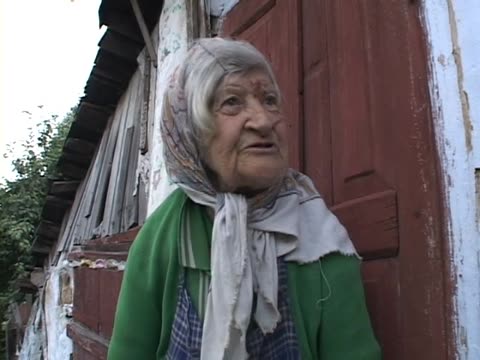
People › Klara (Khaye) Naumovna Sapozhnik › conversation

Klara (Khaye) Naumovna Sapozhnik

Tomashpol' 28 June 2005 46 min · 1 part on 1 tape two sources agree
Loading the player…
  1. MDV 699 16:12–1:02:16 · 46 min · not online — MCO · a part of the tape
Passages

16:12

Interview with Klara (Khaye) Naumovna Sapozhnik

From the machine transcript

Formal interview with Sapozhnik, who says she is a native of Tomashpol' and speaks Yiddish with her brother in Israel. She talks about her parents Nusn and Rukhl and the kolkhoz, her siblings, the old synagogue and how women prayed, her father's siddur and her poor childhood. She recalls the war, with her brothers drafted and the killings and ghettos under Germans and Romanians. She also mentions the town's remaining Yiddish speakers, and answers Kerler's questions on Yiddish words and on fish, melay and Passover food. Katz adds a general question about the best years.

Beyond the interview, the passage covers a non-Jewish Yiddish speaker, Passover customs, wedding customs and the shoykhet killed by Romanians.

49:00

Children playing and other scenes of Tomashpol’.

Footage life today MDV 699 · MCO
From the machine transcript

Camera and talk on the street in Tomashpol', with an address on Volodarskaya street being given and children heard nearby. Kerler and Katz remark on a typical shtetl street, and Russian-language instructions to film it and to enter a house are heard.

The street is called a real shtetl street, with a street address (Volodarskaya, 18) given.

51:19

Interview with Dora Bentsionovna Guzman.

From the machine transcript

Interview with Dora Guzman, who is welcomed into her flat. Katz states the date as 28 June 2005 and asks about her earliest memories. She was born in Tomashpol', attended the Yiddish school up to the fourth class and then Ukrainian school in Pishchanka, where she stayed with her mother's brother. She names her father Benyamin/Bentsion Abramovich, who worked in the clothing trade, was pious and prayed in one of the three synagogues, and her mother Sara, from the Odessa region. Katz also asks about Yiddish songs, the rabbi, Passover seder, Purim pastries, Hanukkah, the Sabbath and fish dishes.

The transcript adds Katz's questions on Jewish holidays and food, which the catalogue does not mention.