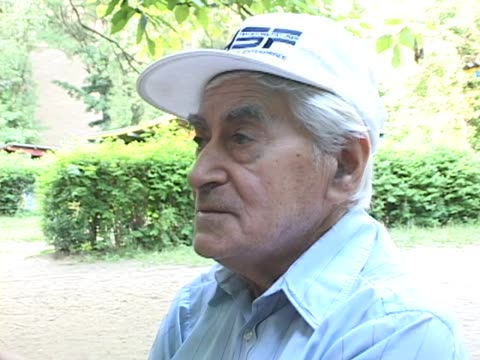
The camera records a funeral notice, before cutting to the second part of the tape, a formal interview with Genrykh (Khayim-Isser) Kalmanovich Zinger, born 1914 in Velykyi Bereznyi (Yiddish: Groys Berezna). The team gets acquainted with Zinger outside of his house, before setting up the interview.
From the machine transcript
The camera records a funeral notice, then the team meets Zinger outside his house. Introductions are made in Yiddish, with the team identified as visitors from America and Vilnius. Zinger says he has not spoken Yiddish for a long time because few Jews are left.
The introductions include Zinger's remark that he rarely speaks Yiddish nowadays.
The interview begins and Zinger provides personal information and discusses his family. He was born in Velykyi Bereznyi.
From the machine transcript
The interview begins with Kerler giving the date and place. Zinger gives his name, Khayim-Isser, his father's name, Kalman, and his birth in 1914, saying he will soon be 91. He was born in Velykyi Bereznyi, forty kilometres from Uzhhorod. He did not know his grandparents, and his parents, brother and sister were all taken away.
Zinger talks about life before World War II. He served in the Czech army from 1936 through 1939 and then returned to Velykyi Bereznyi. Zinger explains that his father organized a tailor apprenticeship for him when he was 14 years old. He then briefly discusses prewar Jewish life. He attended religious school (cheder).
From the machine transcript
Zinger describes the years before the war. He served in the Czech army for three years and came home in 1939, when the Hungarians took over the region. At fourteen his father apprenticed him to a tailor. As a small boy he attended cheder in Velykyi Bereznyi. He briefly contrasts the Jews of earlier days with those today and mentions being called up by the Hungarians in 1940 (?).
Beyond the army service and apprenticeship, he contrasts prewar and present-day Jews.
Zinger talks about life during World War II. He was sent to forced labor by the Hungarians in 1940. He then talks about his family. His father fought in World War I.
From the machine transcript
Zinger describes forced labour under the Hungarians and the Germans, where one could not speak freely. He cannot give the exact year of his father's birth, as he lost his wife in recent years. He met his wife, who was from Voronezh, in 1945. His father served in the First World War and Zinger recalls him laying down his rifle at home. He retells his father's stories of illness and lice at the front.
The passage also covers the death of his wife and his father's First World War service.
Zinger remembers the horrible conditions during World War II, when he moved from place to place in search of food. After the Red Army liberated him from Hungarian occupation in 1943, he worked in a tailor workshop in a POW camp in Voronezh, together with other German, Italian, and Romanian prisoners. Zinger returned to Velykyi Bereznyi in 1946.
From the machine transcript
Zinger recalls the hardships of the war: marching day and night away from the front, bartering for food, and a severe winter at labour service. He fell into Soviet captivity in 1943 and worked as a tailor, organising a workshop with Romanian tailors and shoemakers in a POW camp. Katz asks about the dates and the camp, which Zinger names as Otman (?). He describes searches of prisoners and the American canned food that improved conditions. He returned home in 1946.
It gives the 1943 capture, the Otman (?) camp, searches of prisoners, American food parcels, and the return home.
Zinger talks about life after the war. Since his entire family perished in Auschwitz, he moved to Uzhhorod into his sister’s house. Zinger then discusses his family. He grew up with two siblings.
From the machine transcript
Zinger describes returning in 1946 to find that his parents and the rest of his family had been taken to Auschwitz and no one was left. He moved to Uzhhorod, into the house of his sister Khaye, which he inherited. His family had five members: his parents, his sister Khaye and his brother Leyb. His sister's husband and child also perished, and he alone came back. He calls Velykyi Bereznyi a fine little town.
It names his sister Khaye and brother Leyb, and records that all his siblings perished.
Zinger recalls Jewish life before the war in Velykyi Bereznyi. His father worked as a tombstone carver (matseyve kritser) during the summer. Zinger assisted his father in the cemetery. During the winter, his father was a frame builder and glazier. Zinger then talks about the local prayer house, before addressing religious life today.
From the machine transcript
Zinger describes prewar Jewish life in Velykyi Bereznyi, which he calls a large village. It had a synagogue, a study house and a few other prayer houses. His father carved gravestones in summer and Zinger painted the inscriptions and gilded the letters. His father was an honest Jew rather than a great Hasid, and taught him to lay tefillin at his bar mitzvah. He then discusses the present-day Uzhhorod synagogue, a buyer's offer for it, the rabbi Teichman, and a new mikveh and yeshiva.
The passage also covers the Uzhhorod synagogue and the offer to buy it, and the new rabbi, mikveh and yeshiva.
Zinger remembers holiday celebrations, such as Sabbath and Passover. Zinger assisted his father during Passover, baking matzos for their neighbors. He then addresses prewar relations between Jews and non-Jews.
From the machine transcript
Zinger recalls the family's modest life in Velykyi Bereznyi: his father carved gravestones in summer and made picture frames and mended windows in winter. He describes the Sabbath meals, kugel and meat, and the braided challah. At Passover he helped his father bake matzo for neighbours, with women making the dough. He mentions a friend from the Soviet camp who died the day before. He says relations with non-Jewish neighbours were good, with some antisemitism blaming Jews for everything.
Beyond Sabbath and Passover, it covers his father's winter trade and a comment on a recent terror attack in England.