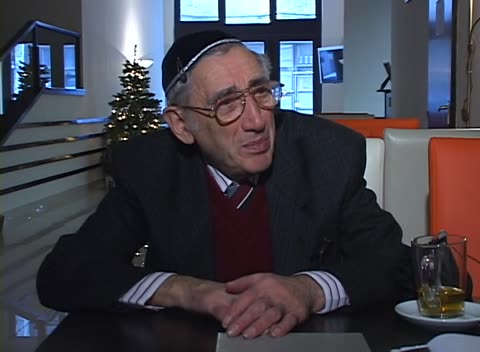
People › Imre (Yitshak) Dof › conversation

Imre (Yitshak) Dof

Budapest 22 December 2006 Interviewed by Dov-Ber Kerler, Jeffrey Veidlinger 16 min · 1 part on 1 tape two sources agree
Loading the player…
  1. MDV 75 26:14–42:12 · 16 min · archive.org · a part of the tape
Passages

26:14

The team concludes the interview with Herbst. The camera then collects outside shots from the synagogue, before the team conducts a brief interview with Dof.

Footage MDV 75 · MCO
From the machine transcript

Kerler and Herbst close the interview with thanks and good wishes. The camera then records outside views of the synagogue while Kerler calls out to someone nearby, and a second male voice is heard briefly. The Dof interview follows.

29:30

Dof speaks about his life during and after World War II. He was born in Uzhhorod and lived in Khust during his childhood. He then speaks about his education, during which he attended a religious school (cheder) and a Hebrew primary school for six years in Khust.

From the machine transcript

Dof says he was born in Uzhhorod but grew up in Khust, where the great rabbi Dushinsky was and whose synagogue still stands. During the war he was in the ghetto with his mother, her sister and the children. He attended cheder and a Hebrew school in Khust, with a Hebrew gymnasium also mentioned.

Adds the ghetto with his mother and her sister's family.

32:03

Dof speaks about contemporary religious life. He is a cantor. He then addresses prewar religious life in Khust, specifically his cheder education. He then recalls a Yiddish-language synagogue service in Buda in 1944. He then talks about contemporary religious life.

From the machine transcript

Dof says he is now a cantor in a Budapest community in Buda. He describes the big Khust synagogue with its cantor and a strict beit midrash, and his cheder with a fine rabbi. He recalls hearing a Yiddish sermon on Yom Kippur in a 'Polish' synagogue on the street where the family lived before the war; Kerler asks for the year. He lives in Buda now and says the synagogue there has Friday-night services. Few Yiddish speakers are left, since many died in the Holocaust; Hungarian Jews spoke Hungarian, some German.

Contains the Yom Kippur sermon memory and the question of how many Yiddish speakers remain among Hungarian Jews.

35:46

Dof talks about his education at a Hebrew primary school. He then sings a Hebrew song, before speaking about his family in Israel.

From the machine transcript

Dof says he studied four or five years at the Hebrew school, after which the war came. He says the family was lucky to get away before deportation. Kerler asks about Hebrew songs, and Dof sings or recites a Hebrew song from school. He then speaks about relatives in Jerusalem and about being afraid to fly there.

Adds the escape before deportation and his relatives in Jerusalem.

38:39

Dof speaks about his life after the war and then addresses prewar Purim celebrations.

after the warbefore the war Daily life (general)Purim MDV 75 · MCO
From the machine transcript

Dof says he worked here after the war and stayed beside his ill mother for years; he is called a devoted son. He and Kerler exchange names, and Kerler gives his card and says he lives in America. Dof explains that his name is Yitshak Dof, not Imre (the Hungarian form), and mentions his mother's brother Bernstein in America, a confectioner. He then recalls the Purim play only dimly and says his wife also speaks some Yiddish.

Covers the name exchange (Dof vs Imre), his uncle in America and care for his mother.