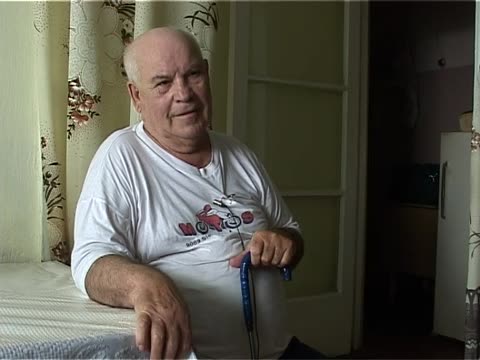
People › Boris (Berl) Goikhman › conversation

Boris (Berl) Goikhman

Zhmerynka 12 July 2002 Interviewed by Dov-Ber Kerler, Dovid Katz, Jeffrey Veidlinger 62 min · 2 parts on 2 tapes two sources agree
Loading the player…
  1. MDV 775 14:21–40:00 · 26 min · not online — MCO · a part of the tape
  2. MDV 776 0:00–36:01 · 36 min · not online — MCO
Passages
MDV 775 14:21–40:00

14:21

Interview with Boris Goikhman

From the machine transcript

Kerler interviews Goikhman, who gives his name and birth in Pervomaysk on 1 January 1927. He tells of the 1933 hunger, his father's move to Birobidzhan, Russian schooling, factory work and mobilisation to Blagoveshchensk, and his mother's death in 1947. He came to Zhmerynka in October 1947 to his father's brother. He then recalls Pervomaysk as a large town with many Jews, synagogues drawing visiting cantors, and Yiddish-speaking Jewish and non-Jewish friends. He also recalls Sabbath, his mother's gefilte fish with sugar and pepper, Hanukkah gifts, latkes and Purim foods, and the Zhmerynka shul on Sovetskaya Street, later a children's library.

MDV 776 0:00–36:01

0:00

Continuation of an interview with Boris (Berl) Goikhman.

From the machine transcript

Kerler puts a series of dialectological questions to Goikhman, often prompting with Russian words. The items include words for ear, attic, potato, blue, luck, broth, groats, deaf, and cross, and Goikhman's memory of Litvak speech. Further questions concern Hanukkah and Purim customs, the word for 'mekhutn' (in-law) and similar family words. Goikhman then recites or sings in-law verses and the tailor song 'Bin ikh mir a shnayderl', and Kerler thanks him.

The catalogue entry is a bare label; the transcript shows the questionnaire items and the songs.

17:53

Street scenes and old Jewish homes of Sharhorod.

Footage MDV 776 · MCO

24:01

Researchers at the home of Abram Khaimovich Vaisman in Sharhorod examining the family’s old books and setting up for an interview

Informal MDV 776 · MCO
From the machine transcript

In a home in Sharhorod, Katz and Kerler talk with the householders while looking at old books, including a Pentateuch printed in Vilna in the 19th century. They discuss where to sit for the interview and how the family live today. The family also talk about the daughter's name and the old Jewish street. Much of the talk is garbled and some of it is in Russian.

The catalogue names Vaisman's home; the transcript shows the scholars handling a Pentateuch and discussing seating and the family's names.