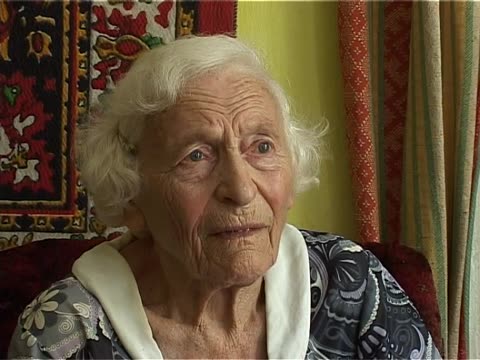
Poberevskii answers Kerler's dialectological questions on a few words and phrases for a naive person, falling into a pit or cellar, and a woman's name. She then speaks warmly of her life today: a good flat, a pension, and help from the Jewish community in Vinnytsya, with holiday celebrations, food, medicine and doctors. She mentions her brothers, one in Israel and one deceased, and that she is the only one left of her family. The segment ends with the team in her garden, where she describes her exercise routine and morning and evening habits, partly in Russian.
Beyond the dialectology, the passage has her family and brothers, her pension and her garden exercise routine.
A brief stretch of street scenes in Zhmerynka with a few unclear words in Yiddish, some repeated over and over, and an English aside about the footage.
Kerler interviews Goikhman, who gives his name and birth in Pervomaysk on 1 January 1927. He tells of the 1933 hunger, his father's move to Birobidzhan, Russian schooling, factory work and mobilisation to Blagoveshchensk, and his mother's death in 1947. He came to Zhmerynka in October 1947 to his father's brother. He then recalls Pervomaysk as a large town with many Jews, synagogues drawing visiting cantors, and Yiddish-speaking Jewish and non-Jewish friends. He also recalls Sabbath, his mother's gefilte fish with sugar and pepper, Hanukkah gifts, latkes and Purim foods, and the Zhmerynka shul on Sovetskaya Street, later a children's library.