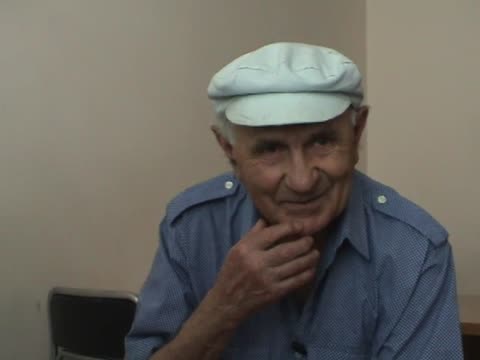
People › Pyotr Shilovich Sandler › conversation

Pyotr Shilovich Sandler

Zhytomyr 11 June 2007 Interviewed by Dov-Ber Kerler, Moisei Lemster 26 min · 1 part on 1 tape
Loading the player…
  1. MDV 801 0:00–26:07 · 26 min · not online — MCO
Passages

0:00

Personal information and family.

From the machine transcript

Sandler gives personal information. He was born in 1926 and lived in Starokostyantyniv (Oltkonstantin) before the war. His father was a barber or hairdresser, and his mother was called Manya. There were eight children. Two sisters now live in Germany and a brother lives in Jerusalem. Kerler also asks about his Yiddish name and about family names.

The father's trade, the mother's name and the siblings abroad are all given.

4:39

Prewar religious life and education.

From the machine transcript

Sandler says he does not remember how many Jews lived in Starokostyantyniv. He discusses speaking Yiddish in the streets and the term for people who say "tate, mame". He recalls going to cheder, where the rebbe hit the boys, and then attending a Yiddish school for four grades until it was closed and replaced by a Russian one, probably in 1934 (?). His parents were displeased because they wanted him to speak Yiddish. He says non-Jews in town spoke only a little Yiddish and mimicked it.

Adds the closure of the Yiddish school, the parents' reaction and non-Jews' Yiddish.

9:10

Childhood memories and friends.

From the machine transcript

Sandler begins speaking of the outbreak of the war. His father had his own horse and wagon and worked with his brother. People around them said the Germans would not harm ordinary working people, and the family hesitated over whether to leave. The passage is garbled, and Kerler urges him to tell it in Yiddish.

The transcript shows the start of the war and the father's wagon rather than childhood friends.

11:02

Evacuation.

during the war Evacuation MDV 801 · MCO
From the machine transcript

Sandler mentions evacuation through the Stalingrad region. Kerler then asks how holidays and Sabbaths were celebrated in Oltkonstantin before the war.

11:43

Prewar holiday celebration and religious life.

From the machine transcript

Sandler says his family was not rich. Kerler asks about Purim. Sandler recalls his mother baking poppy-seed hamantashen and says he was not sent with Purim gifts. He does not know the term purim-shpil. He mentions the synagogue, which functioned until the war, and his own cheder attendance. Kerler asks what challah is, and Sandler recalls his mother baking on a stove. The passage ends with Kerler asking how many years he did not speak Yiddish.

Includes Kerler's terminological questions (purim-shpil, challah) and the synagogue.

16:12

Speaking Yiddish and evacuation.

From the machine transcript

Sandler says that at home the family spoke Yiddish: parents, grandmother and grandfather, a shoemaker. He began speaking Russian at the Russian school. He describes evacuation to Uzbekistan, to a place near Bukhara, where cholera broke out and his father died. His mother returned with the family to Starokostyantyniv and died at about eighty. He lived there briefly after the war and then moved to Zhytomyr, where he had no one to speak Yiddish with.

Adds Yiddish at home and the mother's return and death.

18:58

Postwar life and family.

From the machine transcript

Sandler talks about postwar life in Zhytomyr, where he says few Jews remained and not all spoke Yiddish. He spoke Yiddish with his mother and sisters before the sisters left for Germany, and his brother went to Jerusalem. He returns to his father's death from cholera in Uzbekistan and the mass grave where the dead were thrown. Kerler steers him back to prewar Oltkonstantin and notes that he was fifteen when the war began.

Adds the father's death in Uzbekistan, the mass grave and siblings abroad.

21:57

Life today and holiday celebrations before war.

life todaybefore the war Life todayOther holidays MDV 801 · MCO
From the machine transcript

Kerler talks about memory, saying that childhood years are usually remembered best, and asks Sandler to describe his childhood, games, friends and prewar holidays. Sandler, now 81, says he forgets much. He recalls his father keeping the holidays, including Yom Kippur kapores. He says the family was poor with many children. The interview ends with thanks.

Adds Sandler's age today, Yom Kippur kapores and the family's poverty.