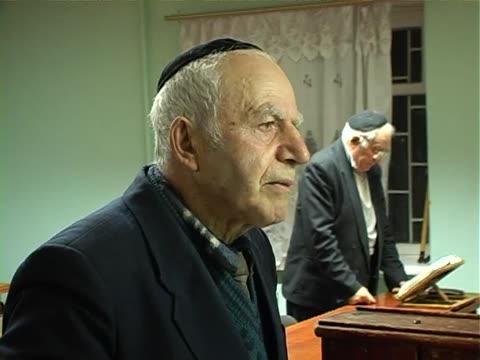
Filmed morning service in the Zhytomyr synagogue, with Hebrew prayers and blessings led by a cantor and responses from others. Much of the speech is unclear in the transcript, and Kerler is heard only briefly.
After the service the singer performs songs from his childhood and his own songs. These include a Polish song, a Yiddish song about being together with friends, and a song he composed about the summer of 1939 and a longing for the old home.
The transcript shows a Yiddish song he composed himself about 1939, besides the Polish and Yiddish songs.
Bluvshtein gives personal information: born in 1929 in Zhytomyr, in the Pavlikovka quarter. His father Itsik, son of Velvl, made ice cream together with his mother, and both parents came from Zhytomyr. He also speaks of his grandfather, a sister and a brother, his two sons (one in Jerusalem) and his grandchildren.
The transcript adds his siblings, his sons and grandchildren, one son in Jerusalem, and the family ice-cream trade.
Asked about prewar Zhytomyr, Bluvshtein says little: his father went to the synagogue, and Jews kept the Sabbath. He and Kerler discuss how his parents made dairy ice cream in a mould and sold it from a stand near the post office.
The transcript shows the ice-cream making and selling in detail.
Bluvshtein describes his mother's Sabbath baking: challah and strudel, with the dough rolled out and filled. He then begins to say the family was evacuated.
Bluvshtein tells how the family left on the third day of the war, was picked up by a military train and travelled via Kharkiv to Stalingrad. They stayed there about two years, and he worked in a factory making cartridges and similar items. They returned in 1945. Meanwhile someone shows a newspaper to the team.
The transcript shows the route through Kharkiv, the factory work, and the newspaper interruption.
Bluvshtein says he has attended the synagogue for about seventeen years and has been its shammes for ten. He says Yiddish was spoken at home before and after the war, because his parents came from Zhytomyr and his father could not speak Russian. The father lived to about ninety years.
Bluvshtein names the best time of his life as coming home from the war. He and his family first slept on the floor at his mother's brother's place for half a year before getting an apartment. He then compares work and pay then with the difficulty of finding work now.
The transcript adds the comparison of work then and now.
Bluvshtein tells about a brother who lived and died in Moscow and a sister in Zhytomyr, and which of them was oldest. In answer to Kerler he recalls Stalingrad: hiding during the bombing, hunger, and the city destroyed and rebuilt as Volgograd.
The transcript adds his siblings, as well as his memories of the bombing and hunger in Stalingrad.
Bluvshtein describes life after the war: bread on ration cards, then work and good earnings as a painter. Kerler asks about a ritual slaughterer in the town.
A short, partly unclear exchange about Jewish religious life in the town after the war. The speakers discuss whether there was a rabbi and a neighbor or teacher figure.
Kerler puts questions about cultural terminology and Bluvshtein and the others answer. They discuss words for a wicked person, a good person, a snob or arrogant person, a townsman, and a golem.
Closing chat that includes Kerler's question about pretty girls in Zhytomyr. It also clarifies the name of the Pavlikovka district where Bluvshtein lived before the war, which was bombed, and recalls the half year with his uncle. Others speak of a songbook copy.
Questions put in this conversation
Items of the dialect questionnaire asked here; each link plays the moment.