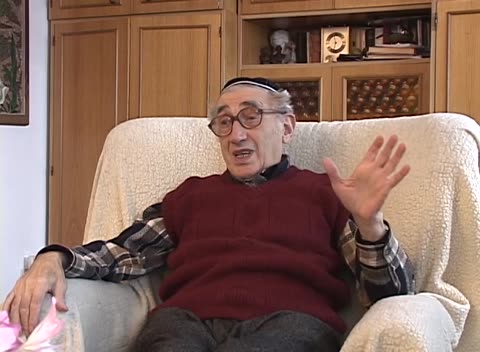
Herbst provides personal information and speaks about his life today and mentions acquaintances. He then addresses contemporary religious life as well as his praying customs.
Herbst gives personal information: he is elderly and his health is poor, and he describes his praying and Torah-reading in synagogue. He recalls travelling to Linz and nearby places for the High Holidays and working in Austria. He mentions his visits to hospital and his gifts to a doctor, along with other acquaintances and current religious life.
Also covers his travel to Austria for the High Holidays and his illness.
Herbst explains his work in the community, making and restoring prayer books for several synagogues, and the recognition he received for it. He shows a Chabad prayer book in Hungarian and English, discusses its nusach, and shows his awards and certificates, with some Hungarian speech. He also reflects on peace in Israel.
Includes a Hungarian-English Chabad prayer book and his remarks on peace in Israel.
Herbst recites a Sabbath prayer, before addressing contemporary religious life. Herbst mentions non-Jews who attended prayer services in Linz, Austria.
Herbst recites a prayer, then speaks about the services in Linz, Austria, where he went to pray. He mentions the lack of young men there for a minyan, the people who attended, and the non-Jews who came to listen and pray. He says the recognition he received there meant more to him than other honors.
Gives details of who attended in Linz, including Jews from Romania and Poland and people who spoke Yiddish.
Herbst talks about his childhood in a small village in the mountains with a minyan of Jews and one school, and about his bar mitzvah. He describes his work at a lumbermill, including an accident in which a friend fell in, and his job estimating timber. He mentions that he worked there until the ghetto, when his parents had to leave.
Adds the lumbermill accident and the departure for the ghetto.
Herbst addresses his prewar religious education at cheder (religious school) and yeshiva in Viseul de Sus (Yiddish: Oyber-Visheve). He attended a cheder in Rakhiv and recalls eating in different homes.
Herbst answers Kerler's question about who taught him in prewar days. He describes going to a cheder in Rakhiv, nine kilometres away, and eating at different homes, then attending the yeshiva in Oyber-Visheve, where he studied Chumash, Rashi and Talmud. He recalls visiting rabbis and the Friday-night meals.
Adds his sister's marriage and a recollection of a Rakhiv rabbi.
Herbst speaks about weddings and food customs before the war, recalling his sister's wedding with a fiddler. He describes dishes such as bundlekh (a dumpling-like dish) and the simple meals eaten when he worked in the forest. Kerler asks about the word takan (?), which Herbst explains as a flour dish.
Herbst speaks about his family, particularly his father's observance and childhood memories of him. He also addresses food customs at home, where his parents kept animals.
Herbst speaks about his father, who was old, how he prayed and said Psalms, and how he shared his last bit of food with others. He recalls the family's food, with meat at most once a week and false fish on Sabbath, and the geese and chickens they kept. He also describes how little news reached them.
Includes the lack of news and radio in the village.
Herbst answers Kerler's question about the best childhood memories: Sabbath afternoons with a simple meal, berries gathered in the forest, and his mother's not reading to the children. He names himself as the youngest of eight children and describes how his sisters learned to sew and what they were paid in. He also mentions his older brother, a carpenter who trained in Brno, and a second brother who trained as a tailor in Rakhiv.
Adds the siblings, their trades and the family's poverty.
Herbst speaks about his work as cobbler, before the German occupation in 1944. He then returns to childhood memories and answers questions about cultural terminology.
Herbst talks about working to support his parents before the war and giving all his wages to the family. In answer to Kerler's questions, he says he was a good child and discusses words for a non-Jewish cemetery, mentioning the Jewish and reformed cemeteries in his town. He says the Jews lived among the non-Jews.
Adds the terminology questions on words for a non-Jewish cemetery.
Herbst speaks about prewar Jewish life in Berlabashe and explains how he learned Ukrainian and Hungarian. He then speaks about his return home from the concentration camp Mauthausen. Herbst explains how he was taken in a car from Mauthausen to Merikó,Hungary, which was under Red Army command. He then headed to Budapest, via Bratislava, Slovenia.
Herbst speaks about Jewish life in Berlabashe, where Jews lived among Russians and Rusyns who spoke Yiddish and Sabbath goyim, and which languages he knew. He explains that he learned Hungarian after the war, then describes returning from Mauthausen, being registered as Czechoslovak and transported by car to Merikó (?) in Hungary. He then went on foot and by freight train toward Bratislava and then Budapest.
Includes the route home via Bratislava to Budapest.
Herbst speaks about prewar Purim celebrations in his hometown, specifically performing Purim shpiels. He also recites a couple of shpiels. Herbst then speaks about daily life in prewar Berlabashe.
Herbst answers Kerler's questions about Purim in Berlabashe: children went around from synagogue to synagogue performing a Purim shpiel and asking for money. He recites some lines and discusses how much a coin was worth and what a day's wages bought. He then talks about how the family could not afford meat.
Herbst is asked about food for Hanukkah and says that the family did not make pancakes, though they did in Rakhiv. The rest of the passage is largely garbled conversation between Kerler and others in the room, with some English and Hungarian.
Shows that most of the passage is unrelated side talk among Kerler and the others.
Herbst answers Kerler's questions about the golem and the dybbuk, saying the golem figure was kept in a synagogue attic. He is then asked about his current life, and the passage becomes a discussion partly in Hungarian.
The terminology questions concern the golem and dybbuk, and the end drifts into Hungarian talk.
Herbst talks about his life after the war, after his arrival in Budapest. He recovered at sanatoria in different cities, including Budapest and Debrecen. Herbst also addresses his religious customs.
Herbst talks about arriving in Budapest after the war, feeling ill and looking for a doctor. He was sent to a sanatorium in Debrecen, sleeping in a cellar room with eight men, then to one in Mátra, and finally to a Jewish hospital in Budapest. He says he arrived there with a tallis and tefillin to pray.
Adds a sanatorium in the Mátra mountains and a Jewish hospital in Budapest.