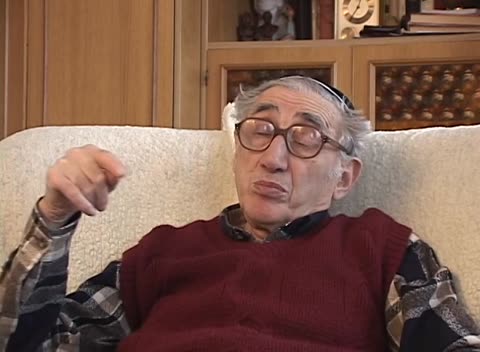
Herbst speaks about his life and acquaintances, he met after World War II. Herbst also mentions the support from the American Jewish Joint Distribution Committee (JDC) in the postwar period.
Herbst recalls friends and acquaintances after the war, including a pianist whose name is given as Becker (?) and whose concerts he attended. He also recalls receiving clothing sent by the JDC and having trouble with influence and connections. He complains that the Carpathian Jews were sent in the first transport to Auschwitz.
Also mentions Carpathian Jews deported in the first transport to Auschwitz.
Herbst describes a visit to the Bronx in America, where he was pressed to lead the morning service in a synagogue. Kerler then asks about Yiddish words and expressions, such as the Russian-derived word for 'right away', the meaning of 'apakn' and related words, and the word for 'now'. Herbst then answers questions about his family in America and Israel, and about a friend who became a rabbi. Kerler asks about a song on the coming of the Messiah.
Includes Kerler's word questions, Herbst's relatives abroad, and a friend who became a rabbi.
Herbst and Kerler discuss a Yiddish song about a burning town, and Herbst tries to show a picture. Herbst then speaks about the postwar years, saying he spent five years in hospital after the war. He thanks the American Jews and the JDC for paying for his upkeep, including a monthly allowance and daily meals.
Herbst describes daily life and living conditions in the Mauthausen concentration camp toward the end of the war. He also addresses his praying customs in the camp.
Herbst describes conditions in Mauthausen in the last months of the war: prisoners of several nationalities, hunger, the lack of space on the bunks, and a single watery soup a day. He found a prayer book and tefillin there and recited psalms daily. He says he was liberated in early May and was too weak to go to the window.
The formal interview closes with toasts, drinks and chat among Herbst, Kerler and the others present. Herbst sends good wishes to the American Jews, Kerler arranges to photograph Herbst and copy photographs, and some of the talk is in Hungarian. The passage ends as a photograph of Herbst's two grandchildren is mentioned.
Herbst looks at family photographs with those present, with some Hungarian talk about a grandchild. The passage then turns to chat between Kerler and Herbst about Kerler's writing and a historian colleague working on Hungarian Jews, and about a Hebrew term and the word for microphone.