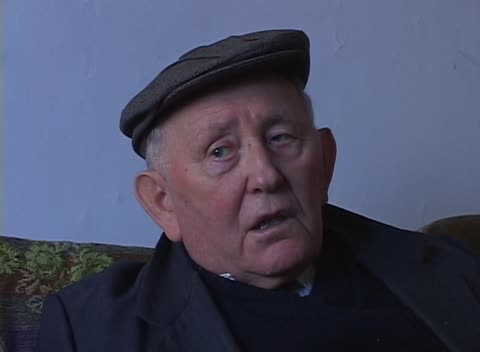
Opening of the interview: Kerler gives the date and place and asks the interviewee's name. He gives his family name, says he was born in Rohod and that his Hungarian name is Réti Béla. Kerler also asks where he lives now (unclear).
Reti confirms his name Borukh, his birth in 1924, and that he studied in yeshivas before the war. He names a yeshiva in Balkány with a rabbi who was a great scholar (name garbled) and a village yeshiva near Rohod, Nyírmada, with Rabbi Yankl Yosef Halevi Yungrays. Kerler then asks about his father.
gives his birth year and names a second yeshiva in Balkány
Reti speaks about his family. His father built a prayer house and mikvah in Rohod and taught. Reti recalls how he studied with his father in the mornings before the war. His father was also born in Rohod and owned animals.
Reti speaks about his father Mordkhe Roze and his mother Perl. His father was a wealthy landowner and great scholar, not a strictly Hasidic-dressing Jew. He had his own prayer house and mikvah in the courtyard, rose before dawn to study, and learned Mishnah and Gemara with others. Reti studied with him in the mornings and names relatives who studied there. He also mentions his brothers, one of whom died in 1984, and that his father earned his living from his own fields, horses, sheep and servants.
adds his mother's name, brothers and the father's livelihood from fields and animals
Reti describes his childhood home and remembers the annual visits from the Kosoner rebbe and his court of 400 or 500 hasidim from what was then called Mezőkaszony in today's Ukraine (Koson). He then talks about the Sabbath celebrations with the Kosoner rebbe.
Reti describes the long family house and the Kosoner hasidim in Rohod, who gathered each year for one Sabbath around their rebbe, Rabbi Yisroel. He says several hundred Jews came to the courtyard, slept on straw, and that the rebbe blessed him and received petitions and money through his gabbai.
adds the large number of hasidim, the straw beds and the petitions to the rebbe
Reti talks about the the Kosoner rebbe's brother Mendele from Nagykálló, which was the birth place of the Kaliv Hasidic dynasty. Reti maintains that Mendele would visit Rohod several times during the year. He then sings the Hungarian Hasidic tune "Szól a kakas már."
Reti speaks about the Kosoner rebbe's brother Mendele of Kalev (Nagykálló), who had a beautiful voice and came to Rohod each year. He sings a Hungarian folk melody ("Szól a kakas már") that he says comes from the Kalever tradition. He mentions that Hasidic pilgrims still come from Hungary, America, Israel, Canada and Belgium, and Kerler asks about miracle stories.
Reti tells of the Kosoner rebbe's foresight and judgment. The rebbe predicted that a man held by the authorities would be freed by a court, and it happened; this was in Kleinwardein (Kisvárda). Visitors, including non-Jews, relied on him, as he knew why they came. Reti again mentions the brother, Mendele of Kalev, as a small rebbe with a fine voice.
adds the story of the rebbe predicting the outcome of a trial and the brother Mendele
Reti sings a Hasidic plea song, to heaven for mercy for the Jews (pre-war), several times, and Kerler asks him to repeat it more slowly. He says it was sung only before the war, in the synagogue after prayers.
Reti speaks about his family: his mother Perl, who worked at home, and the nine children, six brothers and three sisters, whom he names with Kerler (the eldest Khaym Menakhem, then Ester, Sheyndl, Rivke (?), Shloyme Yoysef, Aron Yoytz, Yisroel and himself). He says that Yiddish was spoken only at home, while the non-Jews spoke their own language.
gives the names of the siblings and the language spoken at home
Reti speaks about prewar life in Rohod. He recalls non-Jews who spoke Yiddish. According to him, twenty Jewish families lived there. Reti speaks about his father's observance as Kosoner hasid and the Kosoner rebbe. Reti then talks about his family today.
Reti recalls that the village's non-Jews could speak Yiddish and that only about twenty Jewish families lived in Rohod, mostly with many children. He mentions his brothers, all learned, and his father as a Kosoner hasid whose home hosted the rebbe, including the divan the rebbe slept on. He says that he later travelled to Debrecen to have psalms said for the rebbe's memory. He talks about his brother Shloyme Yoysef, who is now seriously ill, and answers Kerler's terminology questions about a word for non-Jews and a word for a Torah scroll. He recalls the Torah scrolls of the village being made into shoes.
adds the brother's illness today and the question about words for Torah scroll and non-Jews
Reti says he studied for four years with Wolf Günsner, a great scholar, and recalls a long half-hour prayer Günsner would chant. Kerler tries to recall a related song and asks about it, but the transcript is unclear.
On Hanukkah Reti sings the Hanukkah hymn "Ma'oz Tsur" and says there were no Yiddish songs. Kerler then asks for a Hungarian song, and Reti sings one about the end of exile and the messiah's coming, with a feast of wild ox. Reti does not recall a Yiddish version.
Reti begins a Passover song and does not recall "Khad gadyo" being sung. He says that as the youngest he asked the four questions, and discusses Passover customs: his father's hasidic avoidance of stuffed goose, avoidance of matzo flour in dishes, krimpl (?) dumplings, and the matzo baked under special supervision. The "mitzve matzos" baked on the eve of Passover were given to the poor or the community.
Reti speaks about Shavuot food customs and Purim celebrations before the war. He recalls singing and dancing on the street and recites parts of the Yosef shpiel. Reti maintains that his brother played Yosef. He then addresses Purim shpiels in Rohod, where boys from the neighboring villages Vaja and Nyírmada (Yiddish: Made) would join in.
Reti speaks about Shavuot and Purim. For Shavuot they ate dairy foods such as cheese dumplings. On Purim, Jews sang and danced in the street, and there was the Yosef play. He recites passages from it, says his brother played Yosef, and that the young men from Rohod, Nyírmada and Vaja performed it for two hours; only boys acted, and local non-Jews attended without understanding. He also mentions his studies in Balkány and the Lichtenstein tallis factory.
adds the Balkány rabbi and tallis factory and the Yiddish names of the neighbouring villages
Reti speaks about Nyírmada, a larger village than Rohod, where the rabbi lived and travelled to nearby villages. This was Rabbi Yankl Yosef Yungrays, from a family of rabbis. He says that the rabbi's family of twelve was sent to Auschwitz and killed together in the crematorium, and about the selection to left and right at Auschwitz.
Reti speaks about his life during World War II. He speaks about forced labor pre-1944 and the deportation in 1944. He then speaks about his life in Mauthausen, as well as a death march from Melk to Ebensee, Austria, which lasted for two weeks according Reti. He then talks about his family's fate during the war.
Reti speaks about the war: the 1944 deportation from Rohod and forced labor on the front. He describes his arrival in Auschwitz and the burning of people, then Mauthausen and Melk, from which he was taken on a two-week march of about two hundred kilometres to Ebensee, naked and hungry. He then tells of his brothers, held in Auschwitz and working in a household of Mengele (?), and one at the stables.
Kerler asks for a story about a rebbe or wonder-worker; Reti recalls none. He recites again part of the Purim Yosef play, then Kerler asks about weddings. Reti says there was a feast and music after the chuppah, played by Gypsy musicians ("shkhorim"). He says the word "klezmer" was not used in his village, only "muzik".
adds the recitation of the play, the wedding and the Gypsy musicians