0:00
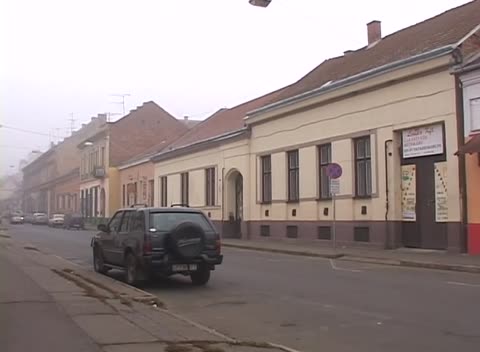
The camera collects town footage of Debrecen including the synagogue.
From the machine transcript
Camera-only town footage of Debrecen. The transcript has almost no speech in focus here, only a single garbled line from Kerler.
One conversation with Bela Reti, continuing over MDV 105, MDV 106, MDV 107, MDV 108.
The camera collects town footage of Debrecen including the synagogue.
Camera-only town footage of Debrecen. The transcript has almost no speech in focus here, only a single garbled line from Kerler.
Reti recites a hasidic prayer, before he chants a Purim Kiddush and remembers Purim shpiels.
Reti recites a hasidic prayer text and chants a Purim Kiddush. Kerler asks him to repeat parts slowly, and he recalls Purim rhymes and a comic wedding verse with a joke about a tall bride. Kerler and Reti also discuss words in these texts.
Beyond the prayer and Kiddush, the passage is mostly Purim verses and jokes that Kerler has repeated and explained.
Reti sings a Hungarian song about when the messiah comes. He then talks about holiday celebration. He explains different games, including nuts and cards.
Reti sings a Hungarian song about the coming of the messiah, and Kerler asks him to sing it again. Kerler then asks about Purim play-acting and holiday games. Reti says the play-acting was only for Purim and he does not remember any at Hanukkah. He describes a Sukkot nut game and the card games played at Hanukkah, with the children's game using a dreidel (?) and the grown-ups' cards called by a local word. Kerler also asks how a winning turn of the dreidel is named.
Beyond the song, the passage covers holiday games with nuts and cards, with questions about their names.
Reti speaks about prewar Jewish life in the region. In particular, he describes cities he visited before the war, including Nyíregyháza, Debrecen and Kisvárda. Reti also addresses peddlers.
Reti answers questions about preaching: sermons were given by the rabbi, not by a special maggid. He talks about prewar visits to Debrecen, Nyíregyháza (?) and Kisvárda and what he remembers of them. He mentions hasidic courts, a prayer house and a rabbi's grandson. He says hasidim spoke Yiddish while others spoke Hungarian, and describes the Orthodox, Status Quo and Neolog communities and the Jewish shops and book dealers around the Orthodox synagogue.
The passage covers the Jewish communities of Debrecen and other towns he visited, and Jewish shops, not just the cities and peddlers.
Reti addresses memorialization and the contemporary relationship between Jews and non-Jews.
Reti explains a memorial stone near the Orthodox synagogue and the mikvah, and a larger monument to the Jews of Debrecen in the cemetery. He says Jews come each year from across Europe. Asked about relations between Jews and non-Jews today, he says there are big conflicts. He describes antisemitism in present-day Hungary and the wearing of a right-wing party flag.
Reti speaks about prewar birth customs.
Kerler asks about customs at the birth of a girl. Reti says the name was given in the synagogue and the father gave a Kiddush. The talk then breaks off because Reti has to leave and the team agrees to resume later.
The interview moves outside and Reti gives a tour of the former Jewish neighborhood, including the mikvah. Reti also mentions antisemitic daub and that antisemites set the Torah ark on fire.
Outdoors, Reti shows Kerler the former Jewish quarter: a rabbi's father's house and prayer house, the ritual slaughter house, a hall where hasidim stayed at Passover, and the beth midrash used all year, with the great synagogue for festivals. He describes kosher butchers, a bookshop and the mikvah, which is cold. He talks about a memorial stone with a board of antisemitic writing and a camera, and about vandals who broke in and set fire to the Torah ark, burning twenty Torah scrolls a few years ago. He names the chief Orthodox rabbi (Tshengeri, name uncertain) and describes the buildings around the synagogue.
The tour includes the former slaughterhouse, the ritual bath, a memorial stone and board, and the arson of the Torah ark.
The team and Reti enter the synagogue and the camera collects footage of the Hanukkah service, in which Reti participates, as well as the synagogue.
The team and Reti go inside the synagogue, and the camera films the Hanukkah service in which Reti takes part, with singing and blessings. Russian and loud background voices are heard, and the Yiddish is largely unclear.