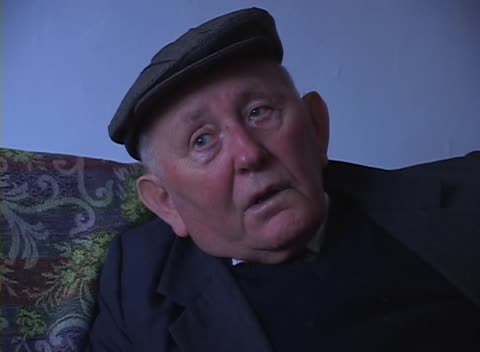
Answering Kerler, Reti says there were no Munkacs Hasidim in his area and that the Jews took no part in politics. He recalls the beit midrash in the courtyard as the meeting place, playing nuts at Sukkot, and every Jewish house having a sukkah, where his father slept. Kerler also asks about Yom Kippur night in the beit midrash on straw, the women's section, taking challah, and the salting of meat after slaughter.
adds Munkacs Hasidim, the beit midrash and the salting of meat
Kerler asks about the evil eye, and about the entertainer at weddings, and Reti is unsure of the term. Reti says his grandfather died before he was born and that his brother is named after him; the grandfather was a learned man. The talk turns to the women who helped at births and the small Sabbath loaves given to children visiting after a boy's birth (barkhes, which Kerler compares with challah), then to other expressions and a yahrzeit blessing.
adds the weddings entertainer, the grandfather and the term for the Sabbath loaf
Reti recites a prayer for yahrzeit. He then addresses birth customs. He then talks about contemporary Jewish life. Reti moved to Debrecen ten years ago.
Reti recites a prayer connected with yahrzeit, repeated more slowly at Kerler's request. He then returns to birth customs: during the week before a boy's circumcision children came in the evening to read the Shema (krishme), and this stopped after the circumcision. Reti says he has lived in Debrecen for ten years, that there has been only one circumcision and one wedding here in that time, and that almost all marriages are mixed. He describes Debrecen's former Jewish community of about twelve thousand, half deported to Auschwitz and half to Austria, and its synagogues.
adds the Debrecen community's size and wartime fate
Kerler asks what a 'good Jew' means, and Reti answers that it means a kosher, observant Jew, and that there are few such people now. Kerler notes that Hasidic rebbes were called tsadikim. Reti gives a saying that where the tsadik is present there is light and glory, and where he is absent there is neither.
Reti recalls a fish-seller, the 'fish Jew', who brought fish from Debrecen every week on his back to the villages; Reti's Hasidic father bought fish for the Sabbath. Kerler asks how it was prepared: Reti describes cold boiled fish and the stuffed fish made from the skin, using a Hungarian name for it, and says he dislikes the sweet Israeli version, which he calls Polish. They go on to the terms for Polish and Lithuanian Jews, whom Reti regards as very pious people.
Reti speaks about prewar religious life in the region. He then explains how his father's mikvah was heated, by the "hoyf-goy." He also mentions peaceful relations between Jews and non-Jews.
Reti says the village had one Orthodox synagogue plus the rebbe's own beit midrash, and that every village had a brick synagogue. He explains how the mikvah was heated with a samovar and wood, hot on Thursday and Friday, with the water changed on Sunday morning. Kerler asks about the Sabbath goy; Reti says Jews did not work on the Sabbath, but a courtyard non-Jew, called the 'hoyf-goy', did the heating and other chores. He adds that relations with the non-Jews were good and there were no quarrels.
Kerler asks about Sabbath songs (zmires), and Reti sings parts of Sabbath songs; the words are not clear in the transcript. Kerler then asks about Hoshana Rabbah and Simchat Torah; Reti recalls dancing with the Torah scrolls, the hakafot, and children being called up to the Torah. They also touch on whether non-Jews understood Yiddish, with Munkacs mentioned as a place where non-Jews spoke it.
adds Simchat Torah customs and non-Jews' knowledge of Yiddish
Reti speaks about prewar Jewish life in Rohod. He also lived in Fehérgyarmat and Balkány before the war. He then discusses his childhood memories. Reti attended a Hungarian school and religious school (cheder). Reti explains that he attended cheder in the mornings and evenings and primary school during the day.
Reti says there was no matchmaker in his village and that the Torah was read on Mondays, Thursdays and Sabbath; there were no Jewish newspapers. Before the war he lived in Rohod, in Balkány and in Fehérgyarmat (?), the last two places not clearly heard, and he mentions a rabbi in a small village. Children spoke Hungarian and all attended a Hungarian school, since there was no Jewish school. He describes cheder from age three or four, morning and evening sessions, with primary school during the day.
Reti lists towns he visited before the war, which included Kisvárda (Yiddish: Klaynvardeyn). He then talks about food customs, particularly baking goods.
Asked about visits before the war, Reti names nearby towns, including Kisvárda, a Hasidic town; he says it now has a minyan only on Friday night and Sabbath and that Yiddish speakers have died. Kerler then asks about baked sweets and other foods: Reti names cheese-filled pastries (delkerlekh) and cheese or cocoa pastries, then Passover and Hanukkah dishes made from potato, and does not know several terms Kerler asks about. Kerler also asks about tomatoes, apples, mushrooms and the word dybbuk, none of which Reti recognises.
adds the terminology questions on foods and the dybbuk
Reti answers Kerler's questions about the meaning of 'golem' (a clumsy person) and about a good place near Rohod. He then says he must leave soon; Kerler arranges to talk again the next day and closes the session with thanks.