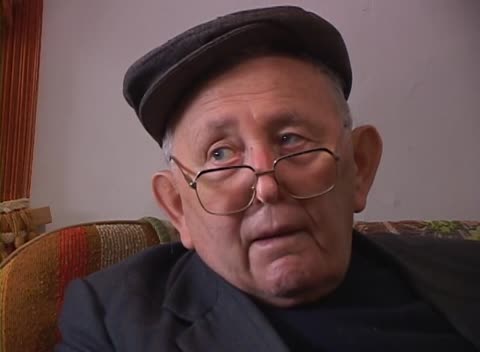
Reti talks about a rabbi in Debrecen, a descendant of a family of rabbis and ritual slaughterers who has brothers in America and Canada, and who is now head of a rabbinical body. Kerler notes the name and hopes this man will speak with them, then steers Reti toward his years of study away from Debrecen.
The rabbi's family background and relatives abroad appear.
Reti answers Kerler's questions about his yeshiva study, including two terms in Balkány, the lack of a celebration at the end of a term, oral examinations, and learning alone as an older student. He explains that Orthodox yeshivas taught Talmud rather than Tanakh. The passage ends with a story that is hard to follow, about Joseph's dream and a rumor about a false report.
Details of yeshiva study methods and curriculum, and a rambling story at the end.
Reti speaks about contemporary religious life. He then speaks about his life and education before the war. Reti celebrated his bar mitzvah in Balkány. Reti states that he attended a yeshiva until his deportation in 1944.
Reti talks about a question of religious law and wine drinking when taking medicine, then about his yeshiva years. He went home only at the end of terms and holidays. He had his bar mitzvah in Balkány, where his family sent tefillin to the yeshiva, and he studied in yeshiva until he was taken away in 1944.
The opening part concerns a halakhic discussion about cantillation and wine.
Reti speaks about his life after the war in Debrecen. He moved in with his two brothers. Reti was a businessman for the government. He then recalls how is father passed away in 1939.
Reti recalls returning to Debrecen after the war, where his oldest brother took care of him. He worked in business for the government under a good non-Jewish supervisor who let Jewish workers keep the Sabbath. He goes to the cemetery on the anniversary of his father's death, who died suddenly in 1939 while Reti was at the yeshiva, and mentions that he was the youngest of his brothers.
Includes his work for the government and visits to his father's grave.
Reti answers questions about Yiddish dialects. On his return home he met Russian and Polish Jewish soldiers whose Yiddish was hard to understand. The conversation then turns to his family, including a brother and a brother's son who does not speak Yiddish, and an expected visit.
The passage covers soldiers' Yiddish and his family, with a request at the end to sing again.
Reti recites a humorous purim-shpil piece about a bride, at Kerler's request. He then tells stories about a Hasidic rebbe, including one about a lost cow, and answers questions about sick people and non-Jews who came to the rebbe. They also discuss divorce and halitsah and a Tash rebbe near Nyíregyháza (?). Kerler ends by asking about the best time in his past.
Includes halakhic discussion of divorce and halitsah and the Tash Hasidim in America.
Reti says the best time was going home from the yeshiva at the end of a term and for holidays, when the family were all at home. He tries to recall a Hasidic melody, says he cannot remember songs from his parents, and recites or sings a plea to God about Jewish troubles that was sung before the war in times of persecution.
Includes the song of supplication and the context in which it was sung.
Reti recalls that before the war many Jews of foreign origin who had been born elsewhere were expelled from Hungary as non-Hungarians, with a brother's help in a village matter. Reti dates this to 1943, and Kerler then recalls a prayer for relief.
The expulsion of non-Hungarian Jews is more specific than the catalogue's reference to Jewish life during the war.
Reti sings a Hasidic song about the messiah, sung at betrothal celebrations, and tries to recall a Passover song. He says that after returning there was no chance to continue studying. Five siblings and more than eighty relatives did not return, and he describes the deportation train, with only three of six brothers coming home.
The family's losses and the deportation journey appear.
Reti speaks about his life during the war, particularly as forced laborer. He then talks about his liberation by the British Army in Ebensee, Austria. Reti remembers a Jewish lieutenant who spoke Yiddish to him. Reti explains how he evaded a potential massacre, shortly before liberation.
Reti says nobody sang in Auschwitz and describes the brutal forced labor, including a beating that broke his hand. He tells of the last days of the war and a Satmar Jew in the British army who spoke Yiddish to the prisoners. He explains how the camp commander refused an order to shut the prisoners in a tunnel to be killed.
Includes the planned massacre in a tunnel and the Satmar Jew in the British army.